Component Deep-Dive · B2B Archive Procurement
Which Core Components Determine the Service Life of Mobile Compactor Shelving?
How six core components decide whether mobile compactor shelving runs 15–20 years — or fails within five.
For overseas archive projects, mobile compactor shelving is a mid-to-long-term fixed-asset investment. Two systems that look nearly identical can age very differently: a compliant unit runs smoothly for over a decade, while a low-priced one starts to jam, deform and lose its seals within three to five years — and cross-border repairs soon cost more than the unit ever saved.
In reality, mobile compactor shelving follows the weakest-link rule: it is an assembly of mechanical parts, sheet-metal structures and sealing components, and the track, the drive, the load-bearing panels, the safety components and the seals — the parts you cannot see — decide how long it actually runs. This guide breaks down every core component that determines the service life of mobile compactor shelving, how each part wears, and the spec lines to write into your tender.

Section 01
Mobile Compactor Shelving Service Life at a Glance
When overseas institutions buy mobile compactor shelving, they often compare appearance, price and bay count while ignoring the hardware inside. A system is not a single piece of furniture: it combines moving drive parts, load-bearing structural panels and sealing hardware, and its actual service life is decided by the shortest-lived core component — the classic weakest-link effect.
Per the EN 15095 archival storage standard, a properly built mobile compactor shelving system — correctly installed, not overloaded and given basic maintenance — is designed for 15–20 years of service. Low-priced non-standard products cut core-component materials, and although they look similar on day one, track wear, drive jams, bowed shelves and failed seals appear within 3–5 years, writing the system off early and making overseas replacement extremely costly.
Section 02
The 6 Core Components That Decide Mobile Compactor Shelving Service Life
Floor track assembly — the highest-wear mobile compactor shelving component
The track is the running base of the whole system: every bay's weight rests on it, so it is the first component that decides whether the system keeps running smoothly. The track set includes the track section steel, backing plates and anchor bolts.
Spec standard: export-compliant products use ≥ 3.0 mm cold-rolled steel with an anti-rust coating, in either recessed (pre-embedded) or surface-mounted form.
How it wears: a fully loaded system is extremely heavy, and every opening and closing cycle rubs the rollers back and forth across the track surface. Track steel that is too thin develops indentations, deformation and warping under long-term load — and once a track deforms, you get stiff travel, accelerated roller wear and tilting bays that are almost impossible to repair later.
Cheap-product failure: thin sheet-metal track, no backing plates and too few fixing bolts — dented, deformed track within 2–4 years.
Hand-wheel drive mechanism — the power heart
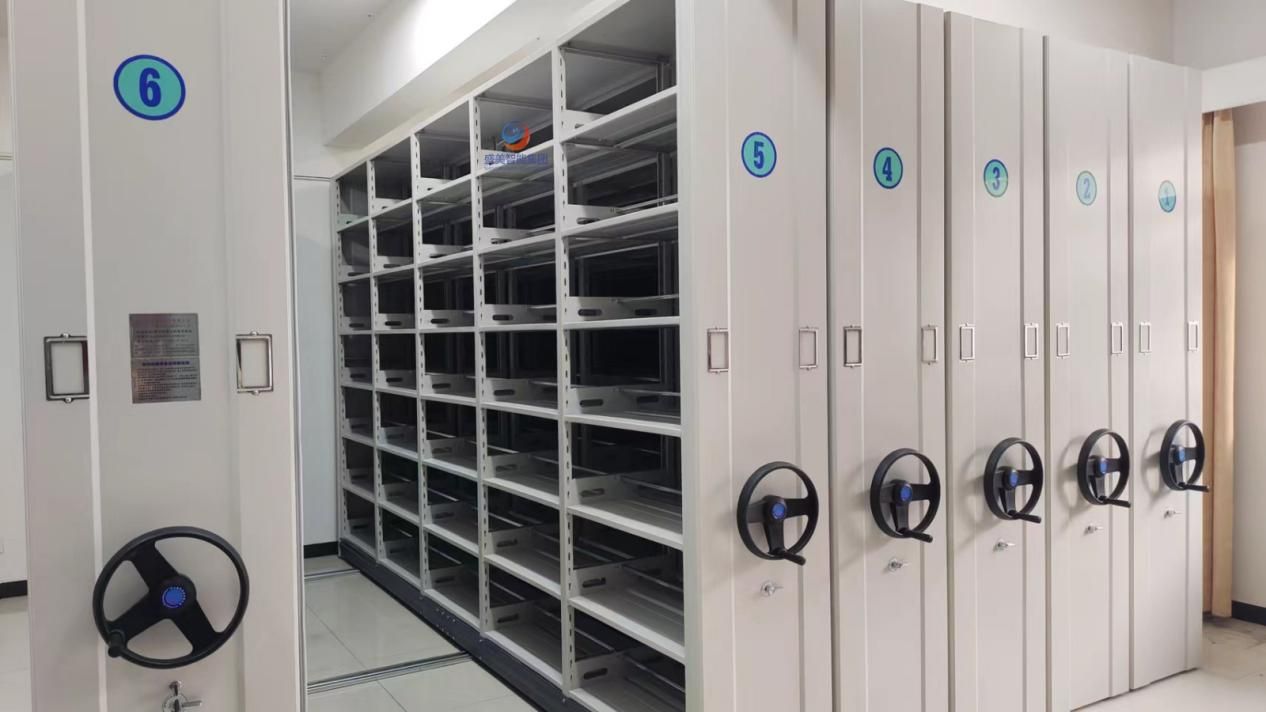
Manual mobile compactor shelving transfers force through the hand-wheel drive, and smart systems keep the same drive as their emergency backup. The drive set includes the hand-wheel crank, gear train, drive chain, drive shafts and roller bearings.
Spec standard: gears in cast iron or alloy steel, a thickened anti-rust chain, and sealed bearings inside the rollers.
How it wears: every cycle turns the gears, chain and bearings under load. Poor gear material or low-grade bearings lead to gear wear, chain stretch and bearing seizure — felt as a heavy crank, a wheel that spins free without moving the bays, or bays drifting to one side.
Uprights and shelves — the load-bearing skeleton
Uprights and shelves are the static structure that carries the full weight of the archive, and they decide whether the bays stay straight. Loading starts one floor below the racks, too — check the floor load-bearing requirements for compactor shelving before installation.
Spec standard: upright panels ≥ 1.2 mm, shelf panels ≥ 0.8 mm cold-rolled steel, with electrostatic powder coating for corrosion protection.
How it wears: under years of continuous loading, under-gauge panels deform plastically — shelves bow downward and uprights lean inward, which is irreversible. Deformed shelves leave files sitting unevenly, squeeze neighbouring bays, and add load to the track and drive.
Cheap-product failure: many low-price units use 0.8 mm uprights and 0.6 mm shelves. They look fine on installation day, then bend visibly within two or three years once fully loaded.
Anti-tilt and limit safety components
Anti-tilt hooks, limit stops and brake-lock mechanisms. Buyers often overlook this set: nothing here moves, yet it governs long-term system safety.
Function: it restrains lateral drift, prevents tipping and stops over-travel of the bays.
Quality impact: thin limit parts crack and deform under repeated bay impact, letting bays run out of alignment — which accelerates track and roller damage and, in the worst case, creates a tipping risk. EN 15095 makes this component set mandatory for overseas archive projects.
Sealing gasket assembly — the protective consumable
The gaskets around each bay are rubber consumables. They do not affect movement, but they decide how well the archive itself is protected.
Function: when bays close, the gaskets compress to seal out dust, moisture and light, protecting the paper originals.
How it wears: rubber hardens, shrinks and cracks with age. Recycled-rubber gaskets turn brittle within 3–5 years; quality EPDM gaskets resist ageing for 8–12 years.
Note: aged gaskets are not a write-off — they are a replaceable part. But once a gasket fails, dust and moisture enter the closed bay and the paper archive itself starts to age faster.
Locks and hardware fittings
Master locks, bay locks, hinges and rivets.
Quality impact: cheap locks suffer corroded cylinders and failed keys. A broken lock does not stop the bays from moving, but it removes the anti-theft protection the archive depends on — and in humid coastal archive rooms, corrosion-proof hardware is critical.
Section 03
What Happens When a Component Fails
Each core component of mobile compactor shelving fails in a recognisable way, and each failure triggers a chain reaction across the rest of the system. Reading these symptoms early is the cheapest form of maintenance.

| Damaged component | Typical symptom | Chain reaction |
|---|---|---|
| Floor track deformation | Stiff travel, drifting bays, running noise | Rollers wear faster, bays tilt, safety risk rises |
| Drive gear / bearing wear | Crank spins free, cranking feels heavy, one side stuck | Bays cannot open or close; the system becomes unusable |
| Thin uprights / shelves deform | Shelves bow downward, bays lean | Bays squeeze each other, track load rises, track damage accelerates |
| Anti-tilt / limit parts break | Bays sway and drift sideways | Further track damage; tipping hazard |
| Sealing gasket ages and cracks | Dust and moisture ingress | Paper archives absorb moisture and dust; archive life shortens |
| Lock hardware corrodes | Locks seize or fail to hold | Archives lose their anti-theft protection |
Section 04
Manual vs Smart: Which System Ages Faster?
Manual mobile compactor shelving
- All-mechanical build, no electronic components.
- Life depends on the track, drive gears and bearings, panels and rubber gaskets.
- With simple periodic lubrication, the mechanical parts reach their full 15–20 year design life.
- Gaskets and locks are replaceable consumables.
Smart mobile compactor shelving
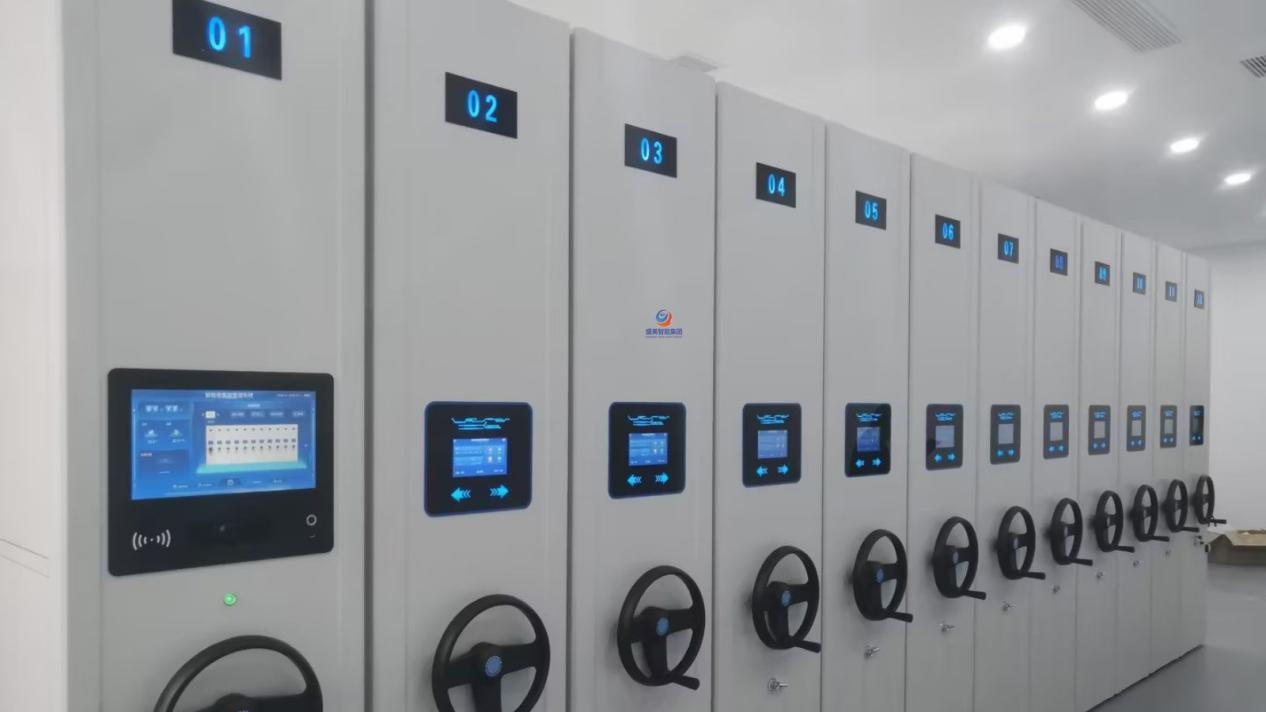
- Adds motors, sensors, touchscreens and communication boards on top of the same mechanical set.
- Mechanical life: identical to a manual system.
- Electronic life: motors, sensors and boards are consumables affected by humidity, temperature and dust — typically serviced or replaced after 8–12 years.

Section 05
How to Spec Core Components Before You Buy
Most overseas projects are bought remotely, without a factory visit, so the core components of mobile compactor shelving must be written into the technical requirements at tender stage to stop suppliers quietly downgrading materials:
Section 06
Daily Maintenance That Extends Mobile Compactor Shelving Life
Even with correct core-component materials, misuse shortens life sharply. Six simple habits keep a system running to its full design age — for fault symptoms and fixes, see our guide to daily maintenance and common fault solutions:
Section 07
Mobile Compactor Shelving FAQ
How many years does mobile compactor shelving normally last?
An EN 15095-compliant system that is correctly installed, normally loaded and given simple periodic maintenance is designed for 15–20 years of service. Low-priced units with cut-corner core components develop jams, deformation and seal failure within 3–5 years.
Which component wears out first?
The floor track and the hand-wheel drive are high-frequency moving parts and wear fastest. Sealing gaskets and locks come next as rubber and hardware consumables. Static load-bearing panels rarely fail if the steel gauge is correct.
Can maintenance really extend the service life?
Yes. Cleaning the track, lubricating the drive, avoiding overloading and controlling humidity all slow component ageing and extend system life — while overloading accelerates core-component damage dramatically.
If the gaskets age, must I replace the whole system?
No. Sealing gaskets are separately replaceable consumables — order the same specification and swap them in; there is no need to replace the bays.
The Bottom Line
The service life of mobile compactor shelving follows the weakest-link rule: not the finish, but the track, drive mechanism, load-bearing panels, safety limits, seals and locks together decide how long the system runs. Tracks and drives carry the movement load, panels carry the static load, and seals and locks are replaceable consumables.
When buying for an overseas archive, compare materials, gauges and processes — not just looks and unit price — and write the core components into the technical requirements. Compliant components, correct daily use and basic periodic maintenance let the system deliver its full 15–20 year design life and avoid the high cost of overseas repairs and early replacement.
Disclaimer: This article is a procurement reference for overseas archive projects. Installation and operation must follow local archival regulations and the EN 15095 storage-safety standard. Some content may be AI-assisted.