Daily Maintenance & Common Fault Solutions for Overseas Archive Compact Shelving
Overview: This guide is tailored for overseas archive engineering projects across Europe, the Americas, Southeast Asia, the Middle East and Africa, and strictly follows EN15095 and OSHA warehouse equipment safety and maintenance standards. Unlike conventional domestic maintenance standards, overseas compact shelving faces unique challenges: ocean-freight salt fog, extreme humidity and heat, large day–night temperature swings, weak local O&M capability, long spare-part supply cycles, non-standard operation by foreign staff, and prohibitively expensive overseas after-sales service. This paper systematically covers standardized tiered maintenance procedures for both manual and smart compact shelving in overseas scenarios, forbidden operations, root causes of high-frequency faults, quick self-check solutions and emergency responses — together with dedicated overseas O&M strategies that help owners, general contractors and O&M teams reduce downtime, extend equipment service life, avoid compliance risks, and dramatically cut high overseas after-sales costs.
Unique Pain Points & Risk Background of Overseas O&M
Many overseas projects begin to suffer rail jamming, cabinet corrosion, motor errors, sensor failures, system crashes and frame tilting within 1–3 years after acceptance. The core cause is rarely a product-quality defect — it is copying domestic maintenance habits, ignoring overseas climate conditions, lacking a standardized overseas O&M system, non-standard operation by foreign personnel, and delayed spare-part replenishment. The difficulty, error-tolerance cost and downtime losses of overseas O&M are far higher than domestic.
Extreme Climates Accelerate Equipment Aging
Southeast Asian, island and coastal projects face year-round high humidity, salt fog, rain and stuffy heat; Middle East and Africa projects face extreme day–night temperature swings, heavy dust and dry air. Salt fog corrodes rails, chains, screws and metal coatings; humidity causes circuit moisture and short circuits; dust accumulation clogs rails, sensors and drivetrain structures — sharply raising mechanical and electrical failure rates.
Weak Local O&M Capability & Non-Standard Operation
Overseas archive managers usually have no dedicated compact shelving experience, leading to overweight one-sided loading, forced pushing/pulling, illegal power cuts, blocked sensors and rough hand-cranking. Without periodic maintenance, small issues accumulate into structural failures — ultimately causing downtime, cabinet deformation and shelves that cannot open or close.
Extremely High Overseas After-Sales Costs & Long Spare-Part Cycles
No in-stock spare parts overseas, long international logistics cycles and expensive on-site labor. When a fault cannot be solved locally, the least impact is delayed archiving and retrieval; the worst is a long-term decommissioned archive room, audit deductions, compliance failure and cascading project losses.
Strict Compliance Requirements on Maintenance Records
European, American and international-school archive rooms require complete, traceable daily O&M ledgers, maintenance records and fault-handling records. Without standardized procedures and written records, equipment O&M is judged non-compliant — directly affecting annual project review and safety ratings.
Multilingual Operation & Cross-Region Technical Barriers
Foreign O&M staff cannot read Chinese manuals; common misconceptions and inaccurate fault diagnosis easily lead to wrong repairs, random disassembly and unauthorized circuit modification — causing secondary damage and raising repair costs.
Standardized Tiered Daily Maintenance System
For the “hard to maintain, expensive to repair, low error tolerance” reality of overseas projects, this paper establishes a four-tier standardized O&M system — daily inspection, monthly maintenance, quarterly maintenance and annual overhaul — distinguishing manual from smart compact shelving priorities. All procedures can be implemented directly and used for overseas ledgers, archiving and compliance acceptance.
Daily Basic Inspection — Routine for All Staff
Applicable personnel: archive managers, warehouse O&M staff · Core goals: clear hidden hazards in time, eliminate foreign-object jamming, avoid running with faults.
- Rail cleaning check: Clean sand, paper scraps, debris and standing water from rail grooves daily. Overseas dust and coastal humidity accumulate grime quickly — jammed rails are the number-one cause of jamming, drifting and derailment.
- Cabinet appearance & placement check: Verify frames do not tilt, shelves are tight, doors close properly; keep files evenly centered. One-sided overweight and end-concentrated loading are strictly forbidden.
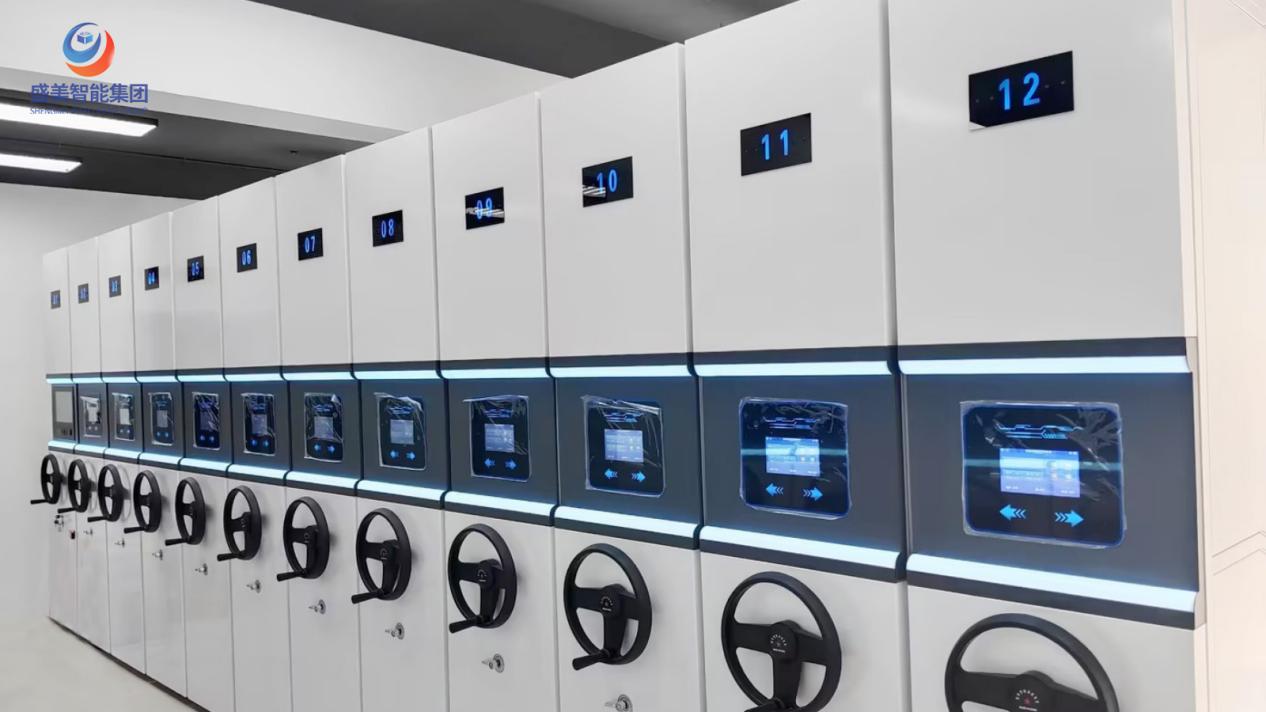
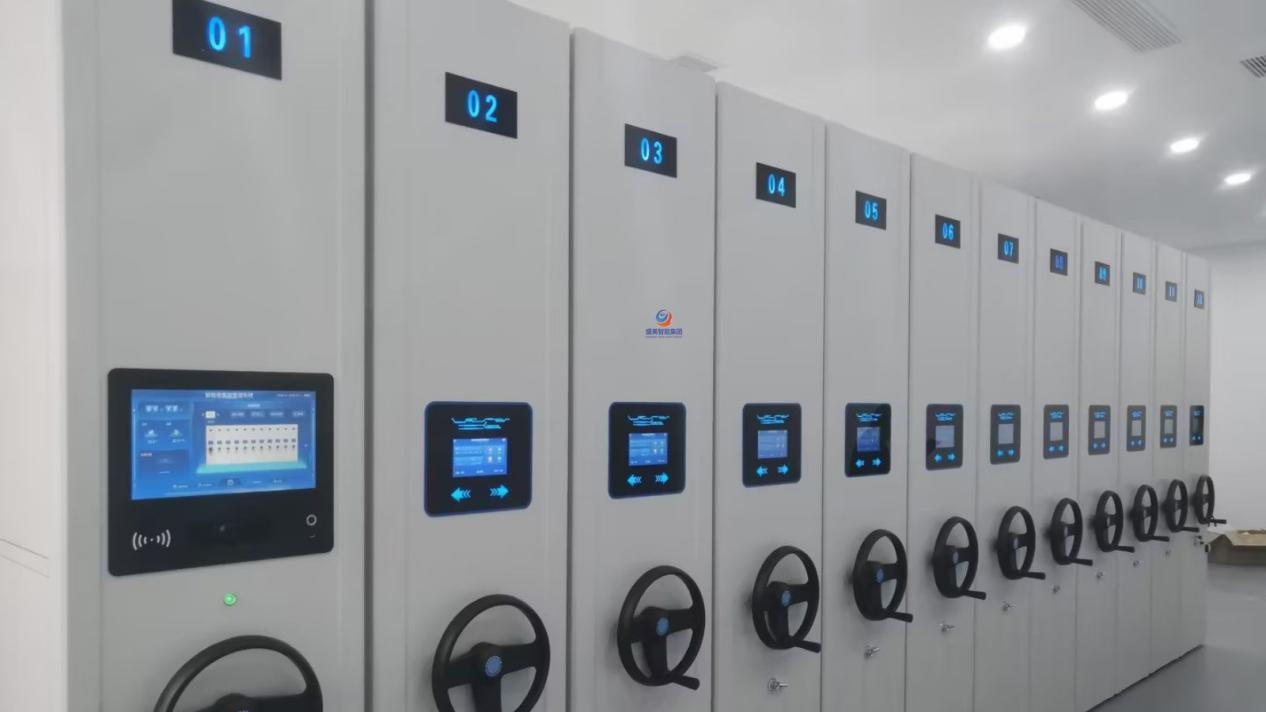
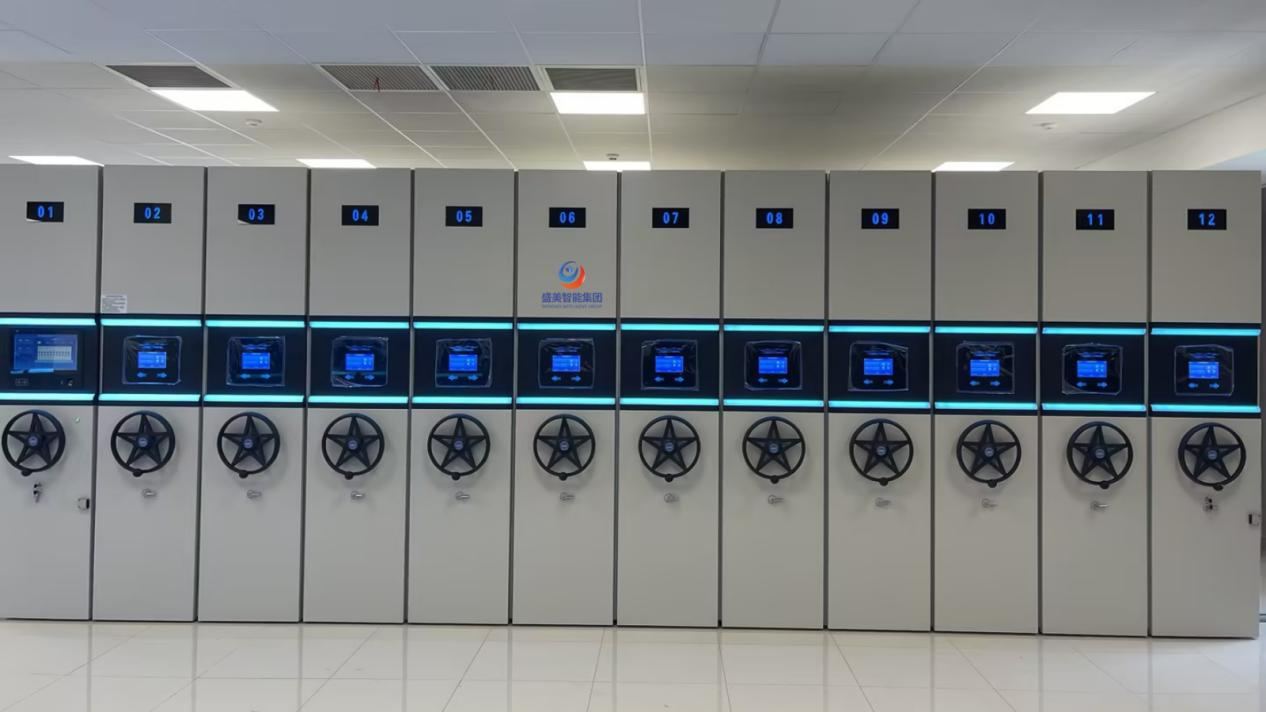
- Smart equipment basic check: Verify power indicators, touchscreens and running status; sensors unblocked and dust-free; no abnormal noise, odor or leakage.
- Archive room environment check: Keep the room ventilated and dry; never allow long-term sealed humidity. In coastal and rainy seasons, focus on standing water, moisture rebound and condensation.
Monthly Special Maintenance — Routine Deep Care
- Mechanical drivetrain care: Clean dust and rust from chains, bearings and rollers; check chain tension — no looseness, disengagement or jamming. Manual units focus on hand-crank smoothness; smart units on motor drive clearance.
- Rail & grounding check: Check rail levelness and fastening screws; tighten promptly; clean fine rust spots and apply simple anti-rust care; verify reliable grounding to eliminate leakage hazards in humid environments.
- Safety function self-test: Test infrared anti-pinch, light-curtain sensing, emergency stop buttons and limit start/stop functions — per OSHA and EN15095 safety standards.
- Cabinet hardware check: Confirm locks, hinges, handles and limit buckles are intact and open smoothly, without looseness or deformation.
Quarterly Deep Maintenance — Core Wear Care
- Drivetrain lubrication (overseas priority): For high-temperature, dry and salt-fog environments, apply neutral wear-resistant lithium grease to sprockets, bearings, drive shafts and roller contact surfaces. Low-quality engine oil is forbidden — it cakes with dust and causes jamming.
- Paint anti-corrosion care: Check powder-coated surfaces for scratches, paint loss and substrate exposure; patch minor damage promptly to stop salt-fog and moisture from spreading corrosion.
- Circuit & low-voltage wiring inspection: Check power cables, control lines and terminals for aging, looseness and moisture oxidation; clean electrical cabinet dust and keep circuits dry and tidy.
- Frame level calibration: Re-measure verticality and levelness, fine-tune anchor bolts and correct slight tilting — preventing long-term drift from wearing rails and overloading motors.
Annual Full Overhaul — Mandatory for Overseas Compliance Review
- Disassembly-grade deep cleaning and full-point rust and corrosion treatment;
- Full-function testing and parameter calibration of motors, reducers, mainboards and sensors;
- Overall rail flatness re-measurement, wear assessment and gap correction;
- Wear-part assessment (rollers, seals, locks, sensors, circuit boards) with advance overseas spare-part stocking;
- System data backup, program inspection and full functional test;
- Issue an annual maintenance report for overseas project compliance archiving and annual review.
Absolutely Forbidden Operations — High-Risk Red Lines
Most overseas faults originate from illegal operations rather than product quality. The following are strictly prohibited and managed as overseas O&M red lines.
Red Line 01No Rough Operation, Forced Pushing or Violent Hand-Cranking
Forcing a blocked frame directly causes chain tooth-skipping, roller deformation, rail scoring and drivetrain misalignment — permanent mechanical damage.
Red Line 02No One-Sided Overweight or Eccentric File Stacking
Long-term one-sided heavy loads tilt frames, unbalance rails and cause running drift; later rectification is extremely costly and basically impossible to fix on site overseas.
Red Line 03No Corrosive Solvents on Cabinets
Gasoline, high-concentration alcohol, banana oil, strong acids or alkalis will dull, peel and crack the powder-coated surface and rust the substrate. Use only a soft cloth with neutral clean water or diluted mild detergent.
Red Line 04No Blocking or Shielding Safety Sensors
Covering or disabling infrared sensors to make operation “easier” defeats anti-pinch protection and directly causes collision accidents and equipment damage — violating overseas safety standards and failing acceptance outright.
Red Line 05No Unauthorized Disassembly, Circuit Modification or Protection Bypass
Unauthorized removal of motors, mainboards, wiring or safety devices causes equipment write-offs, burnt circuits and safety accidents — and voids the manufacturer warranty immediately.
Red Line 06No Long-Term Fully-Loaded Standstill or Long-Term Idleness
Full-load standstill accelerates structural fatigue and rail settlement; long-term idleness lets parts rust and circuits fail from dust. Idle overseas archive rooms have extremely high failure rates.
Top 12 High-Frequency Faults, Causes & On-Site Quick Fixes
Drawing on global overseas project after-sales data, here are the Top 12 high-frequency faults with self-check + solutions that local O&M staff can perform independently — no waiting for international after-sales, dramatically reducing downtime and repair costs.
Jamming, Abnormal Noise, Heavy Pushing/Pulling
Core causes (high incidence overseas): rail dust and debris accumulation, dry rollers lacking grease, light rail corrosion, slight frame offset, eccentric file loading.
Quick fix: thoroughly clear rail groove debris; re-grease rollers, bearings and chains; fine-tune anchor bolts to level; redistribute files evenly; test-run until smooth.
Overseas prevention: in dusty regions increase rail cleaning frequency; do monthly rail anti-rust care during rainy seasons.
Hand Crank Spins Idle, Frame Does Not Move, Chain Slips
Core causes: loose chain, tooth-skipping, insufficient tension, drive disengagement, long-term dry wear.
Quick fix: adjust chain tensioner, re-seat skipped chain, add lubricant; replace chain parts if wear is severe.
Overseas tip: keep spare chains and spring tensioners on site.
Smart Compact Shelving Will Not Open Electrically, No Response
Core causes: external power loss, breaker trip, moist wiring contact failure, motherboard standby protection, emergency button not reset.
Quick fix: check main power, distribution box and leakage protection; reset the emergency stop; power-cycle the control system; inspect terminals for moisture oxidation, dry and tighten.
Emergency plan: switch to manual mode for temporary operation — archive retrieval is not affected.
Screen Lights Up but Frame Does Not Run, Keys Unresponsive
Core causes: system program freeze, touch failure, parameter disorder, limit protection triggered.
Quick fix: power-cycle the system, restore factory parameters, recalibrate limits; check whether the sensing area is blocked for long periods.
Infrared Anti-Pinch Failure, No Sensing, No Stopping
Core causes: sensor dust, blockage, moisture, aging photo elements, loose wiring.
Quick fix: clean sensor probes, remove obstructions, tighten wiring; replace aged sensors outright.
Compliance note: anti-pinch failure is an overseas safety red-line issue — stop and rectify immediately, or the system cannot pass OSHA inspection.
Frame Running Drift, Uneven Gaps, One-Sided Friction
Core causes: long-term eccentric load, unleveled rails, loose anchors, uneven roller wear.
Quick fix: balance file loads, level the cabinets, tighten rail screws, replace worn rollers.
Local Rust Spots, Paint Whitening, Coating Oxidation
Core causes: coastal salt fog, humid condensation, cleaning water residue, paint scratches.
Quick fix: sand off rust, dry thoroughly, repaint with anti-corrosion coating; strengthen ventilation and dehumidification; eliminate standing water residue.
Lock Jamming, Stiff Opening/Closing, Latch Misalignment
Core causes: slight deformation, dust entering the lock cylinder, long-term dryness.
Quick fix: clean lock cylinder dust, apply a small amount of lubricant, fine-tune door-frame alignment screws; never force the lock.
Smart System Frequent Errors, Auto Shutdown, Frequent Protection
Core causes: motor overload, unstable voltage, humid-environment leakage, sensor false triggering.
Quick fix: reduce one-sided loads, stabilize power supply, dry the circuit environment, recalibrate sensing sensitivity.
Loose, Wobbling Shelves with Load-Bearing Noise
Core causes: loose buckles, shifted hanging points, long-term heavy-load fatigue.
Quick fix: re-clip shelf buckles, correct hanging tabs, distribute loads evenly.
Humid Room Causes Moisture-Damaged Circuits, Boot Errors
Core causes: overseas rainy seasons, island environments without dehumidification, condensation in electrical cabinets.
Quick fix: activate ventilation and dehumidification, power off and air-dry, add desiccant; severely soaked units require professional drying and inspection.
Data Anomalies, Inaccurate Inventory, Positioning Disorder
Core causes: long uptime without restart, data cache accumulation, repeated mis-operations.
Quick fix: back up data regularly, restart the system to refresh, recalibrate the archive location ledger.
Overseas-Specific O&M Strategies
Domestic maintenance models cannot fit overseas projects. For slow logistics, distant after-sales, expensive labor and harsh environments, adopt these dedicated strategies to sharply cut failure rates and O&M costs.
📦 Advance Spare-Part Stocking Strategy
Ship a dedicated overseas wear-parts kit at delivery — spare sensors, seals, locks, chains, rollers and simple circuit parts. Small faults get local immediate replacement with zero waiting — no international logistics.
🌤 Climate-Zoned Maintenance Plans
Humid salt-fog regions: add monthly anti-corrosion, dehumidification and rail anti-rust cycles. Dusty dry regions: add daily rail and sensor dust removal. Extreme temperature-swing regions: reinforce circuit connections against thermal expansion loosening.
📋 Bilingual Standardized O&M Ledgers
Provide English maintenance record forms, inspection sheets and fault-handling logs that foreign staff can fill in directly — fully traceable, satisfying overseas annual review, safety compliance and engineering audit requirements.
🛰 Remote Technical Managed Service
Rely on manufacturer remote diagnosis, video guidance and online debugging to replace expensive on-site after-sales — low-cost, high-efficiency O&M.
🎓 Standardized Training for Foreign Personnel
At delivery, complete English operation teaching, fault-recognition training and forbidden-operation briefings — cutting human-caused failures at the source.
Manual vs. Smart Compact Shelving — O&M Focus Differences
| O&M Dimension | Manual Compact Shelving | Smart Compact Shelving | Overseas O&M Priority |
|---|---|---|---|
| Core maintenance parts | Rails, chains, hand-crank drive, anchors | Circuits, mainboard, sensors, motors, program | Smart units need moisture & dust protection |
| High-frequency fault points | Jamming, slipping, noise, drifting | Power anomalies, sensing failure, system errors | Electrical faults dominate in humid climates |
| Maintenance frequency | Quarterly lubrication focus | Monthly circuit inspection, quarterly calibration | Smart units need denser maintenance |
| Emergency capability | Faults never block basic use | Electrical faults need manual fallback | Manual emergency mode is a must overseas |
| Spare-part dependency | Low — mechanical parts durable | High — electronics vulnerable to environment | Smart units must stock parts in advance |
FAQ — Overseas Compact Shelving O&M
Q1 · In high-humidity, coastal salt-fog environments, how do I best prevent cabinet rust?
Q2 · How to fix non-standard, frequent mis-operation by foreign staff?
Q3 · When a fault appears overseas, should we disassemble immediately?
Q4 · What wear parts should overseas projects stock?
Q5 · How much longer can standardized maintenance extend equipment life?
⚠ Disclaimer
The overseas archive compact shelving maintenance procedures, troubleshooting methods and O&M strategies in this article serve only as technical reference material for overseas owners, general contractors and archive-room O&M personnel for internal learning and planning purposes.
The on-site fault self-check solutions apply to locally trained O&M personnel; work involving circuit disassembly, mainboards, motors and high-voltage electrical components must never be performed by unqualified non-professionals — contact the original manufacturer's technicians or certified electrical engineers. Wrong operations may cause personal injury, equipment damage and warranty voiding.
Local building codes, electrical standards and safety regulations differ by country and region; this white paper cannot replace local official safety norms and legal requirements — actual O&M must first comply with EN15095, OSHA and the mandatory local safety regulations of the project's country.
The fault-handling suggestions herein do not constitute absolute compatibility with all equipment versions; hardware differs across batches and configurations. For major faults, contact the original manufacturer's remote technical support first.
The author and publisher assume no responsibility for equipment damage or personal injury caused by failure to follow this manual, unqualified repair, non-original spare parts, or archive-room environments beyond the equipment's design conditions.
Conclusion: Standardized Overseas O&M Is the Core of Cost Control
Long-term stable operation of overseas archive compact shelving depends not on initial equipment quality alone, but on whether it fits the overseas climate, whether a localized standardized maintenance system exists, whether illegal operations are avoided, and whether spare parts and emergency plans are front-loaded. Overseas after-sales is expensive, logistics cycles long, labor costly and compliance review strict — once maintenance lapses, small faults quickly escalate into downtime incidents, compliance deductions, rework and heavy repair bills.
Through the daily / monthly / quarterly / annual tiered maintenance mechanism, combined with overseas-specific climate strategies, forbidden-operation control and rapid high-frequency fault response, failure rates fall at the source, equipment life extends, and archive rooms run stably and compliantly for the long term — a durable, low-cost, implementable and compliant O&M guarantee for overseas archive projects worldwide.
For English O&M manuals, overseas inspection ledger templates, wear-parts kit configuration, remote technical managed service or customized local maintenance plans — reach out for one-on-one support, covering overseas archive compact shelving projects in all regions.