Smart Compactor Shelving: The Optimal Solution for Archive Room Space Constraints
Introduction
This article is part of the SHENGMEI Cabinet Overseas Procurement Series of standardized bilingual technical white papers. Its layout, hierarchical structure, and writing style are fully synchronized with the official website white paper standards, suitable for government and enterprise existing warehouse retrofitting, aging archive room expansion, new smart archive room planning, and global archive project bidding and standardized acceptance. Addressing the core pain points of archive room space congestion, insufficient capacity, chaotic stacking, inability to expand, and year-on-year archive accumulation that are prevalent across the industry, this paper systematically dissects the root causes of spatial waste in traditional storage modes, explains the high-density, intelligent, and modular space optimization logic of Smart Compactor Shelving, and provides a standardized space expansion solution that can be directly used for scheme design, bidding documents, and archive retrofit implementation.
Industry Pain Points and Engineering Risks of Archive Room Space Congestion
The vast majority of government agencies, public institutions, medical facilities, and overseas standardized archive projects face the core contradiction between year-on-year archive growth and fixed warehouse floor area. Traditional fixed archive cabinets and ordinary shelving storage modes contain massive structural spatial waste, which is the root cause of warehouse congestion, insufficient capacity, and management chaos.
1. Fixed Aisle Redundancy and Waste — Extremely Low Floor Space Utilization
Traditional archive cabinets adopt a fixed layout, where each row of cabinets must reserve a fixed pedestrian aisle. Regardless of whether archives are being accessed, the aisle remains idle and occupies a large area of effective warehouse capacity. Conventional traditional warehouses achieve floor space utilization of less than 35%, with large amounts of premium warehouse area occupied by ineffective aisles. Archive storage volume is severely limited — the warehouse may appear full, but effective storage space is extremely scarce.
2. Year-on-Year Archive Accumulation with No Expansion Margin
Government document archives, personnel archives, engineering archives, and medical/legal archives increase year by year, while existing warehouses have no reserved expansion space. Later archives can only be stacked or temporarily piled in corners, resulting in mixed archive placement, difficult retrieval, moisture and dust exposure, and disorderly accumulation. This fails to meet global archive storage standardization norms and poses compliance acceptance risks.
3. Chaotic Layout Hindering Standardized Management
Space congestion leads to disorganized cabinet arrangement and unclear zoning, significantly reducing archive classification, filing, inventory, and retrieval efficiency. High-density stacking easily causes archive compression damage, poor ventilation, and temperature/humidity imbalance, fostering long-term mold and pest risks. This fails to meet the digitized, standardized, and traceable requirements of modern archive management.
4. High Cost and Site Limitations for On-Site Expansion
Most aging campuses and office buildings lack additional warehouse sites. New warehouse construction or off-site rental storage costs are extremely high, accompanied by archive handling damage, ledger reconciliation chaos, and management disconnects. Overall retrofit costs are high and implementation is difficult.
Traditional Storage vs. Smart Compactor Shelving: Core Spatial Utilization Logic
The core advantage of Smart Compactor Shelving in solving space congestion is not simply adding more cabinet layers, but reconstructing the warehouse spatial layout logic, eliminating structural ineffective space, and maximizing the extraction of both floor and vertical capacity. It is the optimal engineering solution for zero-expansion, zero-land-acquisition, low-cost capacity expansion of existing warehouses.
1. Dynamic Aisle Design — Completely Solving Aisle Waste
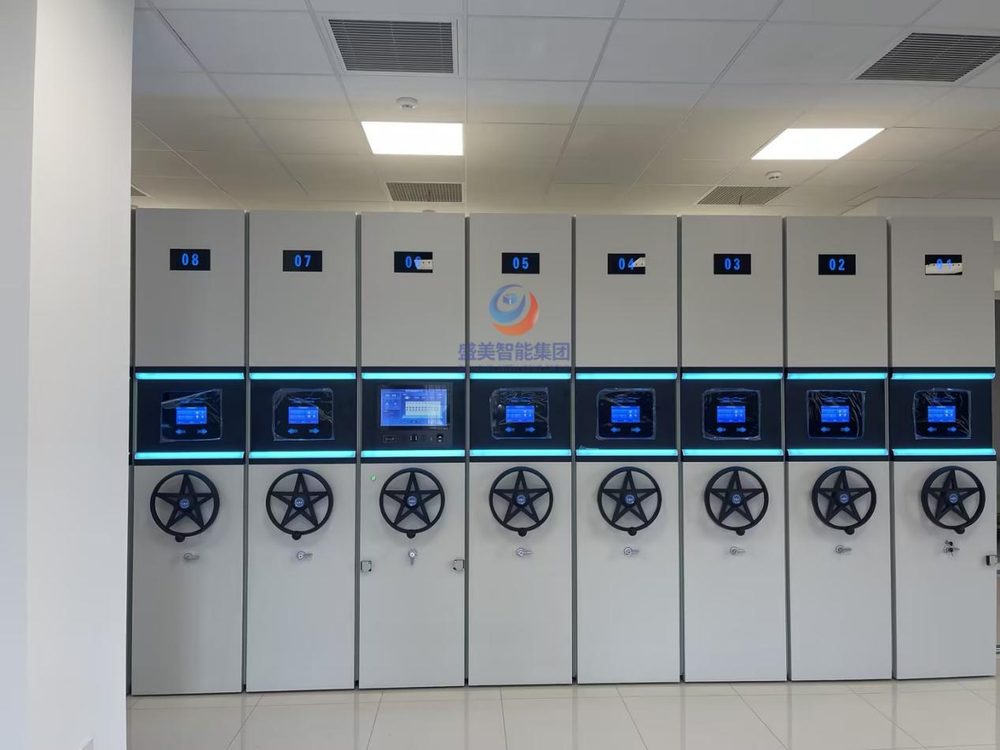
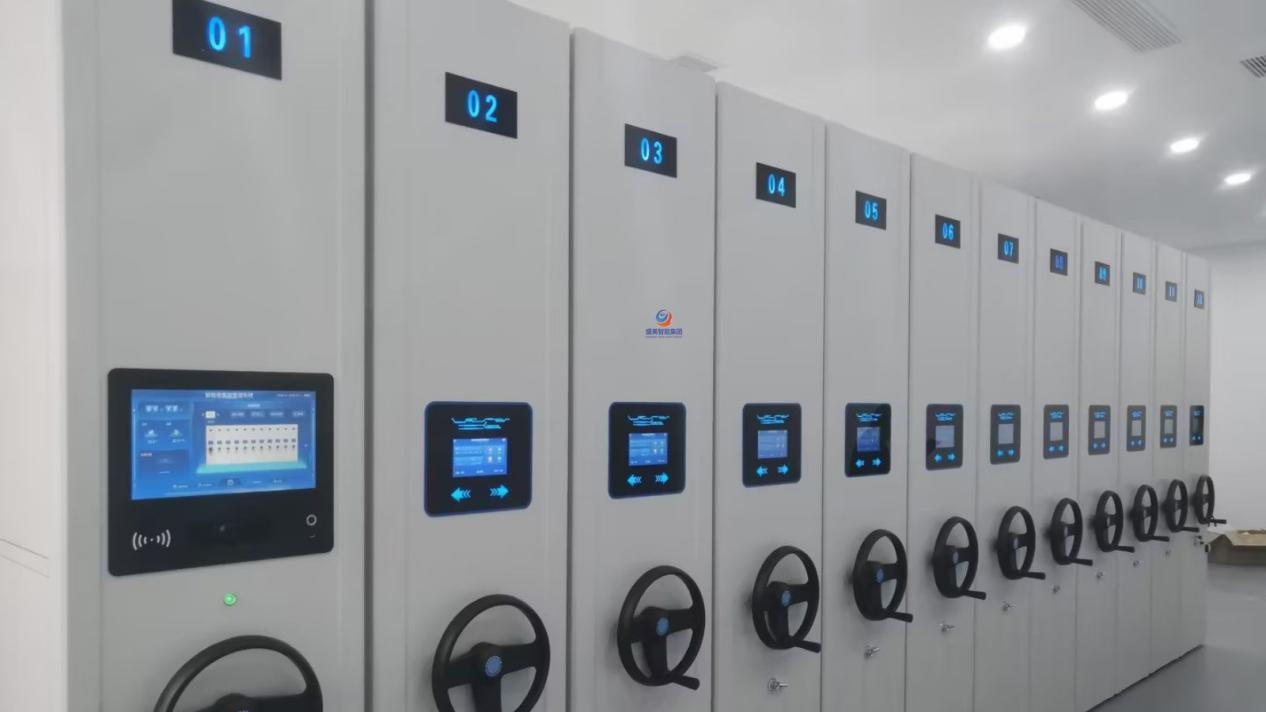
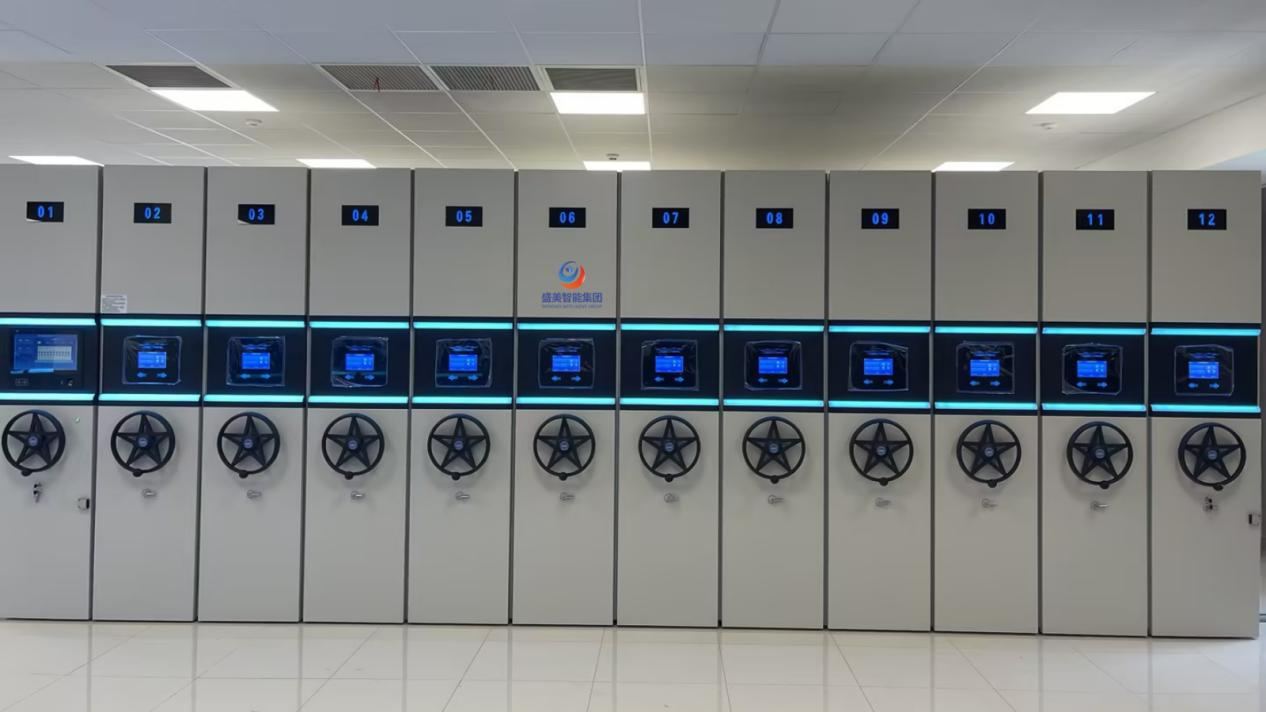
Traditional fixed cabinets: multiple rows and multiple aisles, with aisles permanently occupied and extremely low space utilization. Smart Compactor Shelving: the entire system is equipped with a floor-track mobile system, allowing cabinets to electrically/intelligently auto-cluster and open aisles on demand. Only the corresponding single-row aisle opens during archive access; at all other times, the entire system is tightly arranged, completely eliminating redundant fixed aisles and massively releasing effective storage area.
2. Full Utilization of Vertical Space — Boosting Effective Capacity
Smart Compactor Shelving adopts an all-steel modular layered structure, with freely adjustable shelf heights and customizable layer counts, adapting to archives, drawings, and materials of different thicknesses and specifications. It fully utilizes the conventional 3–4 meter ceiling height of warehouses, abandoning the spatial waste of traditional low cabinets. Without occupying additional floor area, it expands storage vertically. Traditional archive cabinets only achieve 3–4 layers of storage, while Smart Compactor Shelving can be customized to 5–7 standardized layers according to warehouse ceiling height, increasing vertical space utilization by over 60% and doubling single-warehouse capacity — perfectly matching the core demand of year-on-year archive accumulation.
3. Modular Standardized Layout — Eliminating Fragmented Space Waste
Traditional fixed cabinets have fixed dimensions and rigid layouts, leaving warehouse corners, column gaps, and wall margins as fragmented, unusable spaces. Smart Compactor Shelving supports full-size modular customization, precisely adapting to beam/column positions, room structures, and corner dimensions — fitting walls, avoiding columns, and filling fragmented gaps. All usable warehouse space is converted into effective storage area, thoroughly solving the problems of fragmented layout and severe space waste in traditional storage.
4. Intelligent Integrated Management — Improving Space Usage Efficiency
Beyond physical space expansion, Smart Compactor Shelving relies on intelligent control systems to achieve precise archive positioning, automatic retrieval, zoned management, and intelligent inventory. This avoids the hidden spatial waste caused by manual disorderly stacking, duplicate occupation, and archive accumulation errors. Traditional warehouses suffer from management chaos, with large amounts of space occupied by ineffective redundant archives, duplicate materials, and idle clutter. Intelligent digital management standardizes archive placement, maximizing the activation of existing warehouse capacity and ensuring every inch of warehouse space delivers peak value.
Smart Compactor Shelving vs. Traditional Archive Cabinets — Comprehensive Space & Efficiency Data Comparison
To intuitively demonstrate the spatial optimization advantages of Smart Compactor Shelving, combined with 2026 domestic and international archive warehouse construction standards, a 100m² standard archive warehouse is used as the calculation sample. The following standardized data comparison is produced, with all parameters directly applicable to project proposals, bidding documents, budget calculations, and client presentations.
| Comparison Dimension | Traditional Fixed Archive Cabinets | Smart Compactor Shelving | Optimization Effect |
|---|---|---|---|
| Floor Space Utilization | ≤35% | ≥75% | Space utilization increased by 110%+ |
| 100m² Archive Warehouse Capacity | Approx. 8,000–10,000 volumes | Approx. 18,000–22,000 volumes | Overall capacity doubled |
| Fixed Aisle Occupied Area | Over 50% | On-demand opening, no fixed aisle occupation | Eliminates all aisle redundancy waste |
| Vertical Space Utilization | Low, ceiling utilization under 50% | Ultra-high, ceiling utilization over 90% | Vertical capacity massively released |
| Archive Warehouse Layout Standardization | Chaotic and fragmented, unclear zoning | Modular and standardized, clear zoning | Compatible with standardized archive management |
| Archive Retrieval Efficiency | Manual searching, time-consuming and laborious | Intelligent positioning, one-click retrieval | Work efficiency improved by 80%+ |
| Future Expansion Capability | No expansion space, only new warehouses possible | Modular and expandable, add/remove layers and rows as needed | Long-term adaptation to archive growth |
From the measured data, it is clear that under the same warehouse area, Smart Compactor Shelving can achieve doubled capacity, doubled space utilization, and doubled management efficiency — without adding new sites or expansion retrofits. Through equipment upgrades alone, the core problems of warehouse congestion and insufficient capacity can be thoroughly solved, making it the most cost-effective engineering solution for quality improvement and capacity expansion of existing warehouses.
Core Technology Supporting Smart Compactor Shelving Space Optimization
The exceptional space adaptation and expansion capability of Smart Compactor Shelving is not a simple structural upgrade, but relies on mature mechanical structures, intelligent control systems, and engineering adaptation processes to achieve scientific and maximized utilization of spatial resources, fully compatible with domestic and international high-standard archive warehouse construction norms.
Silent Heavy-Duty Mobile Track System
Adopting high-precision embedded/exposed track structures paired with silent roller transmission devices, the entire system moves smoothly without jamming or deviation. It enables multi-row cabinet synchronous clustering and individual opening, completely abandoning the traditional fixed aisle mode. Track horizontal precision error ≤2mm/2m, ensuring long-term stable operation, achieving flexible opening in minimal space, maximizing compression of ineffective gaps, and releasing effective storage space.
All-Steel Modular Adjustable Structure
The cabinet body is formed from thickened cold-rolled steel plate in one piece, with stable load-bearing and resistance to deformation. Shelf heights are freely adjustable without fixed installation specifications. It can flexibly adjust layer heights according to archive thickness, drawing size, and material specifications, eliminating inter-layer space waste. For irregular warehouses, beam/column obstructions, and non-standard spaces, customized cutting and adaptation can be implemented, ensuring every corner of the warehouse is efficiently utilized.
Intelligent Opening Precision Control System
Equipped with a microcomputer intelligent master control system, supporting one-click shelf opening, automatic homing, timed closure, and independent zoned control. When no one is accessing archives, cabinets automatically cluster tightly, maximizing aisle space compression; during access operations, the corresponding single-row aisle opens precisely, balancing operational convenience and spatial efficiency. The system features memory functions, adapting to high-frequency access scenarios and maintaining long-term warehouse standardization and efficient space utilization.
Multi-Layer Safety Protection for Secure Operations in Compact Spaces
Compact warehouse retrofits fear safety hazards the most. Smart Compactor Shelving is equipped with infrared anti-pinch, light curtain sensing, current overload protection, emergency braking, and tilt monitoring multi-layer safety systems. Under high-density arrangement and close-range opening/closing conditions, it completely avoids personnel pinching, cabinet tipping, and equipment jamming failures, achieving dual compliance of high-density storage and high-safety operations, meeting OSHA and EN15095 global safety acceptance standards.
Practical Application Advantages of Smart Compactor Shelving for Solving Space Congestion
Compared to traditional warehouse expansion, off-site relocation, and adding new cabinets, Smart Compactor Shelving upgrades offer core advantages of zero land acquisition, low investment, short construction period, high returns, and strong compliance, adapting to various existing warehouse upgrade scenarios.
1. No New Site Required — Double Capacity On-Site
The vast majority of aging archive rooms are located inside office buildings, government complexes, and campuses, with no surplus land for new construction. Traditional expansion can only rely on off-site warehouse rental, which not only increases site rent and renovation costs, but also causes archive relocation damage, ledger chaos, and management disconnects. Smart Compactor Shelving directly utilizes the original warehouse site, achieving on-site capacity doubling through equipment structure optimization and spatial reconstruction, completely breaking free from site limitations.
2. Short Retrofit Period Without Disrupting Daily Archive Operations
Full warehouse expansion and civil construction projects involve long timelines, complicated procedures, archive evacuation, and office suspension. Smart Compactor Shelving retrofits, by contrast, use modular installation — convenient to construct, low in noise, and free of large-scale civil engineering modifications. Work can proceed zone by zone and batch by batch, with no need to fully empty the warehouse, minimizing disruption to daily archive management while rapidly delivering space expansion and upgrades.
3. Standardized Layout Adapting to Digital Archive Construction
Space-constrained aging warehouses commonly suffer from chaotic layout, disorderly classification, and poor environment, failing to meet smart archive warehouse construction, project rating, and audit acceptance requirements. Smart Compactor Shelving's standardized, modular layout enables archive zoning, centralized management, and orderly storage, paired with intelligent inventory, data traceability, and environmental monitoring functions. It simultaneously completes spatial optimization and digital upgrades, helping warehouses meet advanced review and global compliance acceptance standards.
4. Long-Term Cost Reduction and Efficiency Gains — Avoiding Repeated Retrofits
Traditional cabinets have low space utilization, and with year-on-year archive accumulation, capacity saturation occurs every 3–5 years, requiring repeated equipment additions and warehouse retrofits with extremely high cumulative costs. Smart Compactor Shelving offers strong expansion capability and flexible scalability — a single retrofit can meet 15–20 years of archive growth storage needs, long-term avoiding space insufficiency and repeated retrofits, significantly reducing full-lifecycle warehouse operation and maintenance costs.
Full-Scenario Adaptation: Which Warehouses Must Upgrade to Smart Compactor Shelving?
Combined with global archive engineering construction standards and extensive project implementation experience, the following high-frequency warehouse scenarios suffer the most prominent space congestion problems and yield the highest retrofit benefits from Smart Compactor Shelving upgrades. They are also the core recommended scenarios for bidding and project upgrades.
1. Aging Government and Enterprise Existing Archive Rooms
Long operational history, low original design standards, use of traditional fixed archive cabinets, year-on-year archive accumulation, severe warehouse congestion, no expansion site, unable to meet daily filing and audit acceptance requirements — urgently needing equipment upgrades to revitalize existing space.
2. High-Frequency Filing Warehouses for Personnel, Legal, and Medical Archives
Personnel archives, case archives, and medical archives have rapid growth rates and large storage volumes, with extremely high requirements for storage space, classified management, and precise retrieval. Traditional cabinets cannot handle massive archive storage demands, while Smart Compactor Shelving perfectly adapts to high-frequency expansion and efficient management needs.
3. Core Warehouses with Site Limitations and No Expansion Possibility
Archive warehouses located in core office areas and campus core positions, with no conditions for new construction expansion and excessively high off-site relocation costs, are the core adaptation scenarios for Smart Compactor Shelving spatial optimization.
4. Projects Applying for Digital and Smart Upgrades
Projects needing to participate in archive demonstration warehouse ratings, smart archive construction acceptance, and global standardized audits require not only capacity expansion, but also standardized layout, digital management, and compliant operations. Smart Compactor Shelving simultaneously achieves spatial optimization and qualification compliance.
5. Overseas European and American Standardized Archive Engineering Projects
Overseas projects have expensive site rents and extremely high expansion costs, with stringent requirements for space utilization, equipment compliance, and intelligence levels. The high-density storage, intelligent operations, and high-standard compliance characteristics of Smart Compactor Shelving perfectly adapt to overseas high-end engineering procurement standards.
High-Frequency Industry Misconceptions in Space Retrofitting (Key Avoidances)
In warehouse space expansion retrofits, most procurement and design units hold cognitive misconceptions that not only fail to solve congestion problems, but also cause resource waste, engineering mismatch, and acceptance failure risks. This section summarizes high-frequency industry misconceptions to provide pitfall avoidance guidelines for project implementation.
Misconception 1: Adding More Traditional Archive Cabinets Will Solve Space Insufficiency
Traditional cabinets themselves have extremely low space utilization. Blindly adding cabinets will only further compress aisle space, causing more severe warehouse congestion, blocked passage, and fire safety non-compliance. Not only can this not solve capacity problems, but it also brings fire hazards, management chaos, and acceptance deduction issues — it is an ineffective retrofit.
Misconception 2: Manual and Smart Compactor Shelving Deliver Identical Expansion Results
Both have similar physical expansion foundations, but manual compactor shelving lacks intelligent management systems. Long-term use still results in disorderly placement, chaotic zoning, and cumbersome operations, with low spatial utilization refinement. Meanwhile, manual compactor shelving cannot adapt to digital upgrades, overseas compliance audits, or unmanned operations — it only achieves basic expansion and cannot meet the comprehensive construction needs of modern archive warehouses.
Misconception 3: Directly Choosing Off-Site Relocation for Congested Warehouses
Off-site relocation incurs extremely high costs for new site rent, renovation, supporting equipment, archive relocation, and ledger reset. It also causes archive management disconnects, data errors, and multiplied operation and maintenance costs. Most existing warehouses can achieve capacity doubling through Smart Compactor Shelving retrofitting, with retrofit costs far below relocation costs — making it the more cost-effective preferred solution.
Misconception 4: Ignoring Civil Foundation Adaptation and Blindly Upgrading Equipment
Smart Compactor Shelving is heavy-load electromechanical equipment with dynamic operation generating alternating loads, requiring standard requirements for warehouse floor load-bearing, flatness, and foundation reinforcement. If civil foundations are inadequate during direct installation, later settlement, cabinet tilting, and equipment failures will occur, rendering normal use impossible and generating rework costs — completely contradicting the original intention of capacity expansion retrofitting.
Standardized Implementation Process for Warehouse Space Optimization
To ensure zero-risk implementation of capacity expansion retrofits, maximized space utilization, and engineering compliance, combined with SHENGMEI Cabinet's global project implementation experience, the following standardized retrofit process is summarized and can be directly used for construction plans, technical briefings, and project management.
Step 1: On-Site Precision Survey
Professional teams conduct on-site surveys of warehouse area, floor load-bearing, ceiling height, beam/column positions, fire protection points, electrical configuration, and existing equipment. Precise calculations of maximum expandable capacity, civil foundation adaptation risk screening, and exclusive space optimization proposals are delivered.
Step 2: Custom Modular Layout Design
Based on warehouse survey data, archive storage volume, future growth needs, and project compliance level, custom cabinet layout, layer specifications, opening modes, and intelligent configurations are designed to maximize spatial potential and eliminate all ineffective waste areas.
Step 3: Civil Foundation Adaptation
Addressing floor flatness, insufficient load-bearing, and missing track foundations, standardized reinforcement, leveling, track embedding, and low-voltage wiring construction are carried out to ensure long-term stable equipment operation and compliance with global engineering acceptance standards.
Step 4: Modular Equipment Installation & Commissioning
Zoned cabinet installation, track calibration, intelligent system debugging, and safety function testing are conducted to ensure smooth opening/closing, precise positioning, complete protection, and standardized, rational spatial layout.
Step 5: Acceptance, Archiving & O&M Training
Complete equipment acceptance, space utilization verification, and system trial operation. Simultaneously conduct operator training, deliver complete drawings, materials, and O&M manuals, achieving closed-loop project delivery.
FAQ — High-Frequency Q&A on Warehouse Space Expansion Retrofitting
Conclusion: Smart Compactor Shelving Is the Optimal Solution for Existing Warehouse Space Upgrades
Archive room space congestion and insufficient capacity are rigid pain points universally faced by government agencies and overseas archive engineering projects. The core essence is not insufficient warehouse area, but excessively low space utilization, backward structural design, and lagging management systems in traditional storage modes. New warehouse construction, off-site relocation, and adding new cabinets all suffer from high costs, long timelines, multiple risks, and treating symptoms rather than root causes.
Smart Compactor Shelving fundamentally eliminates the structural spatial waste of traditional storage through dynamic aisle design, modular spatial adaptation, three-dimensional capacity mining, and intelligent precision management. It achieves on-site capacity expansion, doubled warehouse capacity, standardized layout, compliance achievement, and intelligent upgrades — delivering multiple values simultaneously. Whether for aging warehouse retrofitting, existing capacity upgrades, or overseas high-standard archive engineering projects, it is a high-quality solution that balances cost, effectiveness, compliance, and long-term development, thoroughly solving the industry challenges of archive room space congestion, insufficient growth capacity, and management chaos.
Get Your Free Customized Archive Room Layout Plan
If you are facing archive room capacity constraints and planning an archive room upgrade, contact the SHENGMEI engineering team for a free customized CAD space-optimization layout and capacity calculation proposal.
Please provide: archive room length, width and ceiling height · current archive volume · annual archive growth · load-bearing test report (if available) · city · equipment selection preference · whether RFID upgrade is needed.