7 Common Pitfalls in Compact Shelving Procurement
A field-tested risk-control framework to prevent material downgrade, contract loopholes, and acceptance failure across 15–20 year archive-warehouse projects.
Real-World Context of Compact Shelving Procurement
Compact shelving procurement is far more than a product purchase. It spans on-site survey, scheme design, material selection, configuration, installation, and warranty. Many procurement teams treat it as ordinary metal furniture, focusing only on price and neglecting engineering attributes — leading to plate thickness reduction, configuration shrink, unreasonable layout, system incompatibility, after-sales shirking, and failed acceptance. The following seven pitfalls emerge consistently across completed projects and are systematically addressed below.
The Seven Pitfalls
Each pitfall is presented with its manifestation, real-world risk, and a practical avoidance measure.
Price-Only Mindset — Ignoring Total Lifecycle Cost
Procurement comparison focuses only on unit price per group, prioritizing the lowest bidder without calculating hidden material, configuration, installation, and software costs.
Overly low prices bring thinner plates, simplified coatings, off-brand sensors, and reduced installation. Failures emerge 2–3 years later: bent shelves, rust, transmission sticking. Apparent initial savings are outweighed by later repair costs, and some low-price suppliers disappear after project completion.
Adopt total cost of ownership (TCO) thinking. Require itemized quotations listing main materials, chassis, transmission, software, installation, training, warranty, and spare parts. Evaluate material standards, project cases, and after-sales capability rather than bare unit price.
Skipping On-Site Survey — Drawing-Based Estimates
Procurement provides CAD drawings or estimates warehouse dimensions from experience, without arranging supplier on-site surveys. Beams, columns, fire points, door openings, and load-bearing are ignored.
Drawings and actual site differ. Shelving may interfere with beams or fire points; aisle widths may not meet fire regulations; doors may be too small for entry; floor load-bearing may be insufficient. Such problems require factory rework or scrap, causing schedule delays and financial loss.
Every project must complete on-site survey, collecting net dimensions, beam positions, fire points, doors, and floor load. Produce layout and aisle drawings; have both parties sign before production. For older warehouses, test ground settlement and load capacity.
Vague Contract Terms — Relying on Verbal Promises
The contract only briefly states “manual” or “smart” shelving, while plate thickness, chassis, coating, motor brand, sensor model, software functions, and load capacity remain verbal.
Verbal promises have no legal force. Suppliers promise thickened plates and full functions during bidding but downgrade during production. Upright and shelf thickness shrinks; smart modules such as logs, access control, and RFID are deleted. Post-delivery, the buyer struggles to defend rights.
Lock every core parameter into the contract: measured plate thickness, chassis thickness, shelf uniform load, and coating standard. For smart models, specify motor/sensor brands and all functions including access control, logs, positioning, and API integration. Agree on on-site spot checks and return/replace/compensation clauses.
Confusing “Electric” with True Smart Shelving
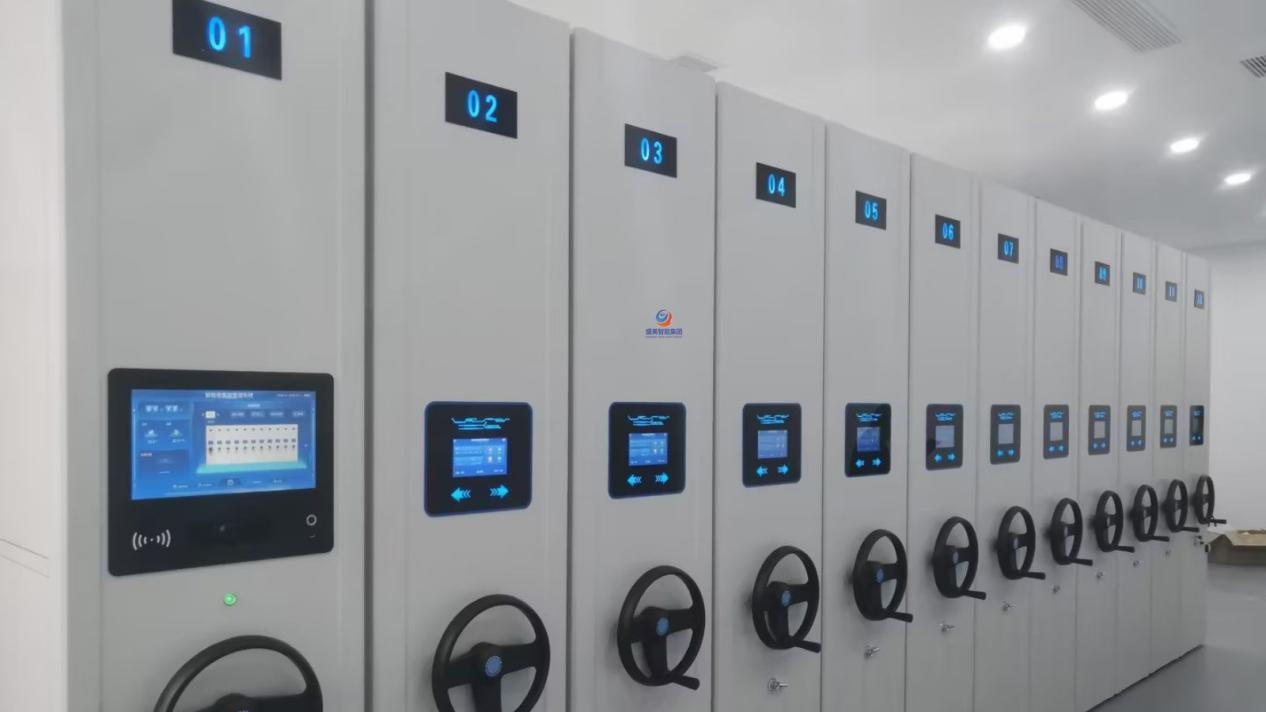
Procurement mistakenly believes electric movement equals smart shelving. Tenders specify electric opening and closing but ignore archive software, access control, logs, RFID positioning, and system integration.
The delivered product has only motor-driven movement, no ledger, traceability, or positioning. It is ordinary electric shelving failing to meet smart-archive ratings. Some systems are third-party white-label software without copyright, blocking upgrades and integration, forming a digital island.
Clearly distinguish manual, electric, and smart shelving. Smart models must include graded access, logs, positioning, and ledger management. Require software copyright; confirm API support; write integration and upgrade services into the contract.
Ignoring Civil Infrastructure Conditions
Procurement focuses entirely on the shelving cabinet without assessing floor load, flatness, electrical load, and fire protection.
Older floors may lack load capacity, causing rail settlement, shelving tilt, and operation sticking. Excessive height differences prevent rail leveling. Insufficient circuit load causes smart shelving to trip. Without resolving civil issues, equipment cannot run stably long-term.
Complete civil condition assessment in the early stage, calculating floor load and evaluating leveling and electrical renovation needs. New warehouses should reserve conditions per installation standards. Treat civil rectification as a project pre-condition, not a post-delivery discovery.
Generic Test Reports Without Project Match
Suppliers provide numerous reports and certificates. Procurement only checks whether certificates exist, without verifying whether report models and standards match the actual products procured.
Suppliers often submit reports from other sample models or other manufacturers. Although bidding may pass, later archive bureau reviews, superior audits, or third-party re-inspections find performance gaps, causing project deductions or acceptance failure.
Verify that report models and standards match procured products. Require originals or officially traceable versions. Manual shelving should comply with GB/T 13667.3-2013; electric shelving with GB/T 13667.4-2013. Reject generic blank reports without model numbers.
Emphasizing Supply but Neglecting Installation & Warranty
Procurement is treated as buying goods. The contract only stipulates delivery; installation, warranty scope, response time, and spare parts are vaguely defined.
Compact shelving is equipment plus engineering. Outsourced installation teams cause quality issues. Broad three-year warranties exclude motors, sensors, seals, and rollers. Fault response is slow; parts become unavailable later, forcing premature retirement.
Clearly define installation responsibilities and construction standards. Detail warranty lists, response times, and parts supply obligations. Require a basic wear-part kit. Make installation and commissioning acceptance a prerequisite for final payment.
Pitfall Summary Comparison
| No. | Pitfall | Main Risk Consequence | Core Control Point |
|---|---|---|---|
| 1 | Price-only mindset; comparing only unit price | Material and configuration downgrade; later failures; higher total cost | Itemized quotation; evaluate total lifecycle cost; reject predatory low prices |
| 2 | No on-site survey; drawings or experience only | Dimensional interference; non-compliant aisles; equipment cannot be installed | Mandatory on-site survey; signed layout confirmation before production |
| 3 | Verbal promises; vague contract parameters | Material and configuration downgrade; difficult rights defense | All technical parameters in contract and annexes; agreed spot-check rights |
| 4 | Treating electric shelving as smart | Lacks archive management; fails smart archive review | Distinguish electric/smart; specify software, logs, and integration requirements |
| 5 | Ignoring warehouse civil conditions | Settlement, uneven rails, circuit trips; frequent failures | Pre-assess floor load, flatness, and electrical load; rectify civil work if needed |
| 6 | Using irrelevant test reports | Reports do not match delivered products; audit or acceptance fails | Verify report model and implementation standard; one product, one report |
| 7 | Supply-focus; neglect installation & parts supply | Poor installation; fault buck-passing; no later parts supply | Define installation, warranty scope, response time, and parts supply obligations |
Standardized Risk-Control Checklist
Directly applicable to tender evaluation, supplier review, and contract negotiation.
- ✓Has an on-site warehouse survey been completed, with signed layout and aisle verification drawings issued?
- ✓Are steel plates, chassis, shelves, load capacity, and coating written into the contract, with on-site spot checks supported?
- ✓Are manual / electric / smart versions clearly distinguished, with smart software, integration, and copyright defined?
- ✓Have test report models been verified to match bidding products and corresponding national standards?
- ✓Is the quotation fully itemized — cabinet, transmission, control, software, installation, and training?
- ✓Are installation responsibilities, warranty component scope, response time, and parts supply clearly defined?
- ✓Is phased payment set, with installation, commissioning, and acceptance as prerequisites for final payment?
- ✓Have the supplier’s similar archive-warehouse project cases been reviewed?
FAQ — High-Frequency Questions
Conclusion
Compact shelving is not simple standardized furniture but an engineering storage system integrating civil work, mechanical transmission, electrical control, archive business, and later-stage O&M. Procurement mistakes often emerge 1–3 years after commissioning with extremely high rectification costs. By avoiding the seven typical pitfalls above and insisting on on-site surveys, written parameter solidification, total lifecycle cost thinking, and clear installation / after-sales responsibilities, archive-warehouse procurement can achieve safety, compliance, value for money, and long-term stable operation.
Procurement Plans & Tendering Documents
Get risk-control checklists, tender parameter templates, key contract clause references, and archive-warehouse layout calculation services.
Email: info@shengmeicabinet.com
WhatsApp: Kerwin +86 189 3280 1260