
Records that must outlive the government that filed them.
A government archive is judged on retention discipline, not shelving looks. Shengmei compact systems give archives departments the density their growing volumes demand — with the access control, logging and environmental monitoring that a records schedule and its auditors require.
Every bay is specified against the record class it will hold, from permanent holdings to ten-year periodic files, so the room can be re-sectioned as the schedule changes.

How the room is zoned by retention class.
Records schedules sort files into retention classes. The shelving plan should follow the same logic — permanent holdings in the deepest bays, active classes nearest the door.
| Class | Typical contents | Retention | Storage treatment |
|---|---|---|---|
| Permanent | Charters, minutes, land and title records | Indefinite | Deepest bays, lowest traffic, environmental monitoring on the zone. |
| 30-year | Major case files, project archives | 30 years | Mid-room bays with batch retrieval access and full audit logging. |
| 10-year | Administrative and correspondence files | 10 years | Aisle-adjacent bays for periodic retrieval; light touch control. |
| Active / current | In-year working files and registers | Until closed | Door-end bays, daily access, smart drive recommended. |
| Disposal queue | Expired files awaiting certified destruction | Holding only | Dedicated bay per disposal cycle, sealed until the certificate is signed. |
Four security tiers, four ways into the aisle.
Government archives rarely run a single access level. The smart terminal authenticates per operator and logs every opening — the tier decides who may enter, the log proves who did.
Open records
Published and declassified material. Standard card access, bulk retrieval permitted, no per-file logging.
Internal
Departmental working files. Password or card per staff member, retrieval logged by bay.
Confidential
Restricted holdings. Fingerprint authentication, per-file audit trail, supervisor override required for batch opens.
Sealed / vault
Sealed exhibits and top-class files. Dual control, tamper-evident locking, every access countersigned.
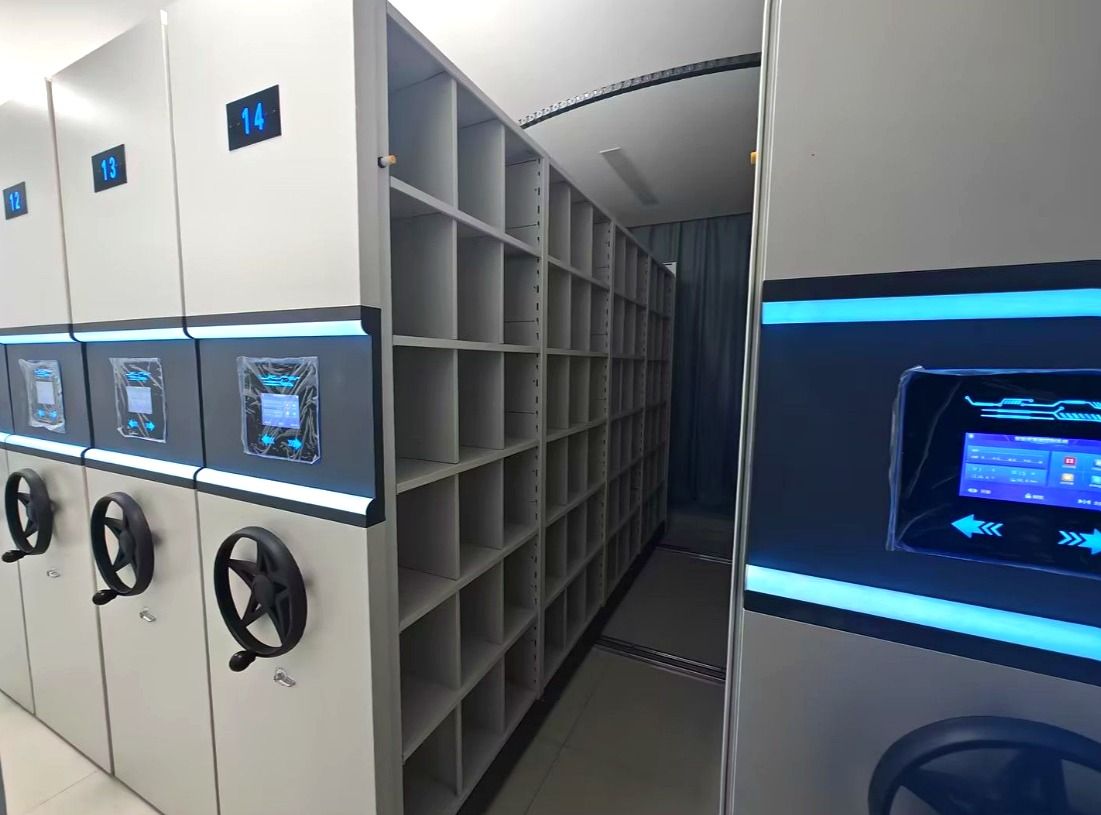
The room reports on itself.
Paper degrades on heat and humidity long before anyone reads it. The smart system monitors temperature and humidity across the archive and alarms at the thresholds you set — so the environment record exists before an inspector asks for it.
Monitoring, access logging and positioning accuracy are all documented in the installation pack, referenced to the standards the catalog declares.
The life of a government record.
A file’s storage treatment changes at each stage of its life. The shelving plan is drawn so a file can travel from the door to the deepest permanent bay without re-housing.
Creation & capture
The file is registered and boxed to the archive standard at the issuing department.
Classification
Retention class and security tier assigned — this decides which zone of bays it may enter.
Active use
Door-end bays, frequent retrieval, logged every time by the operator who opened the aisle.
Semi-active transfer
Moved inward to mid-room bays as retrieval slows; the access log travels with the file.
Retention or disposal
Permanent holdings settle into deep bays; expired files move to the disposal queue for certified destruction.
The four records an auditor samples.
Archive audits do not inspect shelves — they inspect records about the shelves. The system produces all four continuously, not as a year-end scramble.
Access log
Who opened which bay, when and for how long — exported per operator, per zone or per file class.
Environment record
Continuous temperature and humidity history per zone, with every alarm threshold breach flagged.
Bay map & index
The as-built bay map keyed to record classes, so any file’s location is provable on paper.
Disposal certificates
Certified destruction records matched to the bays released, closing the file’s lifecycle on paper.
Plan the archive against its schedule.
Send the records schedule and room dimensions — the proposal zones the room by retention class and returns with drawings in five working days.