Compactor Shelving Safety: 7 Anti-Pinch, Anti-Collision & Lock Features for 2026
Introduction
Compactor shelving is the heavy-duty mobile storage equipment behind every archive room, library, medical records room and corporate document center. With constant open-and-close cycles and heavy per-column loads, any system that lacks complete safety protection creates real risks: personnel crush injuries, cabinet collision damage, and confidential records exposure. Compactor shelving safety standards center on three functions — anti-pinch, anti-collision and lock control — and they are the first items checked in domestic tenders, overseas room acceptance and compliance audits.
Many procurement teams focus only on plate thickness, storage capacity and unit price, leaving safety configurations incomplete. The result is long-term hidden risk and very expensive retrofits later. This guide breaks down how every safety device works, what differentiates each configuration, and which scenarios fit each option — then delivers a standard selection checklist you can copy straight into a tender or RFQ. Pair this with our field guide to smart compactor shelving systems for the broader system context.

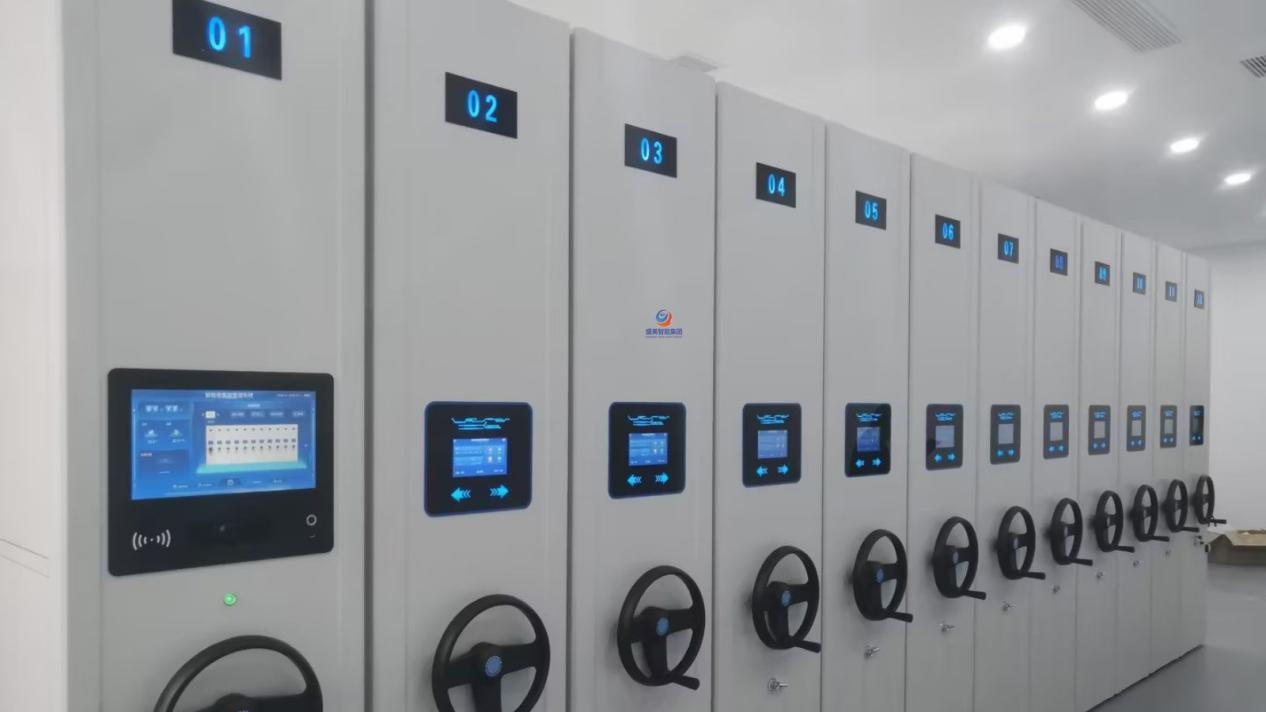
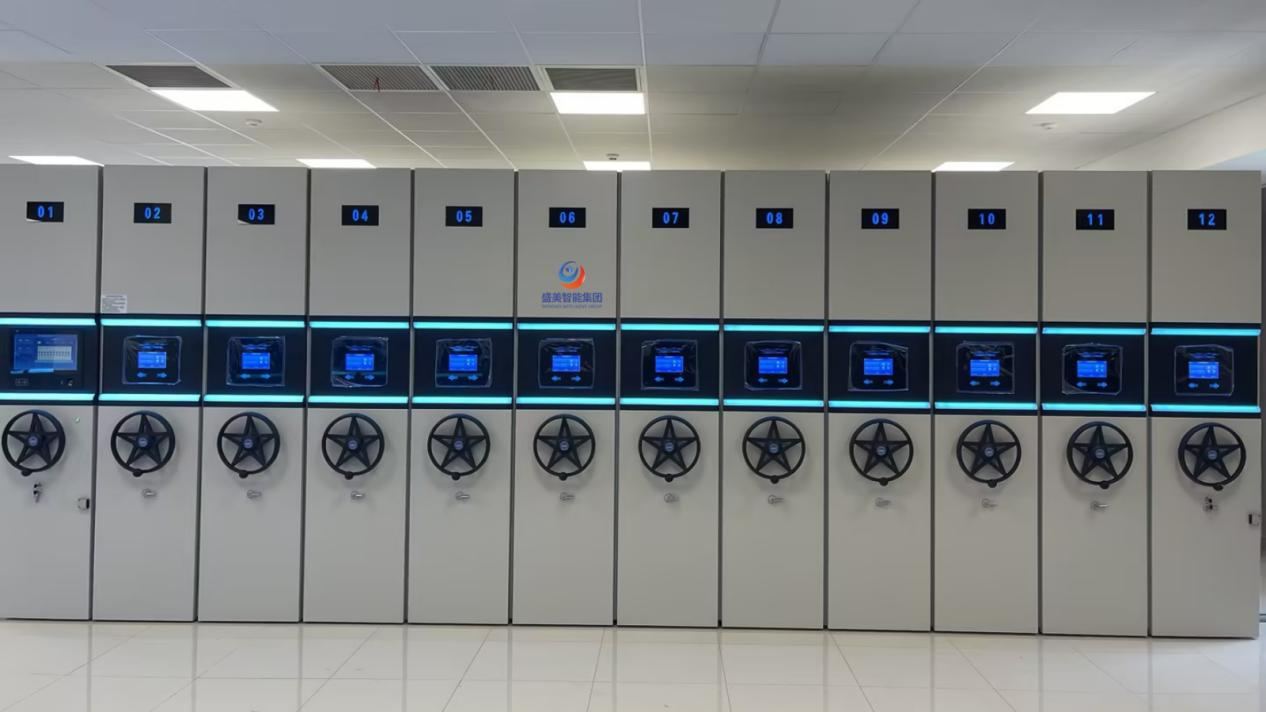
Intelligent compactor shelving fitted with infrared anti-pinch and tiered lock control — the overseas high-spec baseline.
1. Where Compactor Shelving Safety Incidents Actually Happen
Most compactor shelving safety incidents occur during carriage movement, opening, closing and docking — the dynamic phases — and peak when multiple users are searching records, when someone accidentally walks into the active aisle, or during commissioning and maintenance. There are three main categories:
When operators have not fully exited the aisle and another user enters the operating zone, or when a carriage keeps closing during hand-crank mistakes or smart auto-close, limbs get caught. The most common safety incident in everyday archive rooms.
Without travel buffers or travel limits, carriages hit walls, columns or end cabinets — bending rails, displacing car frames and shaking shelves loose. Files fall, equipment breaks, repair bills mount.
Without locks, or with a single-lock design, anyone can open any carriage at any time. Confidential files, medical records, legal documents and corporate secrets face real loss, tampering and leakage risk.
EU, Southeast Asia and Middle East engineering projects have explicit occupational health and safety requirements for heavy mobile storage. Incomplete safety specs are a direct path to project rejection.
2. Anti-Pinch Protection: How It Works & Selection
Anti-pinch is the core mandatory feature of any compactor shelving safety standard. It protects the people operating the system and comes in three technologies, fitting manual, electric and fully intelligent models.
2.1 Mechanical anti-pinch rubber strip (basic passive protection)
Mount high-elasticity rubber anti-collision strips on the closing edges of each carriage. When the strip touches a person, item or obstacle, the physical force triggers clutch stop or power-cut braking, stopping the carriage from closing further. The mechanism works without electricity, keeps working during power cuts, and has an extremely low failure rate — the essential basic protection for manual compactor shelving. It fits budget-constrained and mid-to-small archive rooms. The only limitation: protection only triggers on physical contact.
2.2 Infrared induction anti-pinch (mainstream active protection)
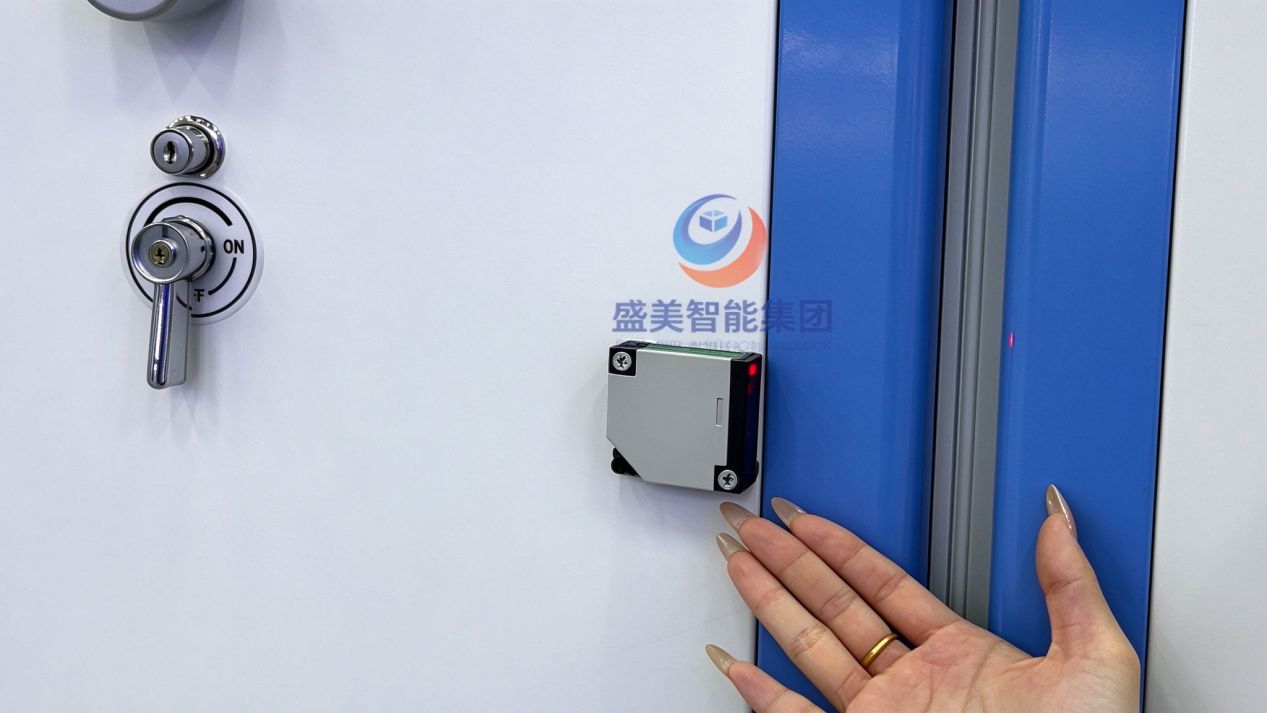
Infrared through-beam sensors on both sides of the aisle create an invisible safety beam. The moment a person or object blocks the beam, the system immediately pauses carriage movement — a "stop before contact" level of active protection that is much safer than mechanical alone. Widely used on electric and intelligent models and standard on overseas high-spec projects. Specify dust- and moisture-resistant sensors for long-term sealed or dusty archive environments.
2.3 Pressure-sensing anti-pinch (premium precision protection)
High-end configuration with precision pressure sensors built into the carriage ends and a preset safe-pressure threshold. Even slight contact triggers an instant stop — higher sensitivity and finer protection. Typical for smart archives, confidential rooms and high-end overseas government projects in high-frequency, high-standard scenarios.

3. Anti-Collision Safety: Passive + Active
Many buyers confuse anti-pinch with anti-collision. Anti-pinch protects people; anti-collision protects the equipment and the building. They cannot replace each other — both are essential compactor shelving safety components.
3.1 Passive anti-collision structure (standard on every system)
Includes end-of-travel buffers, front and rear rail limiters, and car-frame limit stops. When the carriage reaches either end of the rail, buffers absorb the impact while limiters hard-stop the travel. This eliminates derailment, overrun and wall strikes across both manual and electric systems — eliminating the most basic mechanical damage risk.
3.2 Active anti-collision warning (smart high-end option)
Premium intelligent systems can add ultrasonic ranging: real-time obstacle monitoring along the travel path. When distance falls below the safety threshold, the carriage auto-decelerates and stops — preventing high-speed impacts in long rows, large spans and fully automatic smart warehouses. For a deeper look at smart system capabilities, see our temperature and humidity monitoring archive guide.
4. Lock Control: Mechanical, Electronic, Tiered-Permission
Lock control carries three jobs — equipment security, document confidentiality, and operational governance. By project confidentiality level and compliance requirement, it comes in three tiers:
One key locks the entire group of carriages — once locked they cannot be rocked or moved. Stable, durable, maintenance-free, excellent value. Fits non-confidential archives, corporate document rooms and ordinary storage rooms — the standard on manual compactor shelving. Limitation: no per-group permission control.
Each column has its own electrically controlled lock — you can seal off a single zone independently, supporting card, password or electric control. Fits multi-department shared archives with zone-based file management, the mainstream upgrade on electric compactor shelving.
A smart account management system with admin / operator / general reader roles, full unlock logs, operation audit trails, anomaly alerts and remote locking. The core of any high-standard smart warehouse. For compliance-driven projects, also see our guide to EU and US smart compactor shelving safety compliance standards.
For medical, judicial and government projects, the lock subsystem must support operation logging, permission tiering and full traceability — these are baseline requirements, not optional upgrades.
5. Complete Safety Feature Selection Checklist
The matrix below can be copied straight into technical specs, procurement parameters or RFQ standards — clearly separating basic, engineering and overseas high-spec configurations:
| Category | Feature | Basic | Engineering | Overseas High-Spec |
|---|---|---|---|---|
| Anti-pinch | Mechanical anti-pinch rubber strip | ✓ | ✓ | ✓ |
| Anti-pinch | Infrared induction anti-pinch system | – | ✓ | ✓ |
| Anti-pinch | High-precision pressure-sensing anti-pinch | – | – | ✓ |
| Anti-collision | End-of-travel buffer blocks | ✓ | ✓ | ✓ |
| Anti-collision | Front and rear rail limiters | ✓ | ✓ | ✓ |
| Anti-collision | Ultrasonic active anti-collision warning | – | – | ✓ |
| Lock control | Whole-unit mechanical lock | ✓ | ✓ | ✓ |
| Lock control | Per-column independent electronic lock | – | ✓ | ✓ |
| Lock control | Tiered permission + operation log traceability | – | – | ✓ |
| Add-on safety | Motor overload power cutoff | – | ✓ | ✓ |
| Add-on safety | Fault audible + visual alarm | – | ✓ | ✓ |
6. Safety Configuration by Scenario
Minimum compliant configuration: mechanical anti-pinch strip + end-of-travel buffer block + whole-unit mechanical lock. Covers basic personnel, equipment and theft protection.
Infrared + mechanical dual anti-pinch, rail-limit anti-collision, per-column independent electronic lock, motor overload power cutoff, fault alarm — fits the majority of domestic engineering projects and routine overseas projects.
Full high-spec safety system: infrared + pressure dual anti-pinch, ultrasonic active anti-collision, tiered-permission lock control, operation log traceability, audible + visual fault alarms, overload protection.
Local occupational health codes drive the floor. Map this matrix to your jurisdiction's standards before locking the contract — see our safety architecture 2026 framework.

7. On-Site Acceptance Tests
Compactor shelving safety specs cannot be accepted on paper only. Every safety function must be physically tested on delivery.
During carriage closing, use cardboard or a soft obstacle to block the infrared beam or contact the mechanical strip. The carriage must stop immediately, refuse to keep closing, with no stalling or hard push-through.
Push the carriage to both ends of the rail. The limiter must lock the travel precisely — the carriage must not run past the rail or hard-strike the wall, and the buffer must effectively absorb the impact.
With mechanical or electronic locks engaged, the carriage must be completely immobilized and unable to move. For tiered-permission systems, verify account-level isolation, automatic operation log capture and full traceability.
Anti-pinch strips, sensors and lock mechanisms are mounted on steel — see our cold rolled steel thickness and powder coating durability guide for the underlying substrate specs.
8. Procurement FAQ
Do manual compactor shelving systems need anti-pinch protection?
Yes. Manual systems rely on hand-crank operation and create real crush risk through operator mistakes and unauthorized entry. Especially in shared rooms and overseas projects, mechanical anti-pinch strips are basic compliance and effectively prevent safety incidents.
Can I choose anti-pinch or anti-collision alone to save budget?
No. Anti-pinch protects personnel; anti-collision protects equipment and buildings. They target different risks and have entirely different logic — both are non-substitutable essentials.
What standards must overseas lock control systems meet?
Overseas projects involving confidential, judicial or medical records must support operation logging, tiered permissions and log traceability to satisfy local safety audits and data privacy compliance.
What is the benefit of a dual anti-pinch design?
A single protective device fails through dust, humidity and aging. Infrared + mechanical redundancy dramatically raises fault tolerance and safety — the preferred layout for high-frequency, high-standard rooms.
9. Conclusion
Compactor shelving safety is not an optional upgrade; it is the operating safety baseline for every archive room. Anti-pinch protects operators; anti-collision protects equipment and structure; lock control protects document confidentiality. Together they form a complete compactor shelving safety system. Never trim safety configuration to chase a lower unit price — it leaves long-term safety hazards and compliance risk. Match selection to room usage frequency, document confidentiality level and project-jurisdiction safety standards, and use the standardized checklist above to configure precisely. That is how you achieve the three-layer guarantee: equipment safety, personnel safety and document safety.
Need a Compactor Shelving Safety Plan?
Need a custom compactor shelving safety plan, precise technical parameters, overseas project compliance alignment or tender spec support? Shengmei Cabinet supports archive rooms worldwide with one-stop service and free technical consultation and budgeting.
📧 Email: info@shengmeicabinet.com | 💬 WhatsApp: Kerwin +86 189 3280 1260
Email subject format: Compactor Shelving Safety Inquiry + Room Area + Project Type + Country/Region