EU & US Smart Compactor Shelving Safety Compliance Standards
📘 Part of the Shengmei overseas compactor procurement series. This Europe & US regional whitepaper continues our high-density archive retrieval architecture series, focusing on the mandatory safety access rules for all three classes of archive compactors in the EU and US — the two core overseas markets — covering certification thresholds, functional red lines, on-site acceptance standards, and customs compliance details.
In 2026, European and American customs authorities, engineering audits, and public procurement tender systems completed a full upgrade: storage equipment used in archive facilities is now officially classified as an independent mechanical & electrical category, fully separated from traditional steel furniture. Three distinct compliance tiers — Manual, Electric, and Smart compactors — are recognized, and cross-category credential borrowing, downgraded declarations, and generic certificate reuse are strictly prohibited.
Across European and American national archives, government classified repositories, university collection centers, and public-utility archive renovation projects, compliance priority far exceeds price, appearance, and basic specifications. Most export failures are not quality failures — they are compliance mismatches: manual compactors declared with simplified mechanical reports, electric compactors missing complete electrical credentials, smart compactors lacking dedicated functional-safety certification, and software-hardware linked systems with no system-level compliance declaration. The result: customs seizures, return shipments and fines, on-site acceptance vetoes, and project shutdowns. This whitepaper systematically deconstructs the full compliance framework — directives, test standards, structural safety requirements, documentation checklists, and costly pitfalls — and outputs standardized technical clauses you can paste directly into EU/US tender documents, contract SOWs, acceptance checklists, and customs dossiers.

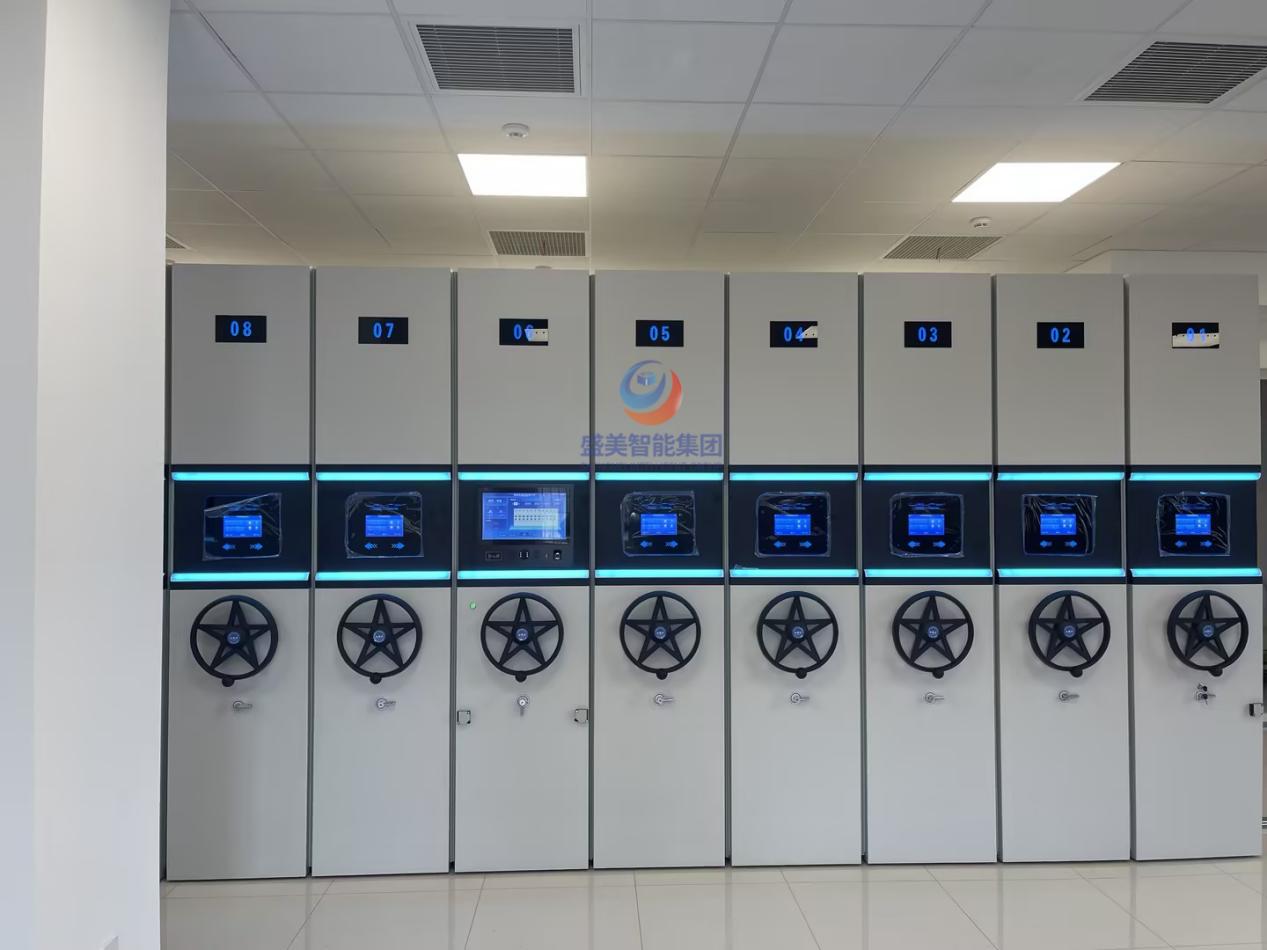
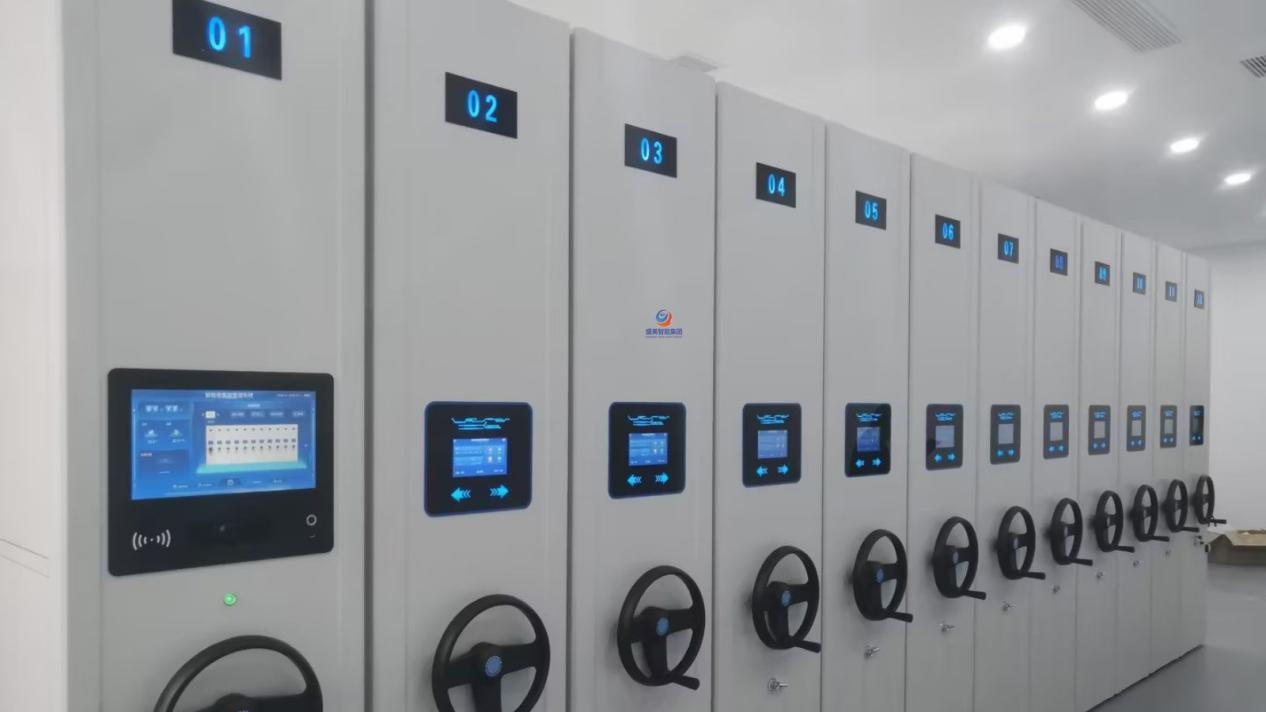
Numbered intelligent mobile compactors (cabinets 01–08) with integrated digital control panels, RFID positioning, and manual hand-crank backup, representative of compliant equipment shipped to high-density archive facilities. Photo used for visual reference only.Source: Shengmei Cabinet reference project — featured for design and configuration illustration.
2026 Core Compliance Tier Definitions for Archive Compactors
European and American archive authorities, customs coding systems, and OSHA site-safety rules are aligned: in new, renovated, or upgraded archive facilities, the three classes of mobile high-density storage equipment belong to entirely different compliance categories. Their certification systems, access thresholds, and on-site acceptance standards are NOT interchangeable — a hard, non-negotiable technical prerequisite in EU/US public tenders. The most common supplier mistake: declaring all three types as "shelving," mixing generic certificates, and downgrading safety standards — zeroing out project compliance.
Manual Compactor Shelving
Industrial Manual Mobile Storage Machinery
Purely mechanical heavy-load storage: no motors, no electronic controls, no automatic operation, no smart sensing — carriage movement via hand-crank transmission only. Assessed solely on mechanical structural safety, load stability, and anti-tipping design. No electrical or functional-safety compliance applies. Suitable only for small non-classified repositories and low-frequency access scenarios.
Electric / Powered Mobile Shelving
Industrial Low-Voltage Electromechanical Equipment
Mechatronic mobile storage with drive motors, control enclosures, and automatic open/close systems for powered carriage positioning. Must simultaneously satisfy three baseline compliances: mechanical safety, electrical safety, and electromagnetic compatibility. Passing inspection with mechanical certificates alone is prohibited. Suited to medium-sized conventional archive rooms.
Smart Compactor Shelving
Programmable Safety-Related Electromechanical System
High-end intelligent equipment with digital control, RFID positioning, software-hardware linkage, remote O&M, and intelligent safety interlocks. Reclassified in 2026 as a "programmable safety-related electromechanical system." Beyond mechanical, electrical, and EMC credentials, ISO 13849 functional-safety levels and programmable-control safety audits are mandatory — the only admitted class for national archives, classified repositories, and flagship university collections.
2026 Official Compliance Matrix — Three Compactor Classes

A concise visual contrast of how Manual, Electric, and Smart compactors differ across five compliance dimensions: mechanical safety, electrical compliance, functional safety, audit traceability, and customs credentials. Smart Compactor is the only class that is fully compliant across all five dimensions. The matrix table below provides the full English reference.
| Equipment Type | EU Mechanical Safety | Electrical | EMC | Functional Safety | Typical Archive Use Case |
|---|---|---|---|---|---|
| Manual Compactor Shelving | EN 15095 basic mechanical | Not required | Not required | No PL/SIL | Small non-classified rooms, temporary storage, low-frequency areas |
| Electric Mobile Shelving | EN 15095 full mechanical | CE-LVD | CE-EMC | No mandatory PL | Mid-size conventional rooms, public records, medium-frequency access |
| Smart Compactor Shelving | EN 15095 heavy-load full | CE-LVD full system | CE-EMC smart-system | ISO 13849 PL-d mandatory | National archives, classified records, university collections, judicial & financial repositories |
EU Mandatory Compliance System for Smart Compactors
The EU enforces the world's strictest archive-storage safety regime. As of 2026, generic certificates, borrowed credentials, expired certificates, and mismatched model certificates are disqualified outright from both customs clearance and acceptance. Smart Compactor Shelving in archive facilities is subject to a five-dimensional mandatory audit — mechanical + electrical + EMC + functional safety + system risk assessment. Any missing dimension renders the equipment non-compliant.
Mechanical Safety EN 15095
The foundational EU access threshold for mobile storage: structural load capacity, rail wear, anti-tipping limiters, anti-pinch mechanical design, hand-crank transmission safety, shelf deformation thresholds, and full-machine stability. Unlike ordinary racking standards, EN 15095 defines dedicated duty cycles for mobile heavy-load archive storage — no deformation, no tilting, and no jamming under fully loaded dynamic push-pull is a hard requirement. Every smart compactor must carry a complete EN 15095 test report and certificate matching its exact model.
Low-Voltage Electrical Safety CE-LVD
Smart compactors integrate PLC control, touch terminals, RFID sensing, motor drives, and sensor alarms — squarely low-voltage electrical equipment. The LVD mandates insulation compliance, complete protective earthing, dielectric withstand tests, and effective short-circuit/overload protection for every electrical component. Ad-hoc assembled electrical parts and uncertified generic control modules are prohibited; the electrical certificate must cover the complete system — individual component certificates never substitute for whole-machine compliance.
Electromagnetic Compatibility CE-EMC
Archive facilities house dense government IT equipment, servers, scanning terminals, and classified-signal devices. Electromagnetic interference can cause control failure, positioning drift, unintended opening/closing, and data corruption. EMC requires both immunity to external interference and emissions within limits so the compactor never disturbs other room systems — a mandatory acceptance item for every EU/US digital archive facility.
Functional Safety ISO 13849 PL-d
The core compliance barrier separating smart from electric and manual compactors. With auto-positioning, intelligent tier detection, automatic aisle creation, and unattended operation logic, a smart compactor is a safety-related control system. The EU mandates Performance Level d: full risk assessment, safety-circuit testing, and verified fault self-diagnostics, ensuring instant stop-and-lock on signal anomalies, sensor failure, or program faults — eliminating pinch, crush, and collapse accidents. Smart equipment without PL-d is categorically barred from EU archive projects.
Declaration of Conformity DoC + Technical File
Every smart compactor exported to the EU ships with a manufacturer-signed Declaration of Conformity stating full model, applied standards, safety level, and batch information — backed by a complete technical file: mechanical structure drawings, electrical schematics, system logic diagrams, risk assessment report, and test ledgers, available to customs and owner auditors on demand at any time.
US Compliance System: OSHA + NFPA + UL
The US does not recognize CE certification. Instead it enforces an even stricter regime of on-site safety, electrical fire prevention, and occupational protection built on three pillars — OSHA occupational safety, NFPA electrical fire codes, and UL component certification — emphasizing field-verifiable safety, equipment fault tolerance, failure protection, and worker safety. These are the mandatory acceptance basis for federal and state archives, public universities, and judicial records centers.
Focuses on anti-collision, anti-pinch, emergency-stop interlocks, personnel-sensing pause, and mechanical limit protection during automatic operation. US site inspections have zero tolerance for unannounced automatic movement, failed safeguards, or sensor blind spots — every smart action requires multiple redundant protections, and staff must be able to cut full machine power instantly.
Given the flammable paper archives these rooms hold, NFPA requires overload protection, short-circuit fusing, leakage alarms, flame-retardant wiring, and dust/moisture-insulated cabinet design — eliminating electrical heat, aging wiring, and short-circuit fire risk to protect massive paper collections.
Core electrical components — motors, controllers, sensor modules — must carry UL certification. Uncertified non-standard electronic parts are prohibited, guaranteeing long-term continuous-run stability and safety. UL listing is the default access threshold in US public procurement tenders.
10-Year Compliance Risk Cost Comparison

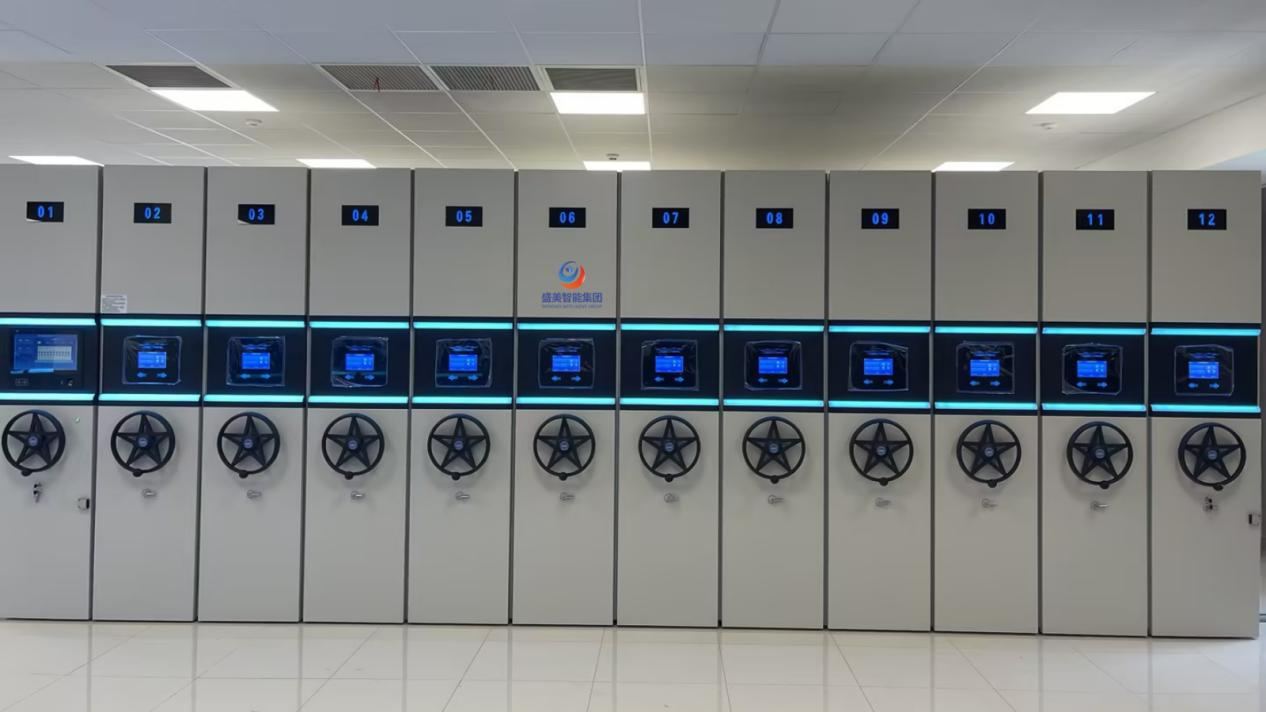
Long-row intelligent mobile compactor installation (cabinets 09 and beyond) with centralized digital control panels, redundant manual hand-crank overrides, and per-bay position indicators. Representative of fully compliant equipment specified for national-level and large-institution archive projects.Source: Shengmei Cabinet reference project — featured to demonstrate the scale of compliant installations typical of EU/US public archive tenders.
| Compliance Approach | Upfront Cost | Annual Rectification Risk | Annual O&M Failure Cost | 10-Year Total | Compliance Status |
|---|---|---|---|---|---|
| Retrofit "smart" low-spec (no PL-d, incomplete certificates) | Low | High — seizures, returns, audit rectification | Extreme — system failures, positioning errors, safety hazards | Extremely high | Non-compliant · fails official annual review |
| Standard EU/US compliant smart compactor (full credentials + PL-d) | Mid-to-high | Eliminated | Minimal | Low | Fully compliant · audit-ready long-term |
Eight High-Frequency Compliance Failure Modes
Drawn from thousands of EU/US customs and project-acceptance records (2024–2026), these are the eight disqualifying triggers most likely to veto a smart compactor export — the core landmines every overseas tender response must neutralize clause by clause.
Certificate–Equipment Mismatch
Reusing generic template certificates, old-model certificates, or other-batch certificates. When customs or auditors find parameter mismatches, credentials are declared void on the spot.
Missing ISO 13849 PL-d
Substituting ordinary electrical certificates for smart-system safety credentials — the single most common fatal rejection in EU/US national archive projects.
Retrofitted Patchwork Systems
Third-party touchscreens, bolt-on smart modules, non-native linkage systems — no holistic risk assessment or system certification, failing programmable-equipment compliance.
Uncertified Electrical Parts
Ad-hoc non-standard control components, uncertified motors, unlabeled sensor modules — automatically rejected under US NFPA and EU LVD review.
Degraded Mechanical Safety
Omitting anti-pinch interlocks, dual limit stops, or anti-tipping structures — failing EN 15095 dynamic load testing.
Bilingual Document Chaos
Mismatched parameters between Chinese and English reports, translation errors, outdated versions — triggering invalid-documentation rulings.
Downgraded Category Declaration
Declaring smart compactors as ordinary electric equipment, concealing intelligent control and automatic operation — classified as fraudulent declaration.
No Complete Technical File
Missing schematics, risk assessments, fault-logic descriptions, or O&M safety manuals — failing EU/US engineering audit outright.
Compliance Delivery Checklist — Paste Directly into Your SOW
EN 15095 full mechanical certification and complete test report — model, parameters, and batch matching shipped equipment 100%.
CE-LVD low-voltage certification, whole-machine electrical schematics, insulation test report, and protective-earth verification.
CE-EMC certification, immunity test report, and machine-room electromagnetic compatibility statement.
ISO 13849 PL-d functional safety certification, whole-machine risk assessment, safety-circuit test data, and fault self-check logic.
US-market package: UL electrical certification, NFPA fire-compliance statement, and OSHA task-safety adaptation file.
Official English DoC, manufacturer credentials, certificate of origin, and batch traceability records.
Full bilingual technical documentation — unified parameters, current versions, zero translation discrepancies.
On-site safety acceptance pack: O&M safety manual, fault-handling SOP, and annual-review adaptation ledger.
High-Frequency FAQ — EU & US Archive Facilities
If the equipment has automatic operation, intelligent sensing, or system self-control logic, PL-d is mandatory regardless of project size — there is no exemption path in either the EU or the US. Only purely mechanical Manual Compactor Shelving with zero electronic control is exempt from functional-safety certification.
Never. Electric / Powered Mobile Shelving carries no smart-system risk assessment and no programmable safety circuits — its compliance grade cannot cover smart-equipment risk. This is a textbook credential mismatch and will be rejected at acceptance.
No. Retrofitted patchwork systems lack whole-machine certification, system risk assessment, and native safety interlocks. They are non-standard modified equipment, and EU/US public archive projects prohibit them outright.
Credentials do not transfer and standards do not interoperate. The EU runs on the CE + EN + ISO system; the US runs on OSHA + NFPA + UL field codes. Exports must be supported by a complete, region-specific compliance package.
Need certification documents, test-report templates, or a smart compactor quotation?
Our compliance team will respond within one business day with region-specific documentation packages.
【Smart Compactor Inquiry】+ Company / Institution Name + Brief Requirement
Disclaimer. All compliance standards, grade requirements, and acceptance clauses in this article apply to new and renovated EU/US archive facility projects. Local municipal and archive tender rules may impose additional differentiated requirements. Final equipment parameters and credential lists are subject to the project tender documents and the latest official regulations of the destination jurisdiction.