SM BUYER PLAYBOOK · VOL. 02 · 2026 SAFETY
Compactor Shelving Safety Architecture 2026: The 7-Layer Anti-Pinch Stack That Decides Whether You Get Sued (Or Not)
A pinched finger in a compactor shelving aisle is not a workplace accident. In 2026, with the legal standard shifted from "did the lock work?" to "did the engineered safeguard meet the recognised state of the art?", it is a 7-layer engineering failure. The reason a single incident can drag a 60-year-old company into a 7-figure settlement is that the plaintiff's lawyer walks into court with the IEC 62061 / ISO 13849 standard in one hand and the supplier's glossy brochure in the other — and the brochure has nothing on those pages. This playbook fixes that.
Why "Compactor Shelving Safety" Is Now a Legal Term, Not a Marketing One
Until roughly 2018, "anti-pinch" on a compactor shelving quote was a checkbox. A rubber strip on the moving column face and a buzzer counted. In 2026, the same checkbox reading on a quote is a liability admission, because three things changed in parallel:
- Functional safety standards matured. ISO 13849-1 and IEC 62061 now classify mobile shelving drives under Performance Level (PL) or Safety Integrity Level (SIL) ratings. A spec sheet that does not name the rating is, in audit terms, an admission that the rating has not been engineered.
- Plaintiff counsel learned the standards. The legal discovery process routinely pulls the supplier's installation manual, the maintenance log, and the operator training records. A missing entry on any of those documents is admissible as evidence of negligence.
- Insurance underwriters repriced the risk. A 2025 commercial property policy with a mobile shelving endorsement now asks for the PL/SIL rating of the anti-pinch system. If the answer is "we don't know," the policy loads 15–40 basis points onto the premium — or excludes the loss entirely.
The supplier that cannot produce a 7-layer safety architecture, with each layer mapped to a specific standard and a specific alarm, is not the cheap supplier. They are the expensive supplier — they just deferred the invoice to the litigation department.
The Anatomy of a Compactor Shelving Injury (What the Failure-Mode Tree Looks Like)
To choose the right safeguard, you first have to map the failure mode. The seven failure modes that actually produce injuries in compactor shelving aisles, in order of frequency:
- Crush at the column face — operator's hand or foot caught between the moving column and the fixed column. Most common injury type.
- Trapping in the aisle — second operator inside the open aisle when a third operator (or a misfiring touch panel) closes it from outside.
- Shear at the wheel groove — finger or foot pulled into the wheel-track channel as the carriage starts to move.
- Tip-over — over-loaded single column collapses onto the aisle. Rare but catastrophic.
- Falling shelf content — soft-start missing; abrupt acceleration throws the top-shelf archives off.
- Electrical contact — operator reaches into the control panel area while the system is energised.
- Lock override abuse — physical override key used outside the documented emergency procedure.
Each of these seven failure modes is defeated by a different engineering layer. No single layer defeats more than three. A 7-layer stack is the minimum architecture that defeats all seven — which is why the "7-layer anti-pinch stack" is not marketing. It is machine guarding arithmetic.
The 7-Layer Compactor Shelving Safety Architecture
1Mechanical Anti-Squeeze Strip
Defeats failure mode: crush at the column face.
A pressure-sensitive strip mounted on the leading edge of every moving column. When the strip is deformed by >5 mm, the controller cuts the drive within one control cycle (≤20 ms). It is the oldest layer in the stack and still the most reliable — purely mechanical, no software in the safety path.
What to ask the supplier: "What is the actuation force in Newtons, and what is the controller cut-off time?" If they cannot answer both, walk away.
2Infrared Fence at the Aisle Mouth
Defeats failure mode: trapping in the aisle.
A pair of infrared emitter/receiver columns at each end of every aisle. The moment the beam is broken, the controller enters "hold" mode and refuses any close command. Triple-beam is the 2026 minimum — single-beam is 2012 spec and can be defeated by a reflective surface or a leaning operator.
What to ask the supplier: "How many beams per fence, and what is the response time?" The right answer is "three beams, ≤30 ms." The wrong answer is "it has a sensor."
3Motor Current Feedback (Electronic Anti-Pinch)
Defeats failure modes: crush at the column face, shear at the wheel groove.
The controller monitors motor current every 10 ms. When the load jumps >30% above the per-rack baseline within 200 ms — the signature of a foreign object in the drive path — the controller cuts the drive within 80 ms. This layer catches what the mechanical strip misses: objects thinner than 5 mm, hands in gloves, or items the strip has rolled over.
What to ask the supplier: "Is the current threshold a fixed value or a per-rack learned baseline?" Per-rack learned is the only acceptable answer on a 60+ bay installation, because the empty-rack current is meaningfully different from the loaded-rack current.
4Photo-Electric Light Curtain
Defeats failure modes: crush at the column face, trapping in the aisle.
A vertical strip of cross-beam sensors running the full height of the moving column face. A 1,500 mm column should have a light curtain with at least 30 beams spaced ≤50 mm apart — finer than a finger. A photo-electric curtain is the photoelectric sensor-class solution, and it is the most expensive single layer in the stack. It is also the most legally defensible.
What to ask the supplier: "What is the curtain resolution and the safety rating (PL/SIL)?" A curtain rated PL c is acceptable for non-EU deployments. EU and CE deployments require PL d or higher, per ISO 13849-1.
5Soft Start / Soft Stop
Defeats failure mode: falling shelf content.
The motor accelerates from 0 to rated speed over a configurable ramp (typically 1.5–3.0 seconds) and decelerates symmetrically. A carriage that lurches into motion at full torque can throw the top-shelf archives off; the resulting cleanup is a worker-compensation claim even if no one is in the aisle. Soft start/stop is the layer that prevents the indirect injury.
What to ask the supplier: "Is the ramp configurable, and what is the default ramp time?" Configurable is correct. A fixed 0.3-second ramp is not engineering; it is a marketing compromise.
6Anti-Tilt Detection
Defeats failure mode: tip-over.
A tilt sensor mounted on the bottom chassis of each moving rack. When the rack deviates from vertical by more than 0.5° (configurable), the controller immediately cuts drive and triggers a tip-over alarm. This layer is invisible 99.99% of the time, but on the day an operator loads 1,200 kg on a 600-kg-rated shelf, it is the layer that prevents the headline.
What to ask the supplier: "What is the tilt threshold, and is the threshold per-rack configurable?" Per-rack matters because a tall column (2,300 mm) has a different baseline tilt envelope than a short one (1,800 mm).
7Physical Emergency Stop
Defeats failure mode: all of the above (last line of defence).
A red mushroom-head button on every fixed-side master panel and every moving column face. Pressing the button must physically break the 24 V DC bus, not just send a software "pause" command. The distinction matters: a software pause can be ignored by a buggy firmware update; a broken power bus cannot. After an e-stop, the carriage must be re-armed by an authorised operator with a recorded reason code.
What to ask the supplier: "Is the e-stop a hardware break or a software flag, and is the re-arm event logged?" Hardware break and logged re-arm are the only two correct answers.
The 8 Standard Alarms: What Each One Tells the Safety Officer
Beyond the seven physical layers, every intelligent compactor shelving controller surfaces a set of named alarms. Recognising each one is the difference between a 5-minute reset and a 5-hour root-cause investigation.
| Alarm | Trigger condition | Operator response |
|---|---|---|
| Squeeze alarm | Mechanical strip or motor current spike | Visual inspect, clear obstruction, unlock to resume |
| Timeout alarm | Carriage ran continuously longer than the configured threshold | Check for stalled rack, recalibrate threshold if loading pattern changed |
| Fence alarm | Infrared fence broken for > 2 s without an authorised close command | Investigate the aisle, verify no personnel trapped |
| Motor fault alarm | Drive current outside ±15% of learned baseline for > 30 s | Lock the rack, call service — do not bypass |
| Tilt alarm | Rack tilt exceeds configured threshold | Stop all operations in the block, redistribute load |
| Over-range alarm | Carriage travelled past the soft limit switch | Manual rehome procedure, then re-calibrate |
| Communication-loss alarm | Carriage controller lost link to master for > 5 s | Check cabling, then call service if persistent |
| Door-open alarm | End-fixed column face panel opened without authorised access | Investigate immediately — possible tamper event |
The single biggest red flag on a 2026 quote is a controller that lists fewer than these eight alarms. If the spec sheet says "anti-pinch alarm" without naming the seven others, the controller is a 2012 vintage at best, and your safety officer will be the one explaining that to a jury.
The Language Safety Officers Speak: PL and SIL Ratings
When your safety officer asks the supplier for "the PL rating on the anti-pinch function," they are using a vocabulary defined in ISO 13849-1 and IEC 62061. Both standards classify the reliability of a safety function. The mapping is roughly:
| Performance Level (ISO 13849-1) | SIL (IEC 61508) | Acceptable for compactor shelving anti-pinch? |
|---|---|---|
| PL a | — | No. Insufficient for personnel safety. |
| PL b | SIL 1 | Marginal. Acceptable only for low-traffic installations. |
| PL c | SIL 1 | Acceptable for non-EU installations with low access frequency. |
| PL d | SIL 2 | 2026 minimum for EU/CE deployments — and best-practice everywhere else. |
| PL e | SIL 3 | Best-in-class. Required for installations in some regulated industries. |
A supplier that says "our system is safe" without naming a PL or SIL rating has not done the engineering exercise. A supplier that says "PL d on the anti-pinch function" has — and you can write the rating into the purchase contract.
The Lawsuit Math: What a Cheap Anti-Pinch System Actually Costs
To make the 7-layer stack tangible, here is a worked example for a 60-bay intelligent compactor shelving installation in a US-based records facility, single plaintiff, 2025 settlement benchmarks:
| Cost line (USD) | Single-beam IR + buzzer (cheap) | 7-layer stack, PL d |
|---|---|---|
| Up-charge on capex (per bay) | 0 | ~180 |
| Up-charge on a 60-bay install | 0 | 10,800 |
| Annual insurance premium loading (15-40 bps) | ~1,800 / yr | 0 |
| Expected litigation cost if an incident occurs (15% / yr probability × USD 350k average settlement) | 52,500 / yr | 3,500 / yr |
| 10-year expected cost (capex + insurance + expected litigation) | ~544,000 | ~45,800 |
The "cheap" safety stack is roughly 12× the total cost of the engineered one over a 10-year horizon. The capex delta is recovered in the first 8 months of the first year, and the rest is pure insurance against the day your safety officer gets the call that nobody wants to take.
The 10-Point Compactor Shelving Safety Inspection Checklist
Run this checklist quarterly. Print it, file the completed copies with your safety officer, and keep them for at least 7 years — that is the discovery window in most jurisdictions.
- Mechanical anti-squeeze strip is intact, clean, and triggers within 20 ms of > 5 mm deformation.
- Infrared fence at the aisle mouth has all three beams operational, with no reflective-surface bypass (visible scan check).
- Motor current feedback is calibrated to a per-rack learned baseline, not a fixed factory default.
- Photo-electric light curtain has no damaged beams; resolution is ≤ 50 mm across the full column height.
- Soft start / soft stop ramp time is between 1.5 and 3.0 seconds, and the value is documented in the maintenance log.
- Anti-tilt sensor is functional and the threshold is documented per-rack.
- Physical emergency stop button physically breaks the 24 V DC bus, and the re-arm event is logged with operator ID and reason code.
- All 8 standard alarms (squeeze, timeout, fence, motor fault, tilt, over-range, comm loss, door open) are enabled and have not been suppressed in the controller configuration.
- The PL or SIL rating of the anti-pinch function is documented in the purchase contract and matches the as-built configuration.
- Operator training records confirm every user has been trained on the alarm response procedure within the last 12 months.
How Shengmei's SM-ZN-MJJ Family Scores on the 7-Layer Stack
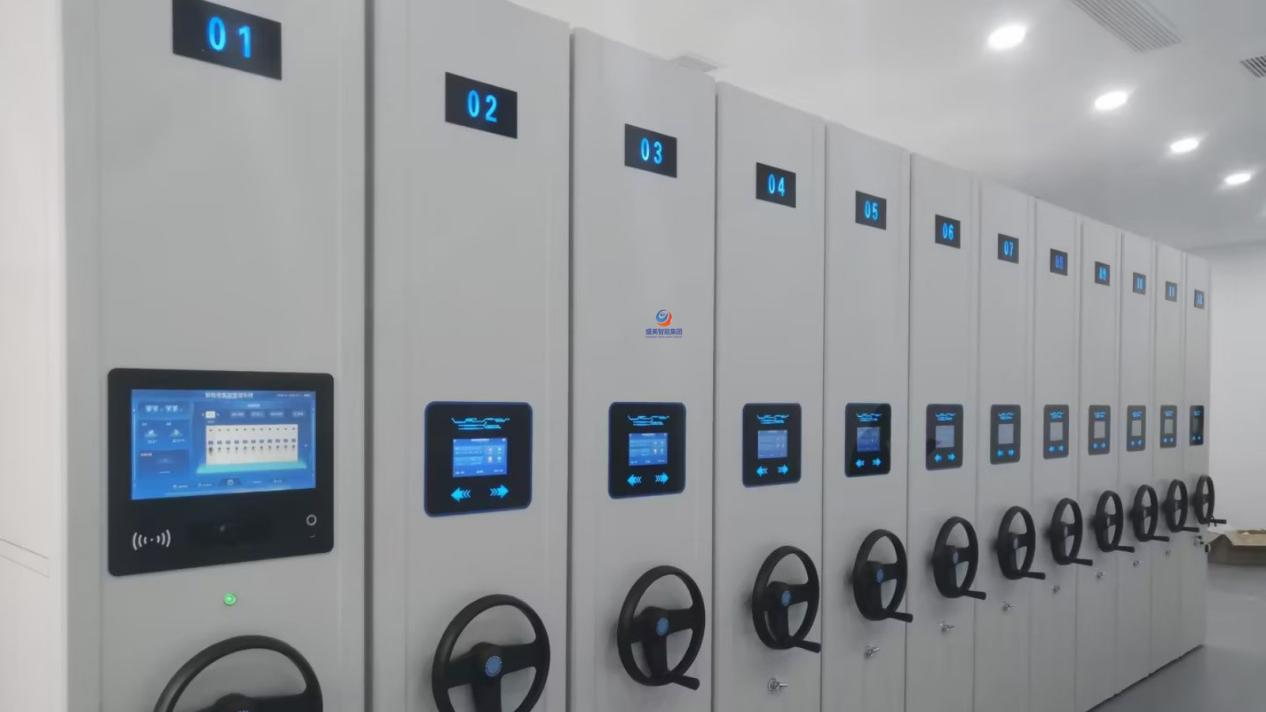
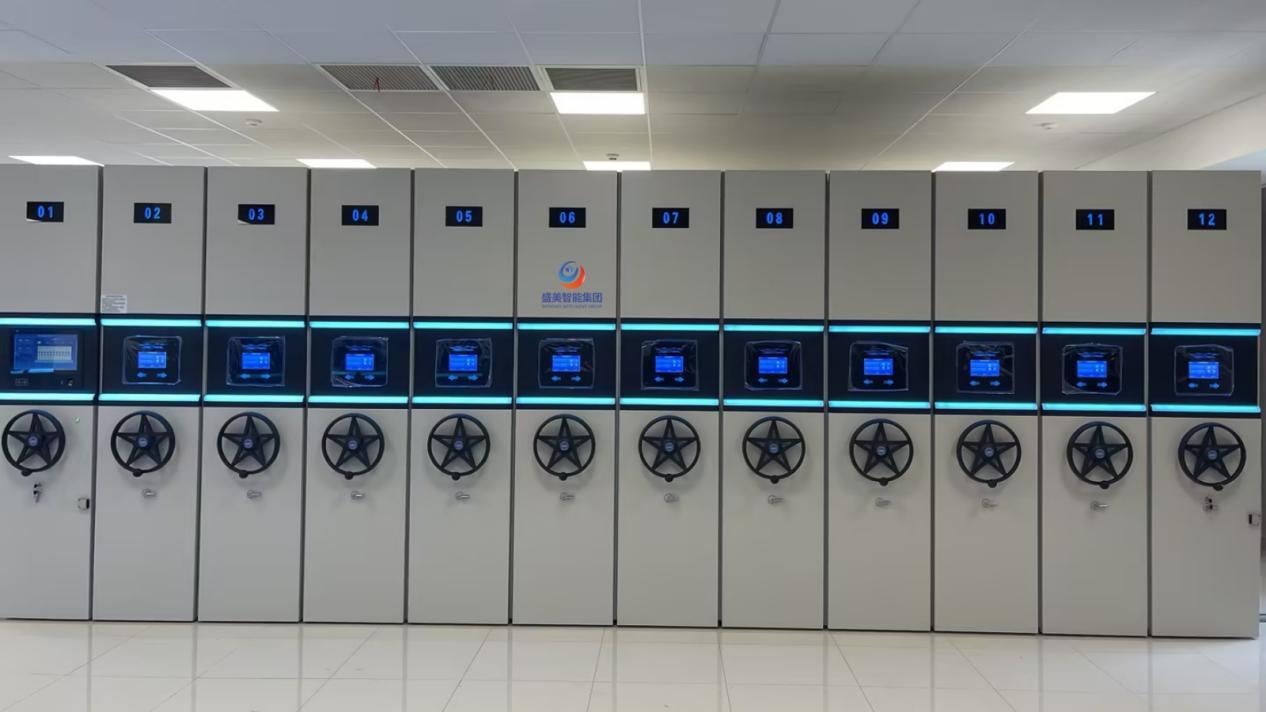
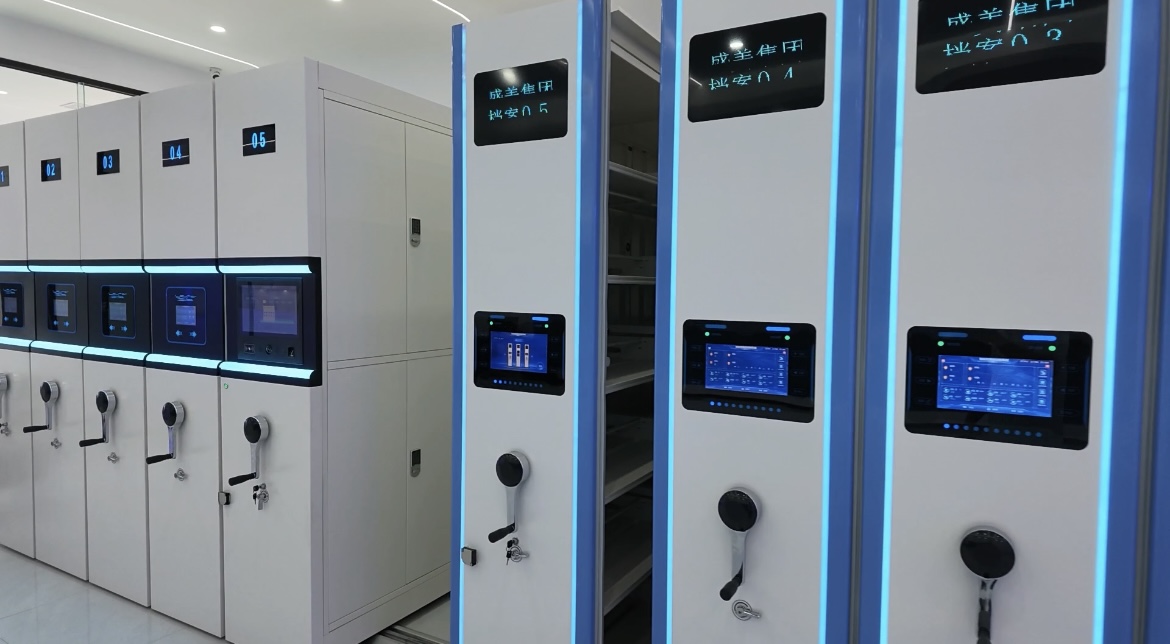
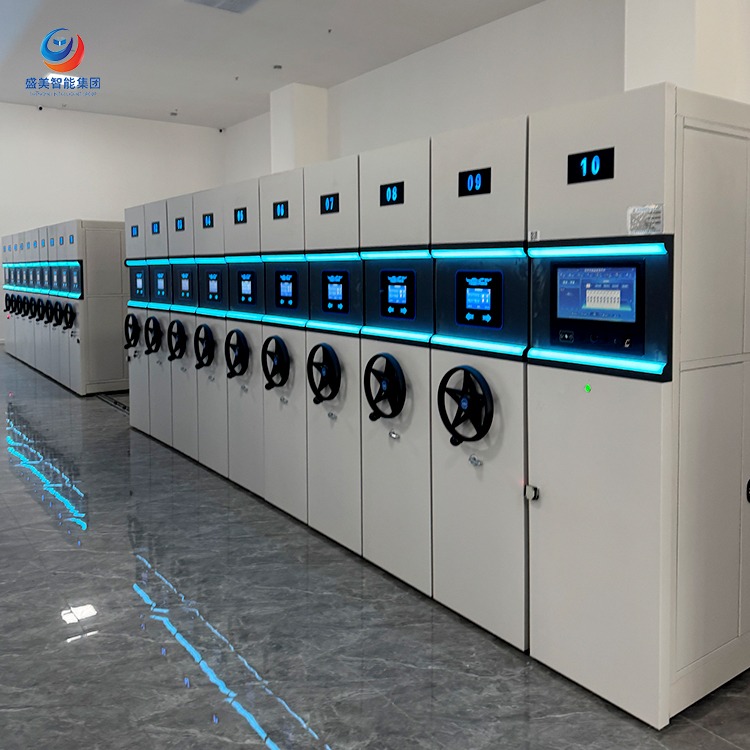
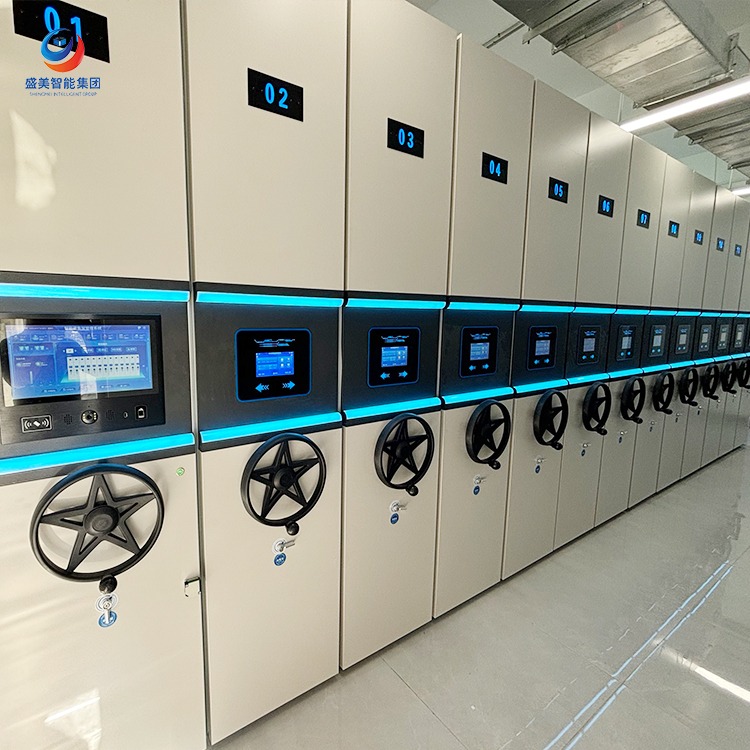
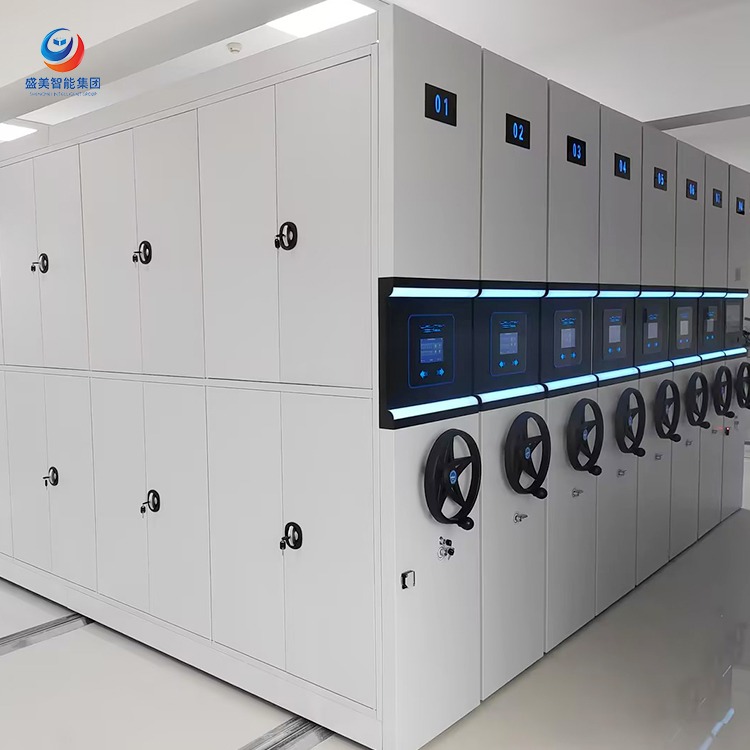
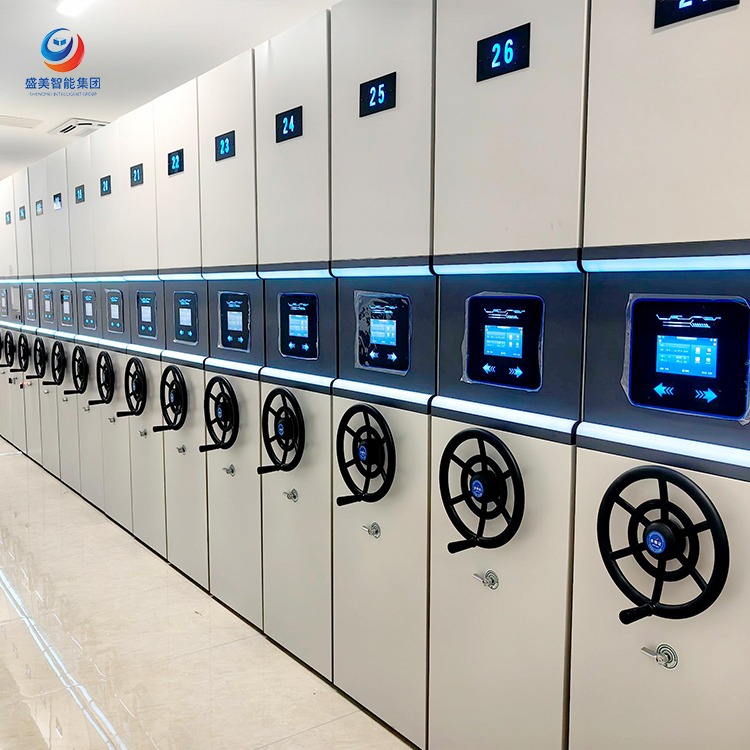
All seven layers ship as standard on the SM-ZN-MJJ-001 through SM-ZN-MJJ-014 series. The controller surfaces all eight standard alarms on the 10-inch touch screen, with full alarm history exportable to CSV via the 3× USB / 1× Ethernet / WiFi port array. The complete intelligent compactor shelving product line is documented on the SM-ZN-MJJ product page for the engineering spec; the safety architecture above is the standard configuration, not an upgrade.
The environmental monitoring side of the system (the 8-channel temperature / humidity / PM / TVOC stack) is covered separately in Vol. 01 of this series — "Smart Temperature and Humidity Monitoring: How Compactor Shelving Protects Valuable Archives." Read it if you are sizing the HVAC envelope around the safety envelope.
Frequently Asked Questions
Is a manual compactor shelving system required to have the same 7 layers?
No — and the supplier that tells you otherwise is upselling. A manual system has no motor, no controller, and no soft-start problem. The applicable layers on a manual system are #1 (mechanical anti-squeeze strip) and #7 (physical lock that prevents the carriage from drifting after the operator lets go). The other five layers either do not exist or are trivially satisfied by the manual design. The relevant safety standard for manual compactor shelving is the same ISO 13890 series, but the PL/SIL rating requirement drops accordingly.
What is the typical response time of the infrared fence on a Shengmei system?
≤ 30 ms from beam-break to drive cut. The triple-beam design means the controller will not register a beam-break from a single reflection or a transient obstruction — only a sustained, multi-beam interruption (which is what an actual intrusion looks like).
How do I prove to an auditor that the safety system was operational at the moment of an incident?
Every intelligent SM-ZN-MJJ controller maintains an append-only alarm history log. The log records every alarm trigger with a millisecond timestamp, the operator response time, and the resolution. The log is exportable to CSV, and it is write-once — there is no edit or delete path. This is the single most important document in the litigation discovery process, and it is the reason an intelligent system is structurally safer than a manual one even at the same PL rating.
Do I need a CE-marked compactor shelving system for an EU deployment?
Yes, if the system is electrically driven. CE marking under the Machinery Directive (2006/42/EC) is the legal requirement. The Declaration of Conformity must reference ISO 13849-1 (or IEC 62061) for the safety-related parts of the control system, and the anti-pinch function must be PL d or higher. A non-CE system in an EU deployment is not "non-compliant" — it is illegal.
What is the realistic maintenance cost of the 7-layer safety stack?
On a 60-bay intelligent installation, expect 4–6 hours of scheduled safety inspection per year, plus ad-hoc service calls for occasional sensor cleaning or recalibration. Annual cost is roughly USD 800–1,500 in technician time, plus USD 200–400 in consumables (sensor covers, button caps, indicator lamps). That is less than 0.5% of capex per year, and it is the single most defensible line item in the maintenance budget.
Get the Safety-Stack Audit Worksheet for Your Installation
Want a one-page safety-stack audit worksheet for your current or planned compactor shelving installation?
Send us your bay count, drive type (manual / electric / intelligent), and the jurisdiction you are deploying in (US / EU / APAC / Middle East). We will return a 7-layer safety stack mapped to your jurisdiction's specific standards — with the relevant PL or SIL rating called out per layer — and an indicative cost to bring an existing installation up to spec.
Email the Editorial Team WhatsApp Kerwin (+86 189 3280 1260)Disclosure: This article is published by SHENGMEI Cabinet (Hebei Shengmei Intelligent Group Co., Ltd.), a manufacturer and exporter of mobile archive storage equipment with 16+ years of production experience and customers in 40+ countries. The litigation and insurance figures cited in this article are conservative mid-market estimates derived from publicly available industry data and from our own export project records between 2018 and 2025; they are illustrative, not legal or actuarial advice, and your results will vary by jurisdiction, claim history, and operator training program.