Smart Compact Shelving Price: 2026 Cost Ranges & 6 Price Factors
- 01 The Complete 2026 Smart Compact Shelving Price Range
- 02 Steel Material & Plate Thickness
- 03 Drive System: Manual / Electric / Smart
- 04 Intelligent Function Modules
- 05 Surface Treatment & Anti-Rust Grade
- 06 Rails, Installation & Site Adaptation
- 07 Volume, Customization & Delivery
- 08 Why Identical Quotes Differ 100%
- 09 Procurement FAQ
- 10 Conclusion
Introduction
Whether you are outfitting a government archive, a corporate records room, a university library, or an overseas warehouse project, smart compact shelving price is the first question every procurement team asks. Many buyers comparing quotations discover a confusing spread: market quotes range from roughly USD $95 to over $200 per square meter, and it is hard to tell what configuration sits behind each number — or where the low-price, thin-spec traps are. Smart compact shelving is not a standardized commodity: its price is shaped by steel plate thickness, drive system, intelligent controls, function modules, coating standards, installation scope and customization. Drawing on 2026 market data, this guide breaks down the full smart compact shelving price range and every core cost factor, so buyers can read a quotation, separate high-spec from low-spec systems, and shut down inflated quotes and junk-grade low bids.

1. The Complete 2026 Smart Compact Shelving Price Range
Industry-wide, compact shelving is quoted per projected square meter — the standard for domestic and overseas engineering projects alike. The 2026 smart compact shelving price bands below include tax but exclude long-distance freight and special installation:
| Grade | CNY/㎡ | USD/㎡ | Best for |
|---|---|---|---|
| Economy manual compact shelving | 380–480 | ~$50–65 | Temporary stores, small warehouses, basic storage |
| Standard engineering manual | 480–600 | ~$65–85 | Government & corporate tenders, routine archive rooms |
| Electric semi-automatic | 600–850 | ~$85–120 | Mid-to-large archive rooms, mainstream commercial pick |
| Fully intelligent networked | 850–1200+ | ~$120–170+ | Smart archives, digital repositories, premium libraries, overseas high-spec projects |
Overseas export reference: the smart compact shelving price in USD sees standard intelligent models average USD $95–180/㎡; fully loaded smart systems can reach USD $200+/㎡, depending on configuration, packaging, certification and container volume.
Thin-gauge boards, basic hand-crank structure, simple coating, no intelligent system. Fine for temporary, low-frequency storage; weak durability, unsuitable for humid or heavy-use rooms.
Thicker SPCC cold rolled steel, full pickling-phosphating pretreatment, quiet hand-crank drive, solid rails — the usual government tender benchmark for conventional archive rooms.
Adds motor drive, one-touch open/close, overload protection and anti-pinch safety. Labor-saving with a low failure rate; the default choice for active archive rooms.
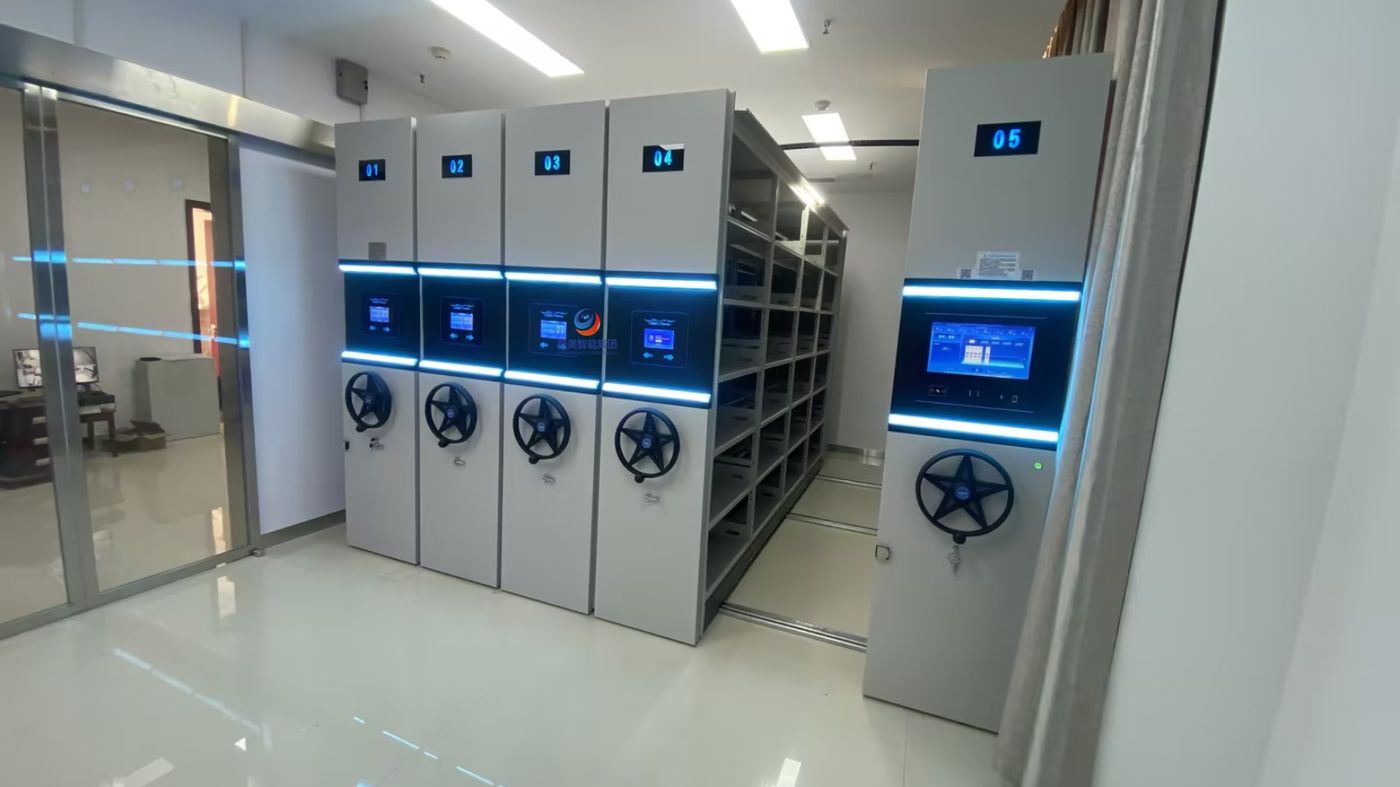
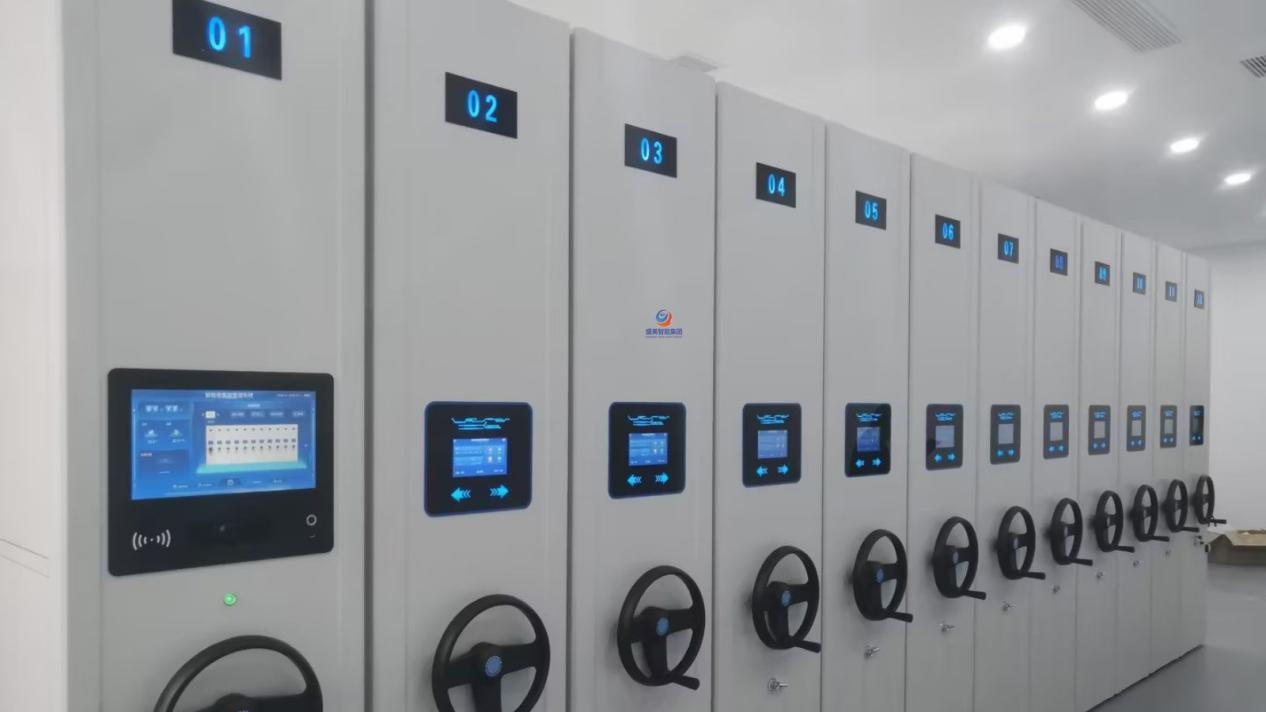
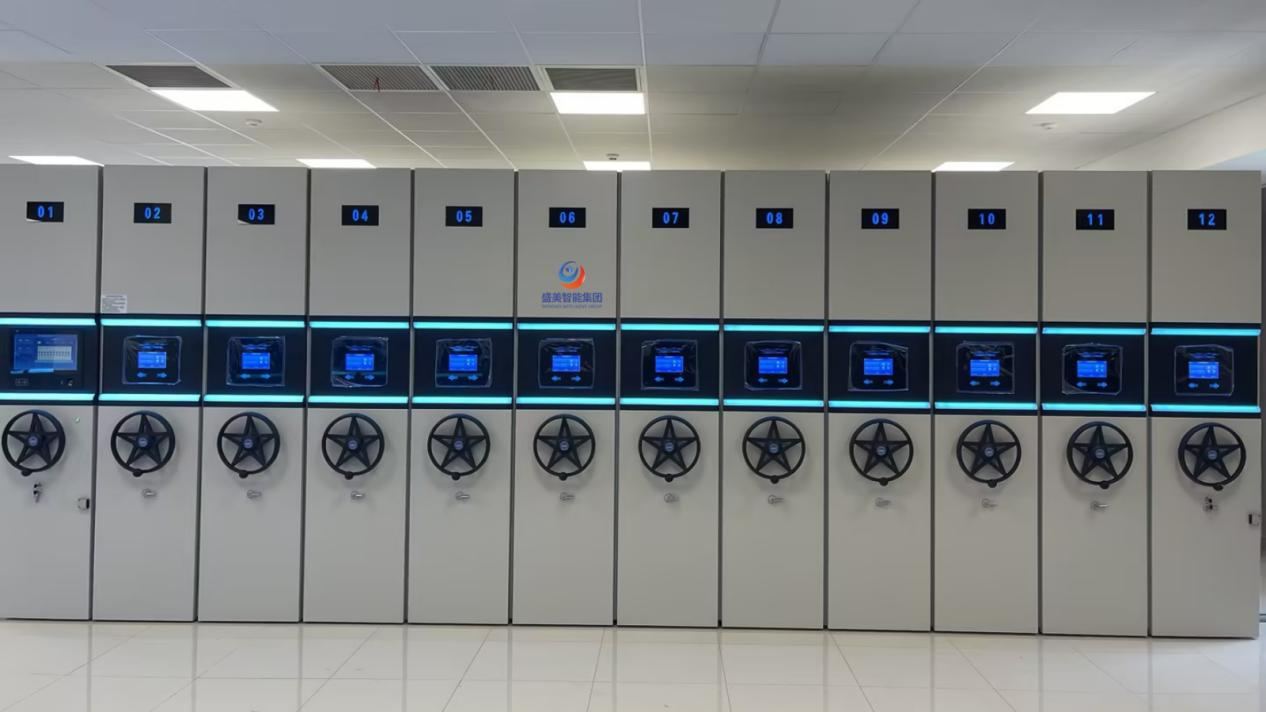
PLC control, PC linkage, archive retrieval, LED location lighting, temperature & humidity monitoring, automatic ventilation, remote control and RFID scan management.
2. Factor 1: Steel Material & Plate Thickness — the Base Cost
About 70% of a compact shelving system's cost is steel. Plate thickness and substrate quality are the root cause of price gaps — and the first place low-price products cut corners. Premium smart compact shelving uses genuine SPCC cold rolled steel: uniform, tough, deformation-resistant, with stable load performance. Cheap products use hot-rolled or mixed recycled steel that dents, rusts and twists.
Thickness moves the smart compact shelving price directly: the industry norm is 1.5 mm uprights and 1.2 mm shelves, and each additional 0.1 mm of plate raises unit cost by roughly 15%–20%. Low-price products thin out the uprights, shelves and back panels alike — they look identical until a full load makes them lean, wobble or sag. For a deeper dive into substrates and coatings, see our guide to cold rolled steel plate thickness and powder coating durability.

3. Factor 2: Drive System — Manual / Electric / Intelligent
The drive system is the sharpest price dividing line, and the manual versus smart compact shelving decision shapes budget more than any other choice:
Gears, chain and crank only. Fewest parts, lowest cost, near-zero failure rate — right for budget-tight rooms with light open/close frequency.
Pure-copper motors, reduction drive, limit switches, infrared anti-pinch and overload cutoff. Motor brand and wattage directly move both stability and price.
Full control stack — PLC mainboard, touchscreen, database and communication modules, sensor array — linked to PCs, phones and building systems. Highest intelligent premium and the norm for high-end projects.
Stepping from manual to electric typically adds 25%–40% to the unit price; stepping to full intelligent networking roughly doubles the base manual figure — the single largest jump in the smart compact shelving price ladder.
4. Factor 3: Intelligent Function Modules
Same cabinet, different modules — quotes can differ by more than 30%. Intelligent modules are optional add-ons: the more functions and sensors, the higher the smart compact shelving price. Mainstream paid modules include:
Aisle and shelf-level lights auto-illuminate the exact bay you open; doubles as an anti-pinch visibility aid.
Detects people inside the aisle, locks movement and prevents pinch or collision injuries.
Temperature and humidity sensors trigger automatic ventilation and dehumidification cycles to protect paper records.
Scan-based file identification, automatic stocktaking and low-stock or misplaced-file alerts.
PC and mobile linkage, cloud management, data backup and multi-terminal operation logs.
Aisle light locking, automatic fault alarms and complete operation logging for compliance audits.
A base intelligent model keeps electric open/close and simple protection; a full smart archive integrates the whole module set — and the budget rises accordingly.
5. Factor 4: Surface Treatment, Anti-Rust Standard & Durability Grade
Compact shelving is long-service indoor equipment: process standards decide service life and pull the smart compact shelving price apart. Low-price products skip pretreatment steps — fine for a season, then paint peeling, rust spots and delamination appear within 1–2 years.
The full engineering-grade process: degreasing → pickling → phosphating/passivation → electrostatic powder coating → high-temperature curing. Proper phosphating locks the coating onto the steel for strong adhesion and moisture/rust resistance — essential for humid southern regions, coastal high-salt environments and overseas tropical projects. Export projects may also require salt-spray testing and anti-corrosion reports, which further raise process cost and product stability.
6. Factor 5: Rail Structure, Installation & Site Adaptation
Many buyers compare only cabinet unit prices and ignore rails and installation — then the total blows past budget. Simple rails are bent thin-steel tracks for flat floors: cheap but basic. Engineering-grade rails use thicker steel, double limit stops and anti-derailment structure: heavier loads, quiet travel, no jamming — and a higher price. Site conditions also move the final smart compact shelving price: floor leveling, non-standard room dimensions, irregular-space customization, high-rise carrying, and overseas on-site installation and commissioning all add labor and consumable costs. Before signing, review our hidden cost checklist for compact shelving projects so nothing lands outside the contract.
7. Factor 6: Order Volume, Customization & Delivery Terms
Compact shelving is bulk engineering equipment: bigger orders earn lower unit prices; small, scattered or custom-shaped orders price higher.
Whole-room bulk orders amortize design, tooling, logistics and labor costs for the best smart compact shelving price; small orders pay a premium.
Standard dimensions are cheapest. Extra-tall or extra-wide units, special dividers, reinforced load ratings, special colors, silkscreened logos and fire/moisture upgrades all carry premiums.
Domestic cartons are cheap; export shipments need reinforced corner protection, EPE foam, export wooden crates, container-rated seaworthy packing, multilingual manuals and full certification documents.
Unit price is one line of the story. Our compactor shelving TCO playbook walks through the full cost of ownership over 10+ years.
8. Buyer's Alert: Why Identical-Looking Shelving Quotes Differ by 100%
"Identical appearance, double the price" happens because low bids sell looks while serious bids sell the parameters and standards that justify a higher smart compact shelving price. Common low-price tricks:
The paint film adds 0.05–0.1 mm; the actual steel underneath is one grade thinner than the contract says.
Spray directly on unprepared steel and the coating peels within two years, especially in humid climates.
Unknown-brand drives and low-grade sensors fail early and are impossible to match for spares.
Modules removed to hit a price point can rarely be added back later — the platform is not upgrade-ready.
The real way to save money is not chasing the lowest number — it is transparent parameters, standard processes, explicit configuration and contract-locked acceptance criteria, so you avoid the hidden costs of rework, replacement and after-sales repair. Our field guide to 7 common pitfalls in compact shelving procurement covers each trap in detail.

9. Procurement FAQ
How much is smart compact shelving per square meter?
2026 market reference: economy manual 380–480 CNY/㎡, standard engineering manual 480–600 CNY/㎡, electric 600–850 CNY/㎡, fully intelligent networked 850–1200+ CNY/㎡ — the full smart compact shelving price ladder varies with plate, system, functions and project scope.
What factor moves smart compact shelving price the most?
Three above all: steel thickness & material, electric/intelligent system configuration, and surface anti-rust treatment. Then module count, rail standard, customization and order volume.
Why is the gap between manual and intelligent models so large?
Intelligent models add motor drive, control mainboard, sensor arrays, control systems and safety modules — higher hardware, R&D, commissioning and after-sales costs all compound into a much higher unit price.
Why do export quotes run higher than domestic ones?
Export requires export-grade packaging, multilingual documentation, full certification reports, stricter anti-corrosion processes, container-optimized seaworthy packing and standardized QC — every line adds real cost.
10. Conclusion
The wide smart compact shelving price range reflects real differences in material, process, system, function and engineering standards — not cosmetics. Compare quotes against plate thickness, drive type, intelligent modules, anti-rust process, rail configuration and acceptance criteria, never the unit number alone. The optimal 2026 playbook: standard electric models for conventional rooms, fully intelligent networked systems for high-spec smart archives, and premium process plus full certification for export projects — buying the lowest long-term operating cost, not the lowest sticker price.
Need a Precise Quote for Your Project?
Need a whole-room smart compact shelving plan, a precise per-square-meter smart compact shelving price, dimension calculation, export parameters or certification packages? Shengmei Cabinet supports archive rooms, libraries and warehouse projects worldwide with free technical consultation and budgeting.
📧 Email: info@shengmeicabinet.com | 💬 WhatsApp: Kerwin +86 189 3280 1260
Email subject format: Smart Compact Shelving Inquiry + Room Area + Project Type + Country/Region