Smart Compactor Shelving Maintenance: Common Faults & Daily Care Guide (Overseas Edition)
Introduction: Why Systems Age Before Their Time
A smart compactor shelving system is the core heavy-duty intelligent storage asset of any modern archive room. Unlike ordinary furniture, it integrates mechanical transmission, motor drive, intelligent electronic control, infrared sensing and a sealed anti-corrosion structure — a high-precision system built for long-term continuous operation. Many overseas archive projects suffer premature aging, frequent breakdowns and early scrapping not because of product quality, but because a standardized smart compactor shelving maintenance routine is missing. Long-term full-load running, dust buildup, moisture attack, rail fouling, dust-blind sensors and dry motors all lead to jamming, drift, abnormal noise, failure to close, electrical errors and failed anti-pinch protection — disrupting operations and driving up O&M cost.
This guide organizes the complete fault set, rapid troubleshooting and standardized smart compactor shelving maintenance routines for both staffed archive rooms and unattended overseas smart archives. For field-level quick fixes, pair it with our daily maintenance and common fault solutions for overseas archive compact shelving.

1. Why Smart Compactor Shelving Maintenance Must Be Standardized
Many buyers assume the system is maintenance-free once installed. In reality it is a hybrid "mechanical + electrical + intelligent" system: long-term running inevitably produces wear, dust, oxidation and aging — scheduled care is mandatory.
- Cut failure rate and downtime. Regular cleaning, lubrication and calibration prevent over 90% of common faults, keeping the archive room running all year.
- Extend service life dramatically. A properly maintained system runs reliably for 15–20 years; neglected units show severe wear, rust and circuit aging within 5–8 years and get scrapped early — see which core components determine the service life of mobile compactor shelving.
- Keep the archive safe and compliant. Anti-pinch, anti-collision and overload protection must stay effective — periodic O&M satisfies domestic and overseas safety audit standards.
- Save after-sales and replacement cost. A smart compactor shelving maintenance plan is cheap to run; motor replacement, rail renovation, control-board repair and full de-rusting are expensive. Prevention is the highest-ROI equipment strategy.
2. Rail & Travel System: 4 Common Faults and Fixes
Rails and travel wheels are the load-bearing and motion core — and the most fault-prone part of the system. Most jamming, drift and noise originates here, so rail care is week-one material in any smart compactor shelving maintenance manual.
Fault 1 — Jamming / stiff movement
Causes: dust, grit and debris in the rails, worn wheels, slight rail deformation, objects stuck underneath. Fix: clean rail grooves thoroughly, wipe contact surfaces, grease wheel bearings, fine-correct minor deformation; never strike rails with hard objects.
Fault 2 — Running noise / friction sound
Noise is the earliest audible warning in smart compactor shelving maintenance: treat it as a service call, not a quirk.
Causes: dry bearings, rusty rails, eccentric wheel wear, slight tilt. Fix: remove rust, apply dedicated silent grease, replace badly worn wheels, re-level the bays.
Fault 3 — Drift / misalignment / poor closing
Causes: uneven wheel wear, installation deviation, long-term one-side loading, uneven full load. Fix: adjust wheel spacing and balance, distribute archives evenly, re-calibrate rail parallelism.
Fault 4 — Bay stuck / completely immobile
Causes: a large object wedged in the rail, a derailed wheel, seized bearing, severe deformation. Fix: power off, clear foreign objects, reset the wheels; severe deformation requires professional rail correction or part replacement.

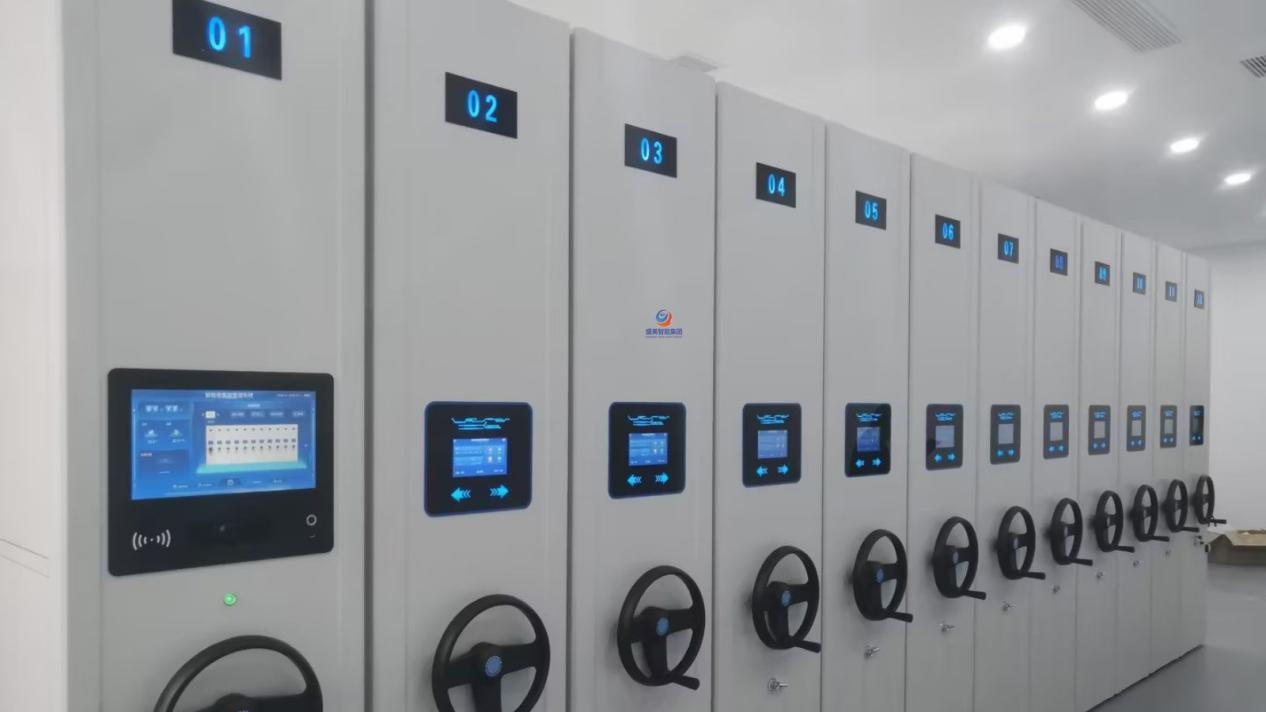
Open bay view: travel wheels, rails and hand wheel — the first places to inspect when movement feels stiff or noisy.
3. Motor & Electronic Control: Fault Diagnosis
Electric systems rely on motors, inverters, main control boards and wiring — electrical faults mostly stem from humidity, dust, unstable voltage and overload. Smart compactor shelving maintenance here is mostly preventive: keep boards dry, terminals tight and voltage stable.
- No button response / won't start. Check main power and branch breakers, read control-box indicator lights; restart to reset protection mode; clean oxidized terminals.
- Weak motor / slow travel. Test supply voltage, reset inverter parameters, reduce local overload, service the gear train.
- Motor noise / overheating / auto-stop. Bearing wear, overload, poor cooling or frequent start-stop. Cool down, re-lubricate, standardize operation — no rapid continuous open-close cycling.
- Black or garbled display. Loose wiring, damp control box, program fault or voltage surge. Power-cycle, re-fasten connectors, keep the cabinet dry and ventilated; add anti-damp treatment in humid regions.
4. Sensor & Safety System Fault Handling
Infrared sensors, anti-pinch protection and limit switches guard personnel safety and precise travel — and are the most overlooked items on any smart compactor shelving maintenance checklist. These devices sit inside the wider compactor shelving safety architecture, so fixing them is also a compliance requirement, not just a comfort issue.
- Anti-pinch false triggers / frequent stops. Usually a dusty or blocked lens or shifted sensitivity. Clean the lens and re-calibrate.
- Limit failure / over-travel / no stop position. Limit switch displaced, loose or with poor contact. Re-fix it, adjust the trigger distance, test the full travel stroke.
- Infrared sensing dead / no protection. Long-term dust, moisture or aged wiring. Clean the sensing window, check circuit continuity, replace damaged sensors.
5. Cabinet Appearance: Moisture, Rust & Noise Repairs
Handle small cabinet problems early — before they grow into the most visible failures of skipped smart compactor shelving maintenance. The substrate matters here: rust resistance starts with steel and coating quality, which we break down in our cold rolled steel thickness and powder coating durability guide.
- Light rust spots / paint scratches. Grind off rust and repaint with anti-corrosion coating to stop spread; avoid hard impacts on the paint surface.
- Slight shelf or side-panel deformation. Usually local overload — redistribute the load evenly instead of single-side stacking.
- Poor closing / uneven gaps. Aging magnetic seal strip or slight misalignment — replace seals, fine-adjust the bay position and restore the sealed damp-proof envelope.
6. Standardized Daily Care Schedule (Daily / Weekly / Monthly / Quarterly / Annual)
The table below is the core of a standardized smart compactor shelving maintenance program — one rhythm that fits domestic archive rooms, overseas tender specifications and daily inspection logs.
| Care Cycle | Module | Core Work | Application |
|---|---|---|---|
| Daily check | Whole unit | Listen for noise or jamming, check display, run function test | All archive rooms |
| Weekly care | Rails + sensors | Sweep rail debris, wipe IR lens, check power lines | Inland routine rooms |
| Monthly care | Safety + seals | Test anti-pinch, limit and alarm; check seals; calibrate sensors | All scenarios |
| Quarterly special | Anti-corrosion | Remove rail salt, de-rust, check paint, grease wheel bearings | Coastal / salt-fog overseas projects |
| Annual deep care | Full system | Motor and gear service, tighten wiring, re-level bays, repaint | All projects |

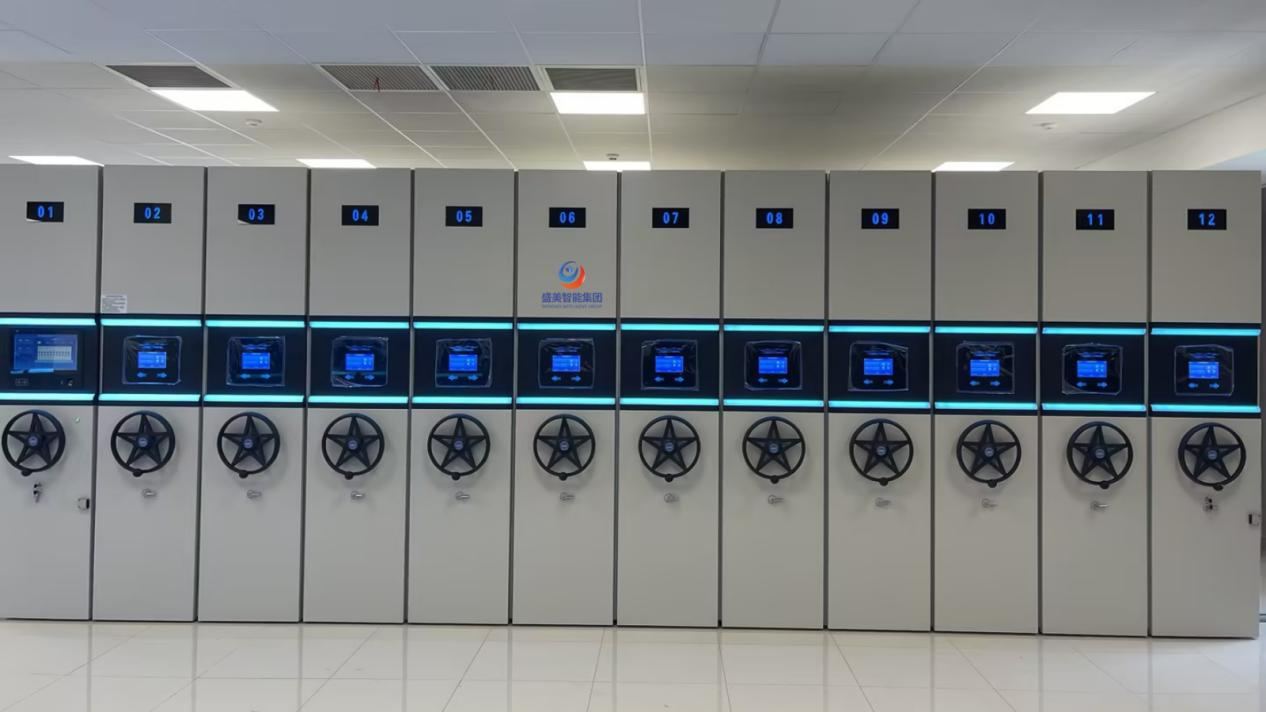
A loaded, well-run archive room — the daily checklist keeps it exactly like this.
7. Overseas Project O&M Notes
Overseas archives face long after-sales distance, thin staffing, unattended operation and harsh climates — so smart compactor shelving maintenance standards must be stricter, not looser. Unattended rooms should enable auto-inspection, timed ventilation and automatic dehumidification, and environmental monitoring helps: see how smart temperature and humidity monitoring protects valuable archives between visits.
- Coastal / salt-fog regions: add quarterly de-rusting, clear salt deposits from rails, and protect mechanics and circuits from salt-fog corrosion.
- Unattended rooms: enable system auto-inspection, timed ventilation and auto-dehumidification modes to cut human-error faults.
- Stock wear parts locally: seal strips, sensors, grease and switches — long logistics cycles should never leave equipment down.
- Archive every smart compactor shelving maintenance record for overseas acceptance, audits and warranty verification.
8. High-Frequency Procurement FAQ
Q1: How often should smart compactor shelving be serviced?
Inland archive rooms: weekly basic cleaning, monthly checks and annual deep care. Coastal or salt-fog overseas projects should add a quarterly anti-corrosion and rail special — the single most effective smart compactor shelving maintenance upgrade in harsh climates.
Q2: Should I stop the system immediately when it makes abnormal noise?
Yes. Abnormal noise means wear, dry lubrication, jamming or deformation. Forcing it to run worsens the damage and can cause seizure, derailment or motor burnout.
Q3: How should a long-idle system be maintained?
Keep the room dry, run the system powered periodically, clear the rails of debris and apply protective lubricant — this prevents seized parts and damp-damaged circuits.
Q4: Why do the sensors keep false-alarming?
About 90% of cases are lens dust, condensation or shifted sensitivity — clean and recalibrate. Frequent repeats mean aged wiring or sensors that need replacement.
Q5: After-sales is far away — how do we minimize faults?
Choose high-spec damp-proof, waterproof, salt-fog-resistant models up front, strictly execute the quarterly smart compactor shelving maintenance cycle and stock wear parts locally. That combination delivers long-term low-fault stable operation.
9. Conclusion: Care Is the Cheapest Insurance
Service life, stability and compliance depend not only on factory quality but on long-term standardized smart compactor shelving maintenance. A system that follows this smart compactor shelving maintenance guide will outlast a neglected one by a decade. Most breakdowns, early scrapping and acceptance deductions come from missing daily O&M and small problems compounding into big hazards. Build a complete daily / weekly / monthly / quarterly / annual O&M system, and the system stays safe, stable and compliant — protecting both archive and equipment assets.
Disclaimer: this O&M guide is general industry reference. Fault repair and deep care should be performed by professional engineers — unauthorized disassembly may damage equipment.
- • Daily Maintenance & Common Fault Solutions for Overseas Archive Compact Shelving
- • Which Core Components Determine the Service Life of Mobile Compactor Shelving
- • Cold Rolled Steel Mobile Compactor Shelving: Steel Thickness, Powder Coating & Durability
- • Smart Temperature & Humidity Monitoring: Protecting Valuable Archives
- • Compactor Shelving Safety Architecture 2026
Shengmei Cabinet provides one-stop service for domestic and overseas archive rooms — free technical proposals and project budgets.
📩 Email: info@shengmeicabinet.com | 💬 WhatsApp: Kerwin +86 189 3280 1260
Email subject format: Smart Compactor Shelving O&M Inquiry + Archive Room Area + Project Type + Country/Region