Shengmei Cabinet · Overseas Smart Archive Series
Smart Compactor Shelving RFID Archive Management: How to Shorten Archive Retrieval Time
- 01 Core pain points of traditional archive-room management
- 02 How RFID and smart compactor shelving work together
- 03 How RFID cuts retrieval time
- 04 Core function list (tender-ready)
- 05 Hardware composition and selection points
- 06 Implementation workflow
- 07 4 common procurement misconceptions
- 08 High-frequency procurement FAQ
- 09 Closing
Across government, legal, hospital, university and overseas archive-room projects, manual document retrieval is slow, stocktaking takes days, misfiled records go missing, and lending logs are a burden. Searchers walk to the shelving and hunt layer by layer; an urgent case-file request can burn hours of staff time.
Integrating RFID technology into the smart compactor shelving RFID system changes that: second-level retrieval, exact shelf-position locating, automatic batch stocktaking, and a fully traceable lending log — with far less manual effort. This guide is written for overseas integrators and dealers and covers pain points, working principle, tender-ready parameters, implementation flow and procurement pitfalls, ready for client proposals and technical benchmarking. For the retrieval-speed background, see our analysis of how smart compactor shelving solves slow mass-archive retrieval.

01Core pain points of traditional archive-room management
Without RFID, a traditional compactor-shelving archive room depends entirely on manual ledgers. Four pain points dominate:
| Pain point | What it costs the archive room | How a smart compactor shelving RFID system answers it |
|---|---|---|
| Slow retrieval | Paper ledgers or a simple e-catalogue; staff walk to the shelving and search layer by layer — minutes to tens of minutes per file, worst of all for urgent requests. | Second-level locating plus LED guide light to the exact box position. |
| Whole-library stocktaking is huge work | Tens of thousands of volumes take several staff members days, with missed and mis-counted items that are hard to reconcile. | Batch antenna reading completes a full stocktake in tens of minutes and auto-generates the report. |
| Misfiled and lost records | A file returned to the wrong layer or wrong carriage is almost impossible to trace until someone needs it and cannot find it. | Wrong-position detection with audible/visual alarm and the correct box position shown. |
| Lending logs are tedious | Manual registration, missed entries, no automatic overdue reminder, and unclear accountability when something goes wrong. | Automatic check-in / check-out registration with operator, timestamp, due date and overdue alert. |
02How RFID and smart compactor shelving work together
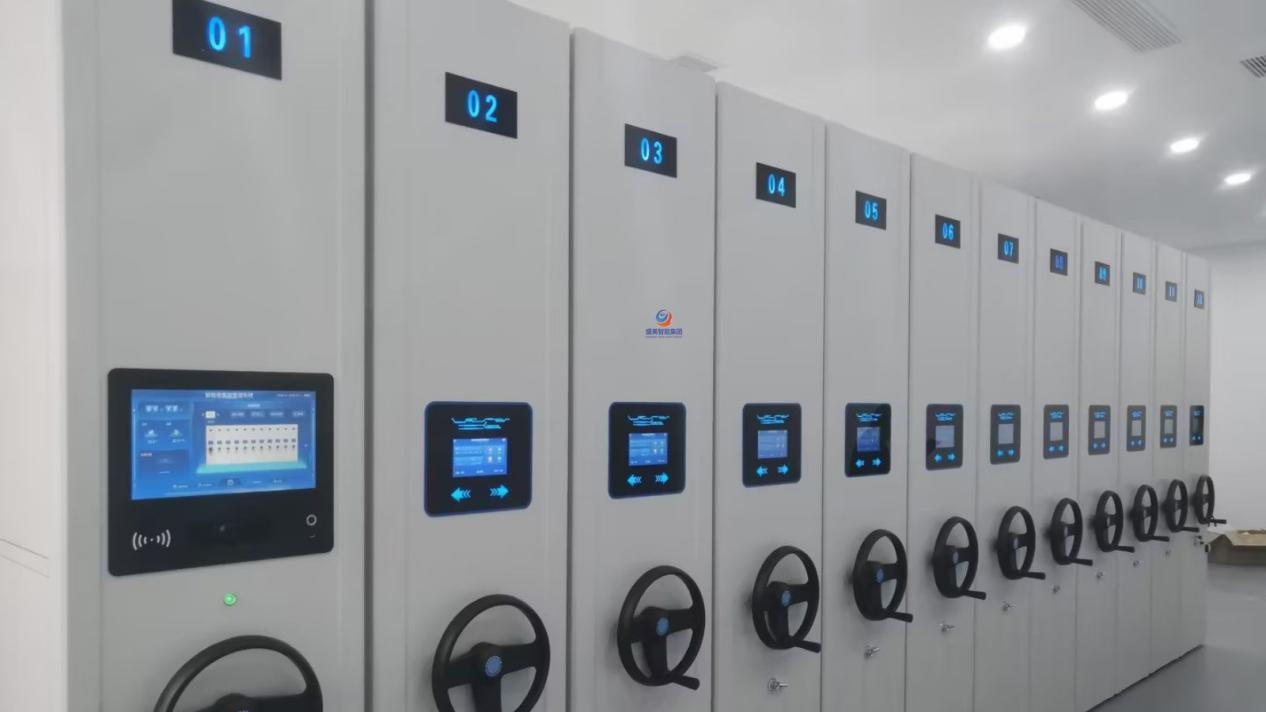
Each archive box receives a unique RFID tag — effectively an electronic ID card holding the document number and case-file information. A smart compactor shelving RFID installation adds readers, layer antennas and LED locating lights to the carriage body.
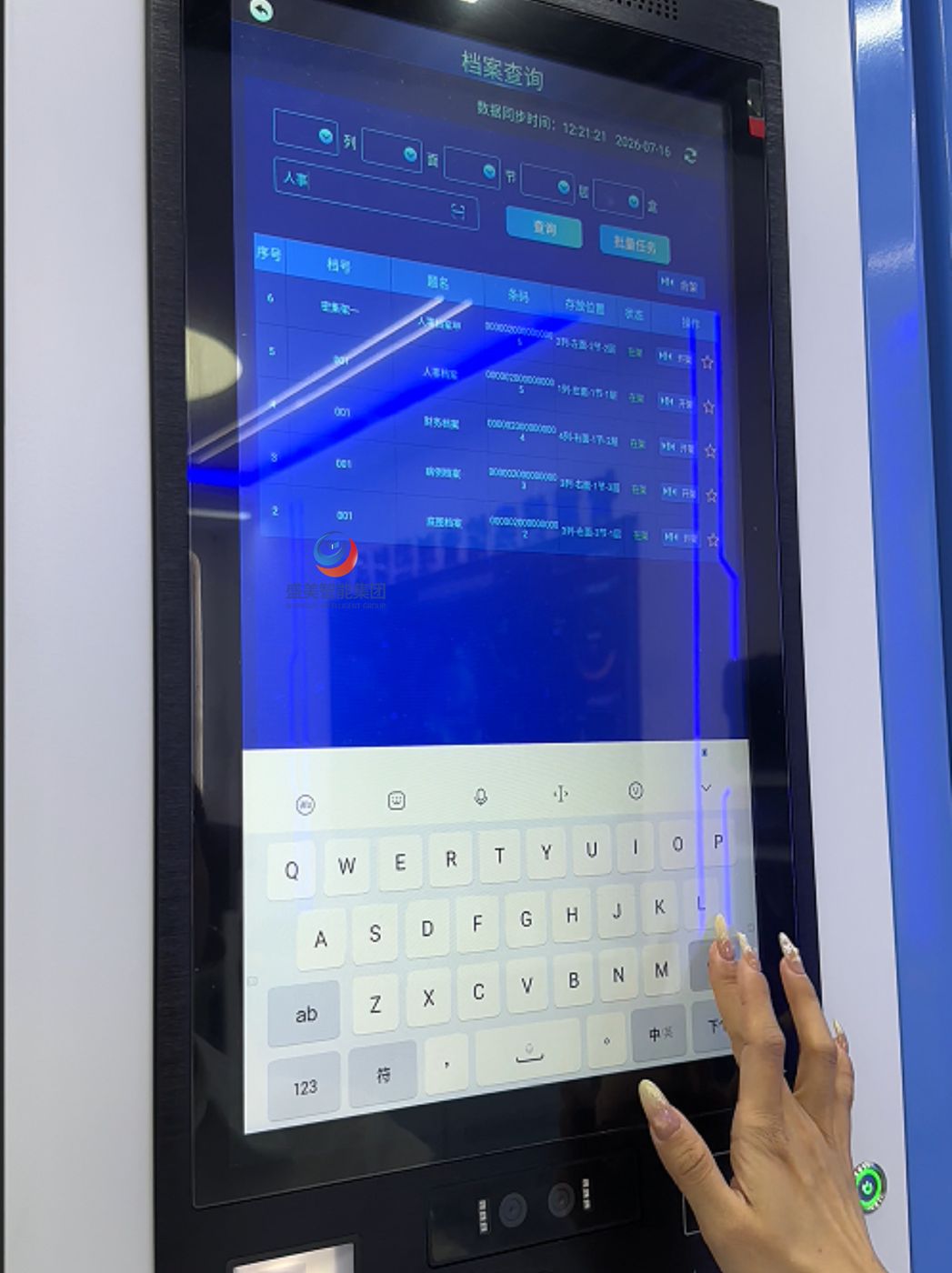
When the operator enters a document number or case-file keyword on the management software or the carriage touchscreen, the system reads the tag, resolves the actual carriage, column, layer and box position, lights the corresponding guide lamp, and opens the correct aisle — guiding the operator straight to the file with no manual searching.
 Smart compactor shelving RFID architecture: electronic tag → layer antenna → reader → locating software → LED guide light.
03How a smart compactor shelving RFID system cuts retrieval time
1. Second-level locating shortens every request
Enter the document number or case keyword and the smart compactor shelving RFID system matches the physical storage position instantly, lights the LED guide and points to the exact box. Manual search averages minutes; RFID compresses it to under a minute for a normal request.
2. Automatic batch stocktaking replaces manual counting
Instead of checking volume by volume, the reader pulls every tag inside the carriage in one pass, completes the whole-library stocktake in a short window, and auto-generates the report with missing and misfiled records flagged. Stocktaking moves from a multi-day task to tens of minutes. For archives under heavy audit pressure, see how mobile compactor shelving speeds up high-frequency audit retrieval.
3. Automated lending reduces registration time
On check-out and return, the smart compactor shelving RFID reader identifies the tag automatically and the system writes the record — operator and timestamp included — with no manual ledger entry. Overdue items trigger an automatic reminder.
4. Full traceability of every movement
If a file is shifted, taken by the wrong person or removed from the archive room without authorisation, the smart compactor shelving RFID system raises an audible/visual alarm and writes an operation log, so the full record journey can be reconstructed.
04Core function list (copy straight into tender documents)
The following functions define a standard smart compactor shelving RFID configuration. Procurement teams can lift this list directly into a technical specification.
| Function | What it delivers |
|---|---|
| Fast retrieval and light-guided locating | Enter a document number or title; the system shows the carriage, layer and box position, opens the matching aisle and lights the layer LED to guide pick-up and return. |
| RFID batch auto-stocktaking | Single-carriage, zoned or whole-library stocktaking with an automatic report that flags misfiled and missing items and exports to Excel. |
| Unordered storage, ordered management | If a file is returned to the wrong position, the system alarms and shows the correct box position — strict physical sequencing is not required. |
| Lending and return management | Automatic registration of check-out and return, configurable loan periods, automatic due-date reminders and a complete operation log. |
| Unauthorised-removal alarm | If a file leaves the carriage without a lending record, the smart compactor shelving RFID system raises an audible/visual alarm to prevent loss. |
| Multi-level permission control | Separate administrator and operator accounts controlling query, shelving and data-modification rights. |
| System integration | Standard communication protocol for interfacing with the client’s upper-level archive business system and exchanging data. |
| Temperature & humidity data capture (monitoring only) | Records and alerts on archive-room climate data. No dehumidifying or temperature-control capability — external constant-climate equipment is required. |
05Hardware composition and selection points (overseas projects)
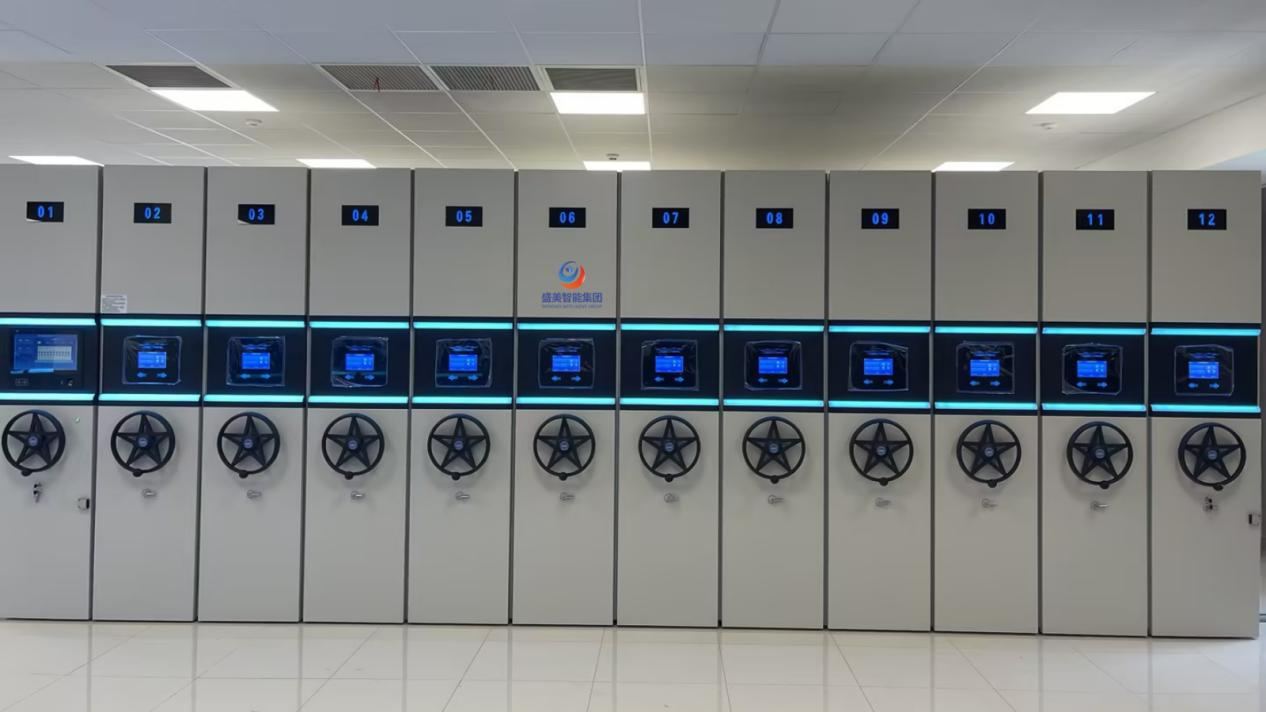
A complete smart compactor shelving RFID solution breaks into three parts: the compactor-shelving body, the RFID identification hardware, and the software platform.
| Component | Role in the system | Selection note for overseas projects |
|---|---|---|
| RFID electronic tag | UHF tag dedicated to archive boxes; rewritable, dust-resistant, suited to paper archive boxes. | Confirm the tag protocol standard and that it matches the locally dominant RFID readers. |
| Reader and layer antennas | One reader per carriage with antennas distributed across layers to protect read accuracy and reduce missed or false reads. | For humid coastal projects specify moisture-resistant RFID hardware. |
| LED locating module | Two-colour layer indicator: on for guided pick-up, flashing for a wrong-position alarm. | Verify voltage and control-signal compatibility with the carriage control board. |
| Human-machine terminal | Local touchscreen on the compactor shelving for on-site query and retrieval, plus a back-office PC or server. | Request a bilingual interface for overseas operators and acceptance inspection. |
| Management software platform | Document entry, retrieval, stocktaking, lending, report export and user-permission management. | Confirm protocol openness so the platform can interface with the client’s existing archive system. |
06Implementation workflow for a smart compactor shelving RFID project
- Preparation — review the existing document list, plan tag quantities, and confirm whether the compactor shelving will be retrofitted or newly built.
- Tag registration and attachment — attach an RFID tag to every archive box, write the document information into the tag and bind document to tag.
- Hardware installation and commissioning — fit readers, antennas and indicator lights onto the smart compactor shelving, then tune read accuracy and eliminate missed reads.
- Data import — bulk-import the document catalogue into the management system and link each document to its physical shelf position.
- Training and go-live — train archive staff on retrieval, stocktaking, lending and reporting before the system enters live service.
074 common procurement misconceptions about smart compactor shelving RFID
❌ Misconception 1 — the RFID system solves archive-room damp and mould. Correction: a smart compactor shelving RFID system only manages document identification and retrieval; it does not change room temperature or humidity. Mould prevention still depends on independent constant-climate dehumidifying equipment.
❌ Misconception 2 — fit RFID and you get 100% zero maintenance. Correction: in humid, salt-spray environments the readers, antennas and connectors need scheduled inspection; tags wear and must be checked and replaced periodically.
❌ Misconception 3 — compare compactor-shelving prices only, ignoring tag volume and software licensing. Correction: a smart compactor shelving RFID project covers carriage hardware, readers and antennas, document tags, software licences and commissioning. Tag quantity follows the total number of archive boxes, so tenders must itemise each line.
❌ Misconception 4 — ignore local communication protocol and voltage adaptation. Correction: confirm the reader supply voltage and RF protocol against local standards so the delivered equipment is usable on arrival.
08High-frequency procurement FAQ (overseas dealers)
09Closing
The core value of smart compactor shelving RFID is compressing the manual time cost of retrieval, stocktaking and lending — upgrading a search-by-hand archive operation into a fully electronic, traceable management model. It fits especially well in overseas government, judicial, hospital and university archive rooms with large volumes and frequent retrieval.
One boundary must stay clear: RFID only solves document locating and business management. It cannot manage archive-room temperature, humidity or damp-proofing. Humid coastal archive rooms still need a salt-spray-resistant compactor-shelving body plus independent constant-climate dehumidifying equipment. Hardware anti-corrosion, room environment and RFID intelligent management must work together to deliver a complete overseas archive-room solution. Climate control is a separate discipline — see our note on smart temperature and humidity monitoring for valuable archives. For the records-management context, refer to ISO 15489-1:2016.
When preparing proposals and tenders, overseas integrators should price the compactor-shelving body, RFID hardware, tag consumables, software licence and room-environment equipment as separate line items, with the functional boundary stated explicitly — this avoids expectation gaps and commercial disputes later on.
Need RFID archive-room tender parameters, a solution template or overseas configuration advice? Shengmei Cabinet provides technical liaison and on-the-ground support for archive-room projects worldwide.
Email subject format: Overseas RFID Archive Compactor Shelving Inquiry + Country/Region + Archive Box Volume