Manual Compact Shelving Overseas Procurement: A Complete Pitfall-Avoidance Guide
Why a "structurally simple" manual compact shelving is actually a top overseas procurement trap — and how to buy right, clear customs, and last 10–15 years.
Look at the Data First 80% of after-sales problems come from the procurement stage
Reviewing more than a thousand overseas projects from 2018 to 2026: over 80% of after-sales issues are not product quality defects but three hidden misconceptions at the procurement stage —
Ignoring civil engineering load standards
Compact shelving is heavy-duty storage equipment. A single fully loaded unit can weigh several tons, with the load concentrated along the rail lines.
Copying domestic non-standard parameters
Domestic procurement competes on price and appearance; overseas procurement competes on structural safety, compliant clearance, and long-term durability.
Overlooking EU machinery safety compliance
Missing certificates, borrowed certificates, or model mismatches directly lead to clearance failure and project rejection.
The dangerous chain of wrong procurement thinking →
Sheet thickness & paint only → load verification & safety structure ignored → cannot clear customs / floor cannot bear load / jamming & deformation → no returns overseas → irreversible loss.

Three Cognitive Upgrades for 2026 Low price ≠ fit; simple ≠ no standards
In the domestic market, manual compact shelving is mature and homogeneous, trapped in low-price competition. But in overseas government and corporate bidding projects, it is industrial-grade heavy-duty mechanical storage equipment subject to clear EU machinery safety, civil engineering fit, and structural load-bearing standards — by no means ordinary furniture.
Change 1 · Mandatory EU safety compliance
Must comply with EN 15095 mobile storage equipment safety standard, with mechanical anti-pinch, anti-tip, and limit-locking structures. Non-certified products are banned from clearance and use.
Change 2 · Old archive room load risks
Many old overseas buildings have lightweight floor slabs never designed for heavy loads. Fully loaded shelving concentrates load on the rail strip — without professional verification, settlement, cracking, and tilting are highly likely.
Change 3 · Durability becomes a core bid criterion
Overseas projects require 10–15 years of service. Low-price simplified versions fail within 1–2 years: jamming, rail wear, paint peeling, frame deformation.
Industry core takeaway: domestically it is about price; overseas it is about safety, compliance, and long-term stability — a simple structure does not mean engineering standards can be lowered.
Six High-Frequency Fatal Failure Modes Most projects suffer from combined risks
1. No dedicated rail load verification
Only room size measured; concentrated rail load ignored. Most common in old archive room retrofits → floor cracking and cabinet tilting after installation. Highest-level safety risk.
2. Stripped-down safety structures
Anti-pinch devices, end stops, anti-tip baffles, and brake locks omitted → fails EN 15095, cannot pass acceptance, pinching and tip-over hazards.
3. Generic reused compliance certificates
Certificate parameters and models don't match the shipped products → clearance review fails, entire project batch rejected.
4. Downgraded drive-train workmanship
Gears, chains, bearings use inferior parts. Smooth at first, then jamming, derailment, and drive failure — extremely high maintenance costs.
5. Vague delivery scope, missing items
Quotes include only the cabinet body, excluding rails, accessories, commissioning, and English manuals → budget overrun and unusable shelving.
6. No written warranty or after-sales terms
No parts warranty period, remote guidance, or replenishment lead time → after a failure, no one maintains it and the system is written off.
Standardized Overseas Procurement SOP Closed-loop control in five stages
Stage 1 · On-site survey and load verification Safety core
The core is rail line-load verification: measure room dimensions, check floor flatness, record beam/column obstructions, re-verify doorways, run load-capacity reduction for old buildings, verify rail layout loads, assess foundation conditions. Never judge by eye that "the floor feels solid enough."
Stage 2 · Structural parameter verification Quality core
Main panels 0.8–1.2 mm; thickened load-bearing shelves; spot + full welding; electrostatic powder coating. Drive parts use thickened gears, quiet bearings, anti-rust chains. Anti-pinch, limit stops, braking, and anti-tip structures are all indispensable. Write all core parameters into the contract annex.
Stage 3 · Dedicated compliance document review Customs core
EU, Middle East, and Southeast Asia projects must provide the EN 15095 machinery safety certificate, Declaration of Conformity, and factory inspection report matching the shipped model one-to-one. Generic templates and reused certificates directly cause clearance failure.
Stage 4 · Lock down delivery checklist and SOW scope
Written checklist: cabinet body, complete rails, floor anchors, hand-crank devices, locking accessories, English operation manual, installation drawings, factory inspection report. The SOW must define installation guidance, commissioning, and training to eliminate hidden charges and omissions.
Stage 5 · Solidify acceptance criteria and after-sales terms
Contract specifies factory and on-site acceptance indicators (flatness, push-pull smoothness, load-bearing deformation), warranty years, free replacement for drive parts, overseas parts replenishment lead time, and remote technical guidance.
Essential technical documents: Rail Load Verification Report · On-Site Survey Record Form · CAD Rail Layout Drawing — usable for audits, acceptance, and dispute evidence.

Overseas Selection Matrix Manual / electric / smart compact shelving
| Equipment type | Core configuration | Suitable overseas scenarios | Compliance focus | Maintenance cost |
|---|---|---|---|---|
| Manual | Pure mechanical hand-crank; no circuits, no motor | Small/medium archive rooms, limited budget | EN 15095; anti-pinch & anti-tip structures | Very low: routine cleaning only |
| Electric | Motor-driven, push-button, basic electronic control | Medium archive rooms, high-frequency access | EN 15095, electrical safety, limit protection | Medium: periodic motor/control checks |
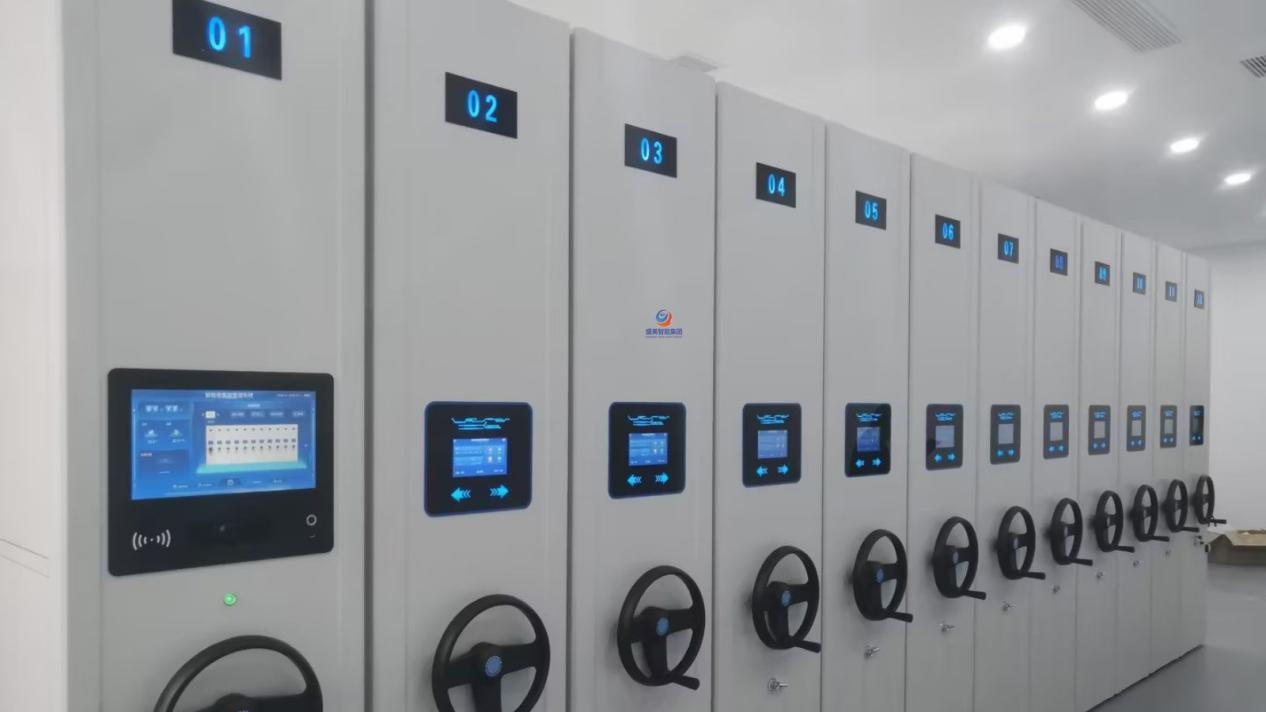
| Smart | Touchscreen + system management, RFID, digital integration | Large government archives, universities, high-end bidding | EN 15095, ISO 13849-1 PL-d, full CE | Medium: digital system upgrades |
High-Frequency FAQs on overseas procurement
Q1 · No motor — does manual shelving still need compliance certification?
Yes. Manual compact shelving is heavy-duty mobile storage machinery. The EU EN 15095 standard mandatorily covers all mobile archive storage equipment — manual, electric, or smart. Without a compliance certificate, it cannot clear customs or pass government/corporate acceptance.
Q2 · The new archive room floor is flat — is load verification still needed?
Absolutely. Ordinary archive rooms are designed for uniformly distributed loads, while compact shelving imposes concentrated loads on the rails — completely different stress patterns. A flat floor does not mean adequate load capacity; even a new room may fail. A dedicated verification report is mandatory.
Q3 · Can we install the shelving overseas by ourselves?
Yes, but strictly according to standard drawings. Rail levelness, spacing, and fixing techniques directly determine service life. Pair the supplier's English installation manual with remote technical guidance to avoid jamming and deformation from improper installation.
Q4 · What warranty period should be agreed for overseas projects?
Industry practice is a 3–5 year whole-unit warranty, with drive parts (gears, chains, bearings) having a separately agreed free replacement period. Also specify the overseas parts replenishment lead time (recommended ≤15 working days) and remote guidance response time.
Q5 · How do we match the number of rails to the number of cabinet units?
Standard configuration is about 0.5 m of rail per unit, with extra end-fixing parts for the first and last units. Rail layout is constrained by clear dimensions, door positions, and beams/columns — re-verify against the CAD layout drawing before ordering to avoid wasted cuts or insufficient length.

Additional Topics for Overseas Implementation Cost, logistics, lead time, and scenario fit
Topic 1 · Breaking down quotations
A standard quotation should include six line items: cabinet body, rail system, installation kit, export packaging, sea freight & insurance, and installation guidance. Low-price suppliers often quote only the cabinet, charging rails per meter separately → 20–40% budget overrun. Require an "all-in price per standard unit" and specify packaging and FOB/CIF/DDP terms.
Topic 2 · Packaging, transport & customs docs
Full foam + pearl cotton wrapping, rails on individual wooden frames, whole container strapped with woven bands. Confirm destination documents in advance: CO / FORM E, EN 15095 conformity files, factory inspection reports. Names, models, and quantities must exactly match the cargo.
Topic 3 · Lead time & project timeline
Production 25–35 days; inland transport & export declaration 3–5 days; sea freight 15–40 days by route; on-site installation 5–10 days. Agree partial-shipment clauses and delay liability; retrofit projects should reserve a floor-reinforcement window before arrival.
Topic 4 · New builds vs old archive retrofits
New builds: get involved at the civil design stage, embed rail load requirements into the drawings — lowest cost, best result. Old retrofits: run load-capacity reduction first; combine "distributed reinforcement + short rails + reduced tiers," or switch to a double-column shallow-rail structure. Never apply one solution to both.
Topic 5 · A typical claim case review
A Southeast Asian government project bought 120 sets of low-price shelving with no rail load verification. Three months after full loading, the floor settled and cracked, cabinets tilted and derailed, and the archives had to be relocated — rectification exceeded the equipment value. An upfront investment of about 3% of the goods value in load verification and floor reinforcement would have completely avoided the loss. This is why this guide says: verify first, then purchase.
Industry reminder: the hidden costs of overseas projects (reinforcement, rectification, downtime, claims) are often several times the price difference saved at purchase. The first principle is always "structural safety and compliance" — price comes second.
Get the Free Compliance Self-Checklist
Turn this article into your hands-on tool: a self-check checklist + one-on-one engineering consultant support. Shengmei Cabinet offers free load verification assessments, compliance document pre-reviews, and rail layout solutions for overseas buyers, general contractors, and foreign trade service providers.
Email the engineering team