Industrial Mobile Compactor Shelving:
High-Density Storage Selection & Load-Bearing Standards
A practical engineering reference for industrial archive warehouses
Why Industrial Archives Need a Different Shelving System
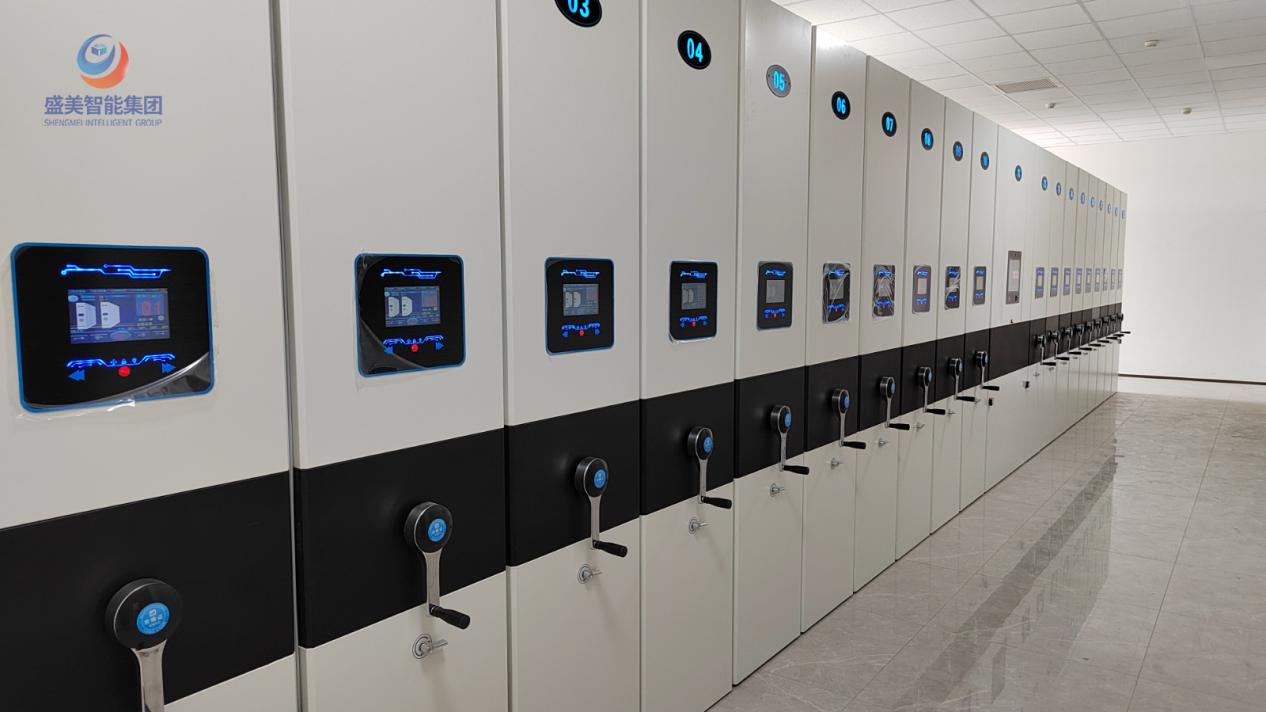
Industrial Mobile Compactor Shelving is a rail-mounted, high-density movable shelving system. By consolidating multiple fixed aisles into a single operating aisle, it raises the effective storage capacity of an archive warehouse by 80%–100% compared with traditional fixed shelving. It is widely used for the archival storage of factory equipment records, tooling and drawing archives, spare-parts documentation, heavy-format engineering drawings, and industrial ledgers.
Many overseas industrial buyers install standard archive-type mobile compactor shelving for heavyweight industrial records, overlooking the reinforced load capacity, base, and rail requirements of industrial applications. Once in service, bent shelves, deformed bases, jammed carriages, and overloaded floor slabs follow — often ending in scrapped equipment and serious archive-safety hazards. Selection must never be based on appearance alone: rated shelf load, base structural strength, rail configuration, and archive-room floor capacity are the four core control points.

Key Differences: Industrial vs. Standard Archive Compactor Shelving
| Comparison Item | Industrial Mobile Compactor Shelving | Standard Archive Compactor |
|---|---|---|
| Typical contents | Heavy engineering drawings, thick equipment ledgers, hardbound archive volumes, heavy industrial documentation | Ordinary paper files, standard file boxes, lightweight books |
| Rated load per shelf | 150–500 kg per shelf, heavy-duty customization available | 80–100 kg per shelf, designed mainly for light paper storage |
| Base structure | Thickened fully welded base with reinforced beams and heavy-duty travel wheels | Extrusion-assembled base, adequate only for light file loads |
| Rail system | Heavy-duty steel rails with thickened base plates, resistant to concentrated pressure | Ordinary cold-rolled rails, suited to lighter loads |
| Protection focus | Impact resistance, deformation resistance, high load stability — built for demanding industrial environments | Dust sealing and lockable closure, focused on protecting ordinary paper records |
| Application scenarios | Industrial enterprise archive warehouses, heavy-engineering drawing archives, dedicated equipment-record rooms | Administrative file rooms, libraries, general institutional records offices |
Three Drive Types — Choosing by Operation Method
1.Manual Crank Chain Drive (Manual Compactor Shelving)
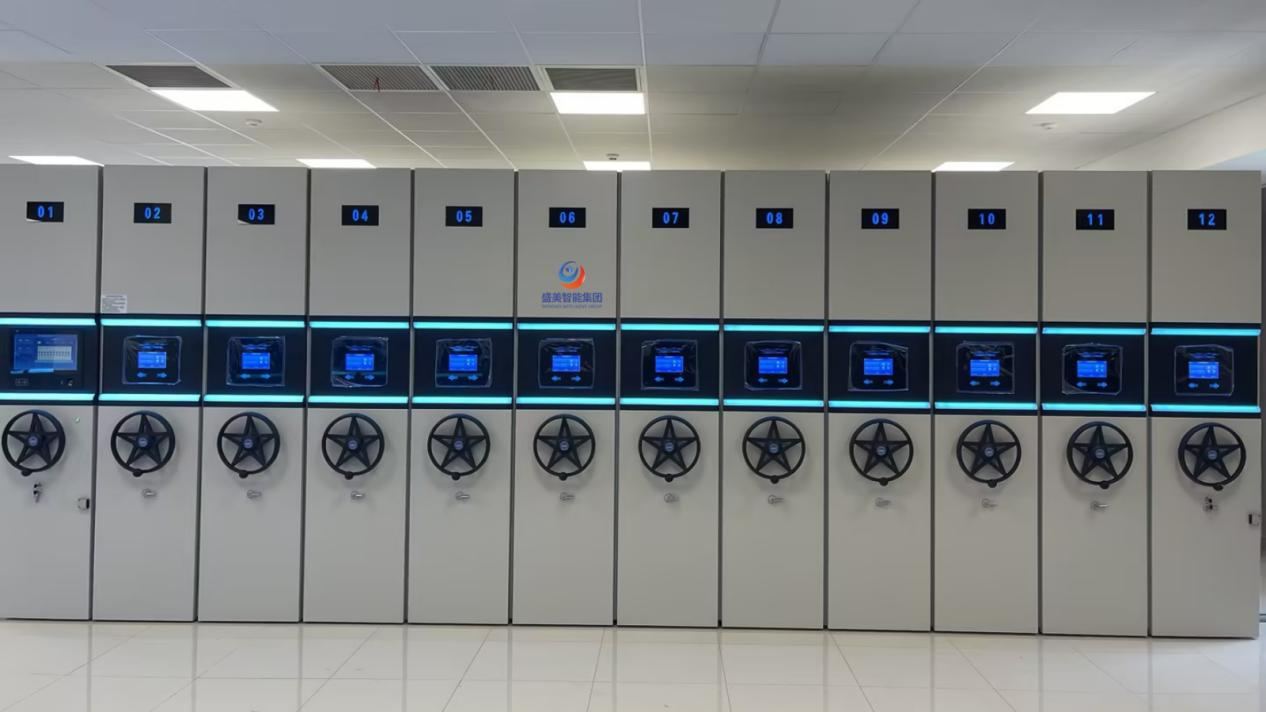
A hand-cranked chain sprocket drives the base along the rails — well suited to small and medium-sized industrial archive rooms.
Maintenance is simple and there are no motor or electrical faults to manage, making it ideal for overseas facilities without a dedicated electrician. Its limitation: in heavy-load, multi-bank configurations, cranking requires considerable physical effort.
2.Motorized Drive (Electric / Powered Mobile Shelving)
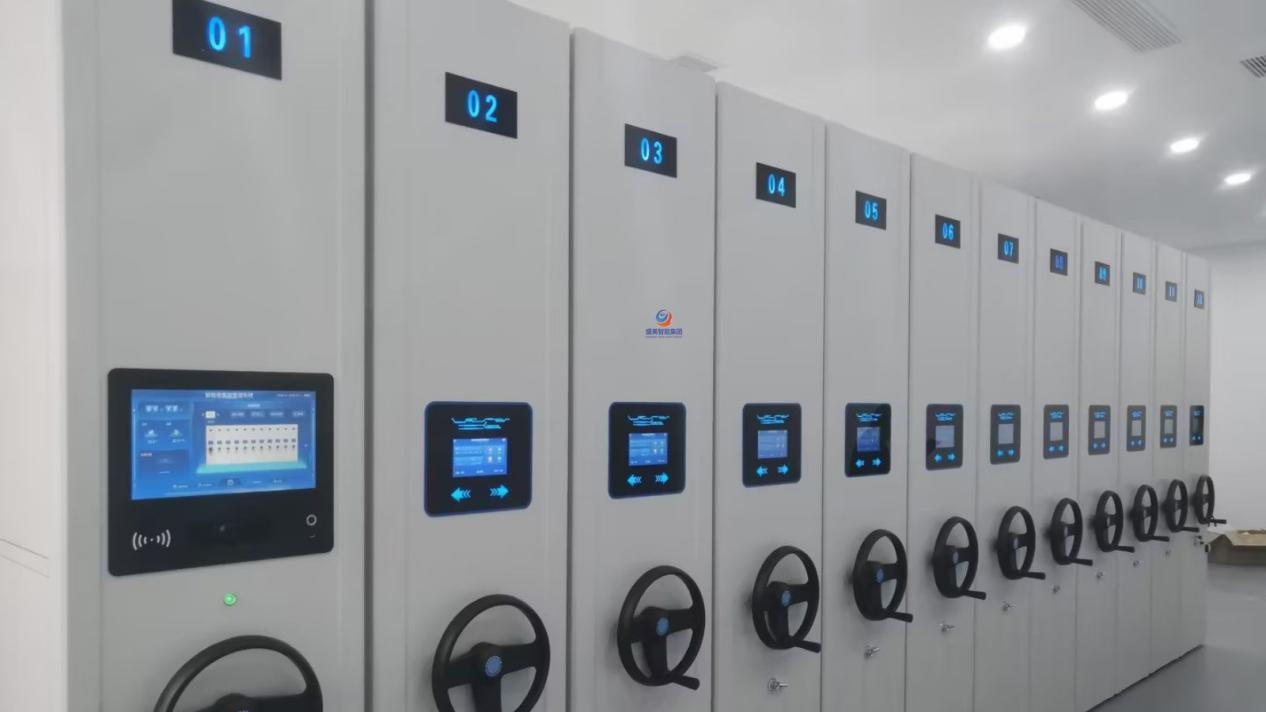
A geared motor moves the base — designed for archive rooms with many banks, high overall loads, and frequent record retrieval. Infrared safety protection and anti-pinch emergency stop come as standard.

Power wiring must be planned in advance — overseas buyers must confirm local supply voltage (220 V / 380 V) before ordering.
3.Manual Push-Pull, Light-Duty
Suitable only for light industrial documents and ordinary equipment paperwork — not for heavy hardbound ledgers or large-format thick drawings. Purchase cost is lower, but this type is not recommended for heavy-duty industrial archive rooms.

Load-Bearing Standards: Three Levels — Shelf, Base & Floor Slab
Loads for Industrial Mobile Compactor Shelving are graded across three dimensions: shelf-level load, full-base bank load, and archive-room floor slab load. All three conditions must be met simultaneously — judging by shelf load alone plants a serious hidden safety risk.
1.Shelf-Level Uniform Load Grading (Industrial Scenarios)
| Load Grade | Uniform Load per Shelf | Typical Materials | Recommendation |
|---|---|---|---|
| Light industrial | 150 kg / shelf | Ordinary equipment documents, light drawing albums, standard archive boxes | General-purpose choice for small and medium enterprises |
| Medium industrial | 250–300 kg / shelf | Hardbound equipment ledgers, complete engineering drawing sets, heavy archived records | The mainstream choice for industrial archive rooms |
| Heavy industrial | 400–500 kg / shelf | Extra-thick drawing collections, heavy bound archives, complete equipment records | Large heavy-industry facilities; requires thickened base and heavy-duty rails, with floor load re-verification |
2.Full-Base Bank Load
The base is the load-bearing core of the whole system. A bank is assembled from multiple sections, so the full-load weight = frame self-weight + total weight of all records on the shelves.
- Manual crank drive — typical engineering upper limit: ≤ 6,000 kg per bank.
- Heavy-duty electric version — engineering upper limit up to 9,000–12,000 kg per bank; requires a custom fully welded reinforced base, thickened travel wheels, and heavy-duty steel rails.
3.Floor Slab Load — The Most Overlooked Factor
| Archive Room Type | Reference Floor Live Load | Notes |
|---|---|---|
| Upper-floor archive room in an office building (slab) | ≥ 12.0 kN/m² (code minimum for compactor use) | Ordinary office slabs rated 2.0–3.0 kN/m² generally cannot accommodate compactor shelving; installing industrial units on them risks overload settlement |
| Upper-floor archive room in an industrial building (slab) | ≥ 12.0 kN/m² | Even light industrial compactor shelving must not fall below this floor limit; medium and heavy loads additionally require verification of the rail line load |
| Ground-floor concrete slab on grade (soil foundation, not a suspended slab) | ≥ 5.0 kN/m² as reference, verified by actual concentrated pressure | Acceptable for light industrial compactor shelving; for medium and heavy loads, local rail pressure must be calculated — this figure alone cannot certify the floor |
Complete Selection Checklist — Ready for Overseas Projects
Profile the archive inventory
Record the unit weight and dimensions of drawings, ledgers, and hardbound volumes; distinguish evenly distributed storage from localized heavy items; forecast 3–5 years of archive growth to settle on a light / medium / heavy product grade.
Survey the archive room on site
Measure clear length, width, ceiling height, columns, fire-protection points, and door openings; obtain building drawings for slab design-load data; for electric systems, confirm on-site power supply at the same time.
Select the drive type
Few banks, moderate loads, no electrician on staff → manual crank chain drive. Many banks, high per-bank loads, frequent retrieval → motorized drive.
Choose the rail solution
Surface-mounted rails: laid directly on the floor, quick to install — ideal for retrofitting older archive rooms. Recessed embedded rails: pre-set during floor casting, smoother running — preferred for new buildings; retrofitting recessed rails into an old floor requires breaking out the slab, which is costly and generally not recommended.
Produce the layout drawings
Confirm the number of banks, sections per bank, main aisle width, and operating-aisle width; specify all technical parameters for base, shelves, and rails, and write load indicators into the project specification.
Confirm the safety configuration
Manual type: bank braking-lock devices and anti-tip limit components. Electric type: infrared safety protection, emergency stop on obstruction, overload protection, and a manual-crank emergency backup mechanism.
Five High-Frequency Mistakes in Industrial Archive Projects
Frequently Asked Questions
Three Matches Decide Everything
Industrial Mobile Compactor Shelving is the core storage equipment for high-density expansion of industrial enterprise archives, solving the storage challenge of heavy-engineering drawings, equipment ledgers, and complete archived record sets. It is not an ordinary filing cabinet — it is a professional storage system where mechanical structure and civil-engineering loads work as one.
Every selection project must achieve three matches: record weight matched to shelf load, base and rails matched to full-bank weight, and the archive-room floor matched to the rail concentrated load. Strictly distinguish standard archive compactor shelving from industrial heavy-duty units, and never run under-specified equipment beyond its rating. This prevents equipment deformation, floor settlement, and record damage at the source — matching the long-term archival needs of overseas industrial enterprises.
Technical & Procurement Support
For domestic and overseas Industrial Mobile Compactor Shelving projects, we provide on-site archive-room surveys, load parameter calculations, and layout planning — plus procurement risk-control checklists, tender technical-specification templates, and contract risk-clause references.
Email subject format: “Compactor Procurement Inquiry + Archive Room Size + Project Type”, e.g. “Compactor Procurement Inquiry + 800 m² Industrial Archive Room + Overseas Factory Upgrade”. Including room dimensions, structural load drawings, and record types helps us respond with precise technical advice faster.