Commercial Shelving vs. Mobile Archive Shelving
A data-driven storage density comparison for warehouse-to-archive retrofits
Core keywords · Commercial shelving · Mobile archive shelving · Storage density comparison · Archive room space utilization · Archive expansion data · Archive storage efficiency
When existing warehouses are retrofitted into enterprise archive rooms, government records centers, or overseas non-profit archive facilities, most procurement managers share the same misconception: that ordinary commercial steel shelving and professional mobile archive shelving differ little in storage capacity — only in function or appearance. To save on the upfront budget, many projects default to generic commercial shelving, converting an entire warehouse into an archive room to house large volumes of paper records, contracts, completion dossiers, and historical files. The result is a familiar chain of costly problems: the archive room fills up almost immediately, space runs out, new records have nowhere to go, and the archive room ends up needing a second retrofit.
In fact, the gap between the two solutions is concentrated in four core data dimensions: storage density, space utilization, archives stored per square meter, and long-term expansion capacity. Commercial shelving is built for general cargo, industrial parts, and assorted goods — wide fixed aisles waste a great deal of space. Mobile archive shelving is engineered specifically for high-density, standardized, long-term paper storage. Through rail-mounted movement, it compresses redundant aisles and unlocks extreme space efficiency. Extensive field measurements show that, with standard A4 archive boxes, mobile archive shelving holds 2.5–3× the number of boxes that light-duty commercial shelving does, raising archive-room space utilization from 35–40% to 85–90% — the proven answer for retrofits that need to solve capacity and space constraints at the same time.
This article is built on real engineering measurements. It compares, in a single archive-room retrofit, the storage density, archives per square meter, total capacity, and cost-benefit logic of commercial shelving versus mobile archive shelving. Using objective data, it shows the core selection criteria for an archive-room retrofit, offering ready-to-use data support for overseas conversions, tender preparation, budget justification, and equipment selection.
Core Concept — Professional Definitions of Storage Density and Archive Room Utilization
In archive-room planning, storage density refers to the number of standard archive boxes or volumes that can be stored per unit of floor area in the archive room; it is the key indicator of how professional an archive system is. Space utilization refers to the proportion of effective archive storage area to the archive room's total floor area, excluding aisles, gaps, and idle zones.
Commercial shelving is designed to “let staff walk up and down aisles frequently and accommodate items of varied sizes,” so it must reserve wide fixed aisles. When a general warehouse is retrofitted into an archive room, archive access frequency is low, but commercial shelving's multiple fixed aisles are kept fully intact — often occupying more floor space than the shelves themselves. The result is severe internal waste inside the archive room.
Mobile archive shelving is purpose-built for archive-room use: paper records are accessed infrequently, kept for long periods, and highly uniform in size and arrangement. Multiple fixed aisles become unnecessary. Through rail-mounted movement, the shelving bodies achieve an “N columns of shelving, one shared aisle” ultra-compact mode, structurally eliminating wasted space and dramatically raising the number of archives stored per square meter.
For a retrofitted archive room, the existing floor area is fixed — space itself is the core asset. Higher storage density means a longer expansion runway, no need to lease additional rooms, and far less expensive second-phase renovation.
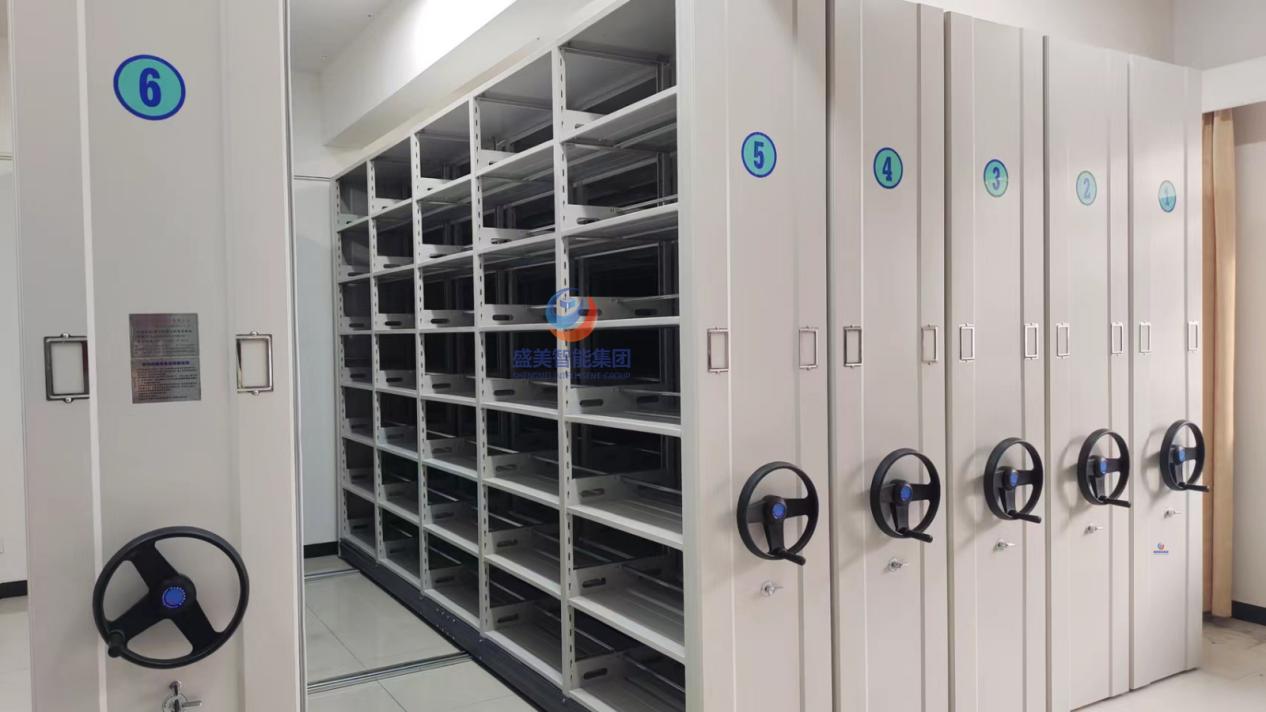
Mobile archive shelving in action — one column opened reveals packed archive boxes; every other column stays compressed to maximize floor usage.
Industry-Tested Storage Density Comparison
Benchmark — same 200 m² warehouse retrofitted into an archive room; 5 cm-thick standard A4 archive boxes; six standard shelf levels. Figures below are theoretical maximum capacity; real projects reserve a safety margin.
Based on field data from hundreds of retrofitted archive rooms across China and overseas, the core parameter gap between commercial shelving and mobile archive shelving is summarized below. The data can be used directly in tender documents, project presentations, and budget calculations.
| Comparison Dimension | Light-duty Commercial Shelvingretrofitted archive rooms | Mobile Archive Shelvingretrofitted archive rooms | Improvement Notes |
|---|---|---|---|
| Archive room space utilization | 35–40% | 85–90% | +50 percentage points absolute; ~140% relative lift |
| Archives stored per square meter | ~180–200 boxes/m² | ~480–520 boxes/m² | Nearly 3× the box count |
| Total capacity of a 200 m² retrofitted archive room | ~400,000 volumes | ~900,000 volumes | Capacity +125%+ (theoretical maximum) |
| Floor area occupied by fixed aisles | 60%+ of the room | Single moving aisle only, under 10% | Invalid space cut by 80% |
| Per-shelf load capacity | 50–60 kg (typical light-duty; medium/heavy-duty commercial shelving can carry more, but archive-room space utilization stays low) | 80–120 kg (archive-specific standard) | +60%+ in archive use |
| Archive tidiness tolerance | Low — boxes shift easily, large gaps | High — flush, neat, almost edge-to-edge packing | Substantial gain in archive consistency |
| Long-term expansion cycle | Room fills within 2–3 years and needs re-fitting | 10–15 years without re-fitting | Expansion cycle extended 5× — derived from mid-volume annual intake; actual values vary with archive inflow |
Note — commercial shelving comes in light-, medium-, and heavy-duty variants. The benchmark above is the light-duty shelving most often mis-applied in archive-room retrofits. Medium/heavy-duty shelving carries more per shelf, but still requires multiple fixed aisles; archive-room space utilization does not improve.
Why Commercial Shelving Has Low Density in a Retrofitted Archive Room
When a general warehouse is retrofitted into an archive room and equipped with commercial shelving, three structural flaws inherently limit density.
Multiple fixed aisles waste too much of the room
Commercial shelving is designed for high-frequency general-warehouse access, so 1.2–1.5 m fixed aisles are mandatory between every shelving run. In an archive room, records do not need that frequency of access. The fixed aisles sit idle year after year — pure wasted floor — which is exactly why so many retrofitted archive rooms “feel big on paper” yet fill up shockingly fast.
Loose structure with large packing gaps
Commercial shelving has fixed shelf spacing, thick posts, and wide frames built for mixed-size goods. In an archive room holding standard boxes, every shelf leaves large, useless vertical and horizontal gaps, ruling out true flush packing. Light-duty commercial shelving also has weak load capacity, so staff avoid fully loading shelves, further depressing real storage volume.
Cannot be densely packed; expansion only means adding more units
Commercial shelving is a stand-alone structure with no way to compress gaps between runs. When a retrofitted archive room hits saturation, the only options are to encroach on the aisles or shrink them — which neither raises storage volume nor solves the resulting disorder, fire-code risks, or access difficulty. The archive room ends up needing a second retrofit.
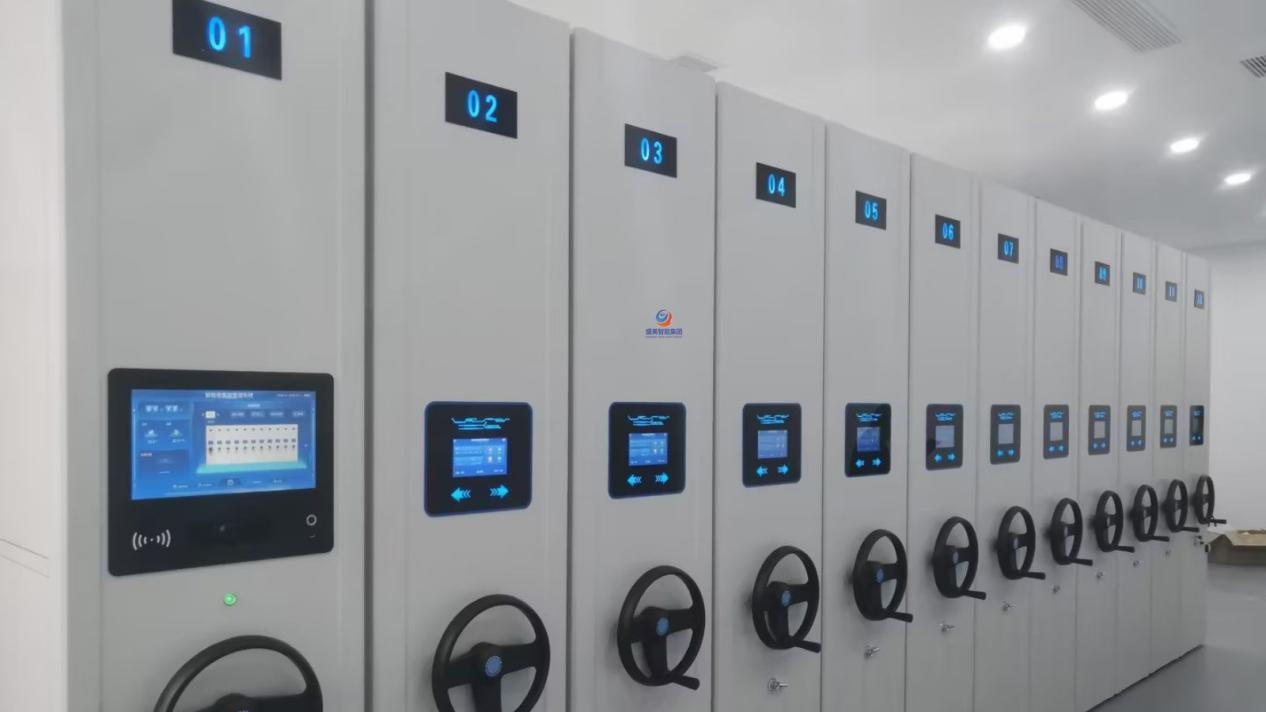
A continuous bank of mobile archive shelving — every wheel drives a column along the embedded rail, opening just one working aisle at a time.
How Mobile Archive Shelving Reaches High Density in a Retrofitted Archive Room
A retrofitted archive room can roughly double its storage density with mobile archive shelving. The performance comes from three archive-grade design principles.
Rail-mounted movement eliminates wasted space
Mobile shelving runs on embedded floor rails. Multiple columns sit flush together; only the column being accessed opens to form a single working aisle, while every other column stays compressed. This erases the multiple fixed aisles of conventional shelving and frees 60%+ of the previously idle archive-room floor.
Archive-specific modular sizing reduces packing gaps
Shelf pitch is freely adjustable; the frame is sized for standard archive boxes, accounting vouchers, and bound volumes; posts are slim while usable shelf area is large. Each level can be packed nearly flush, maximizing every inch of the retrofitted room and cutting gap loss.
Heavy-duty structure enables fully loaded storage
Thicker cold-rolled steel, an integrated welded chassis, and reinforced beams deliver high per-shelf load capacity. Archives can be fully loaded for the long term without excessive safety margin, unlocking the maximum storage performance of the existing archive room.
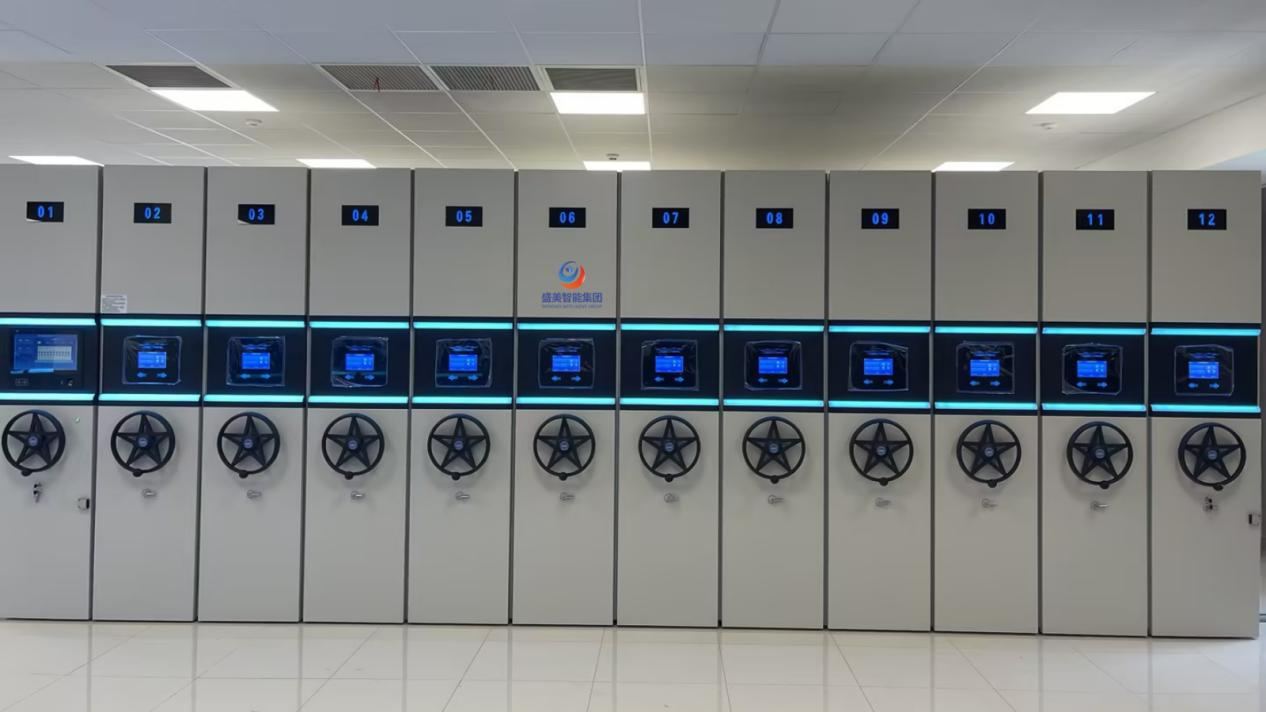
A complete archive-room retrofit built from rail-mounted mobile shelving — capacity more than doubled without expanding the building footprint.
Real-World Project Data Comparison
A 200 m² general warehouse in Putian, Fujian, was fully retrofitted into an archive room. The initial layout used traditional light-duty commercial shelving. Theoretically the room held only about 400,000 volumes, and within two years of operation it was saturated. New records had nowhere to go, and the room urgently needed another retrofit.
After switching to rail-mounted mobile archive shelving, with the same floor area, the same clear ceiling height, and the same fire-protection conditions, theoretical maximum capacity climbed to roughly 900,000 volumes (real-world operations reserve a safety margin). Storage volume more than doubled, completely solving the records-growth problem — no expansion, no extra leased warehouse, and the long-term archive capacity was built in one go.
From a cost perspective, commercial shelving has a lower unit purchase price, but its cost per archived volume in a retrofitted archive room is high. Mobile shelving has a higher upfront cost, but in this case the unit storage cost was about 40% of the light-duty commercial option. (This ratio varies with configuration, tariffs, and logistics.) Over the full lifecycle, mobile shelving is far more cost-effective. For a warehouse converted into an archive room, storage density directly determines the room's service life and long-term operating cost.
Selection by Scenario — Where Each System Truly Belongs
Many archive rooms run out of capacity right after retrofit. The root cause is equipment-scenario mismatch. Commercial shelving and mobile shelving each belong to their own scenario; in an archive room they are not interchangeable.
Commercial shelving — Not recommended as the primary archive-room storage system. It is suitable only for limited, temporary, or transit items in the room. Its multiple fixed aisles consume too much of the archive-room floor and cannot meet long-term, high-volume archive needs.
Mobile archive shelving fits — general-purpose factory or office buildings being fully converted into enterprise archive rooms, government records archive rooms, education and medical archive rooms, and historical records archive rooms. The room footprint is fixed, you want to squeeze out the maximum existing capacity, and the room must keep accepting archive growth over time. The core needs here are high density, long-term preservation, and compliant storage.
Edge-case note — Mobile shelving is optimized for archive departments with a small operations team. If many staff routinely request different columns at once, queues can form; large archive-room projects should refine the floor-plan layout in advance.
FAQ
If the retrofitted archive room already feels generous in floor area, is high storage density still necessary?
Mobile shelving keeps only a single working aisle. Will that hurt access efficiency in a retrofitted archive room?
A small warehouse being converted into an archive room — volume is limited. Is mobile shelving worth the density gain?
Conclusion
Field data makes the picture clear: when a general warehouse is converted into an archive room, commercial shelving delivers low density and significant waste, and cannot sustain long-term archive growth. Mobile archive shelving — built on purpose-engineered rails and archive-specific modular sizing — nearly triples the number of boxes stored, lifts archive-room space utilization dramatically, and lengthens the expansion cycle.
For professional archive rooms built from converted general warehouses, mobile archive shelving is the data-aligned, industry-compliant choice if you want efficient use of the room, durable storage of records, and compliant long-term expansion. Let field measurements drive the selection, and solve space shortage, saturation, and recurring retrofits at the root.
Disclaimer — All storage-density figures in this article come from typical archive-room retrofit cases. Results vary slightly with original ceiling height, building layout, archive format, and annual archive intake. The data is provided as selection reference only and does not constitute a binding standard.
Archive Room Retrofit — Storage Density Calculation & Project Technical Consultancy
For projects converting a general warehouse into an archive room — new builds or capacity upgrades — we provide storage-capacity calculation, archive storage capability assessment, and archive-room layout planning. Outputs include commercial shelving vs mobile shelving selection comparison reports, tender technical-parameter templates, and procurement-risk notes, helping you avoid equipment mismatch, capacity mis-estimation, and under-utilized space in retrofitted archive rooms.
For consistency, please use this email subject line format: “Archive Room Retrofit Capacity Consultancy + Original Room Floor Area + Project Type”. Example: “Archive Room Retrofit Capacity Consultancy + 200 m² Warehouse-to-Archive Conversion + Retrofit Expansion Project”. Please include the original room dimensions, archive box format, and annual archive intake so we can quickly complete capacity calculation and proposal evaluation.