Outdoor Racking Is Unsuitable for Archive Storage: Why Paper Archives Need Mobile Archive Shelving
A deep professional breakdown of the fatal flaws of storing paper archives on outdoor racking, and why permanent archiving must be entrusted to professional mobile archive shelving.
In equipment procurement for overseas projects, government and enterprise supporting programs, and industrial park institutions, many purchasers fall into a fatal misconception: believing that "all shelving is general-purpose and any shelving that can bear weight can store archives," they casually use outdoor storage racking to hold paper archives. To save budget and standardize storage equipment, a number of projects purchase open outdoor racking in bulk to furnish their archive rooms. It appears to complete the shelving and filing task in the short term, yet over the long term it triggers a chain of costly losses — large-scale archive damage, failed compliance inspections, and irreversible loss of assets.
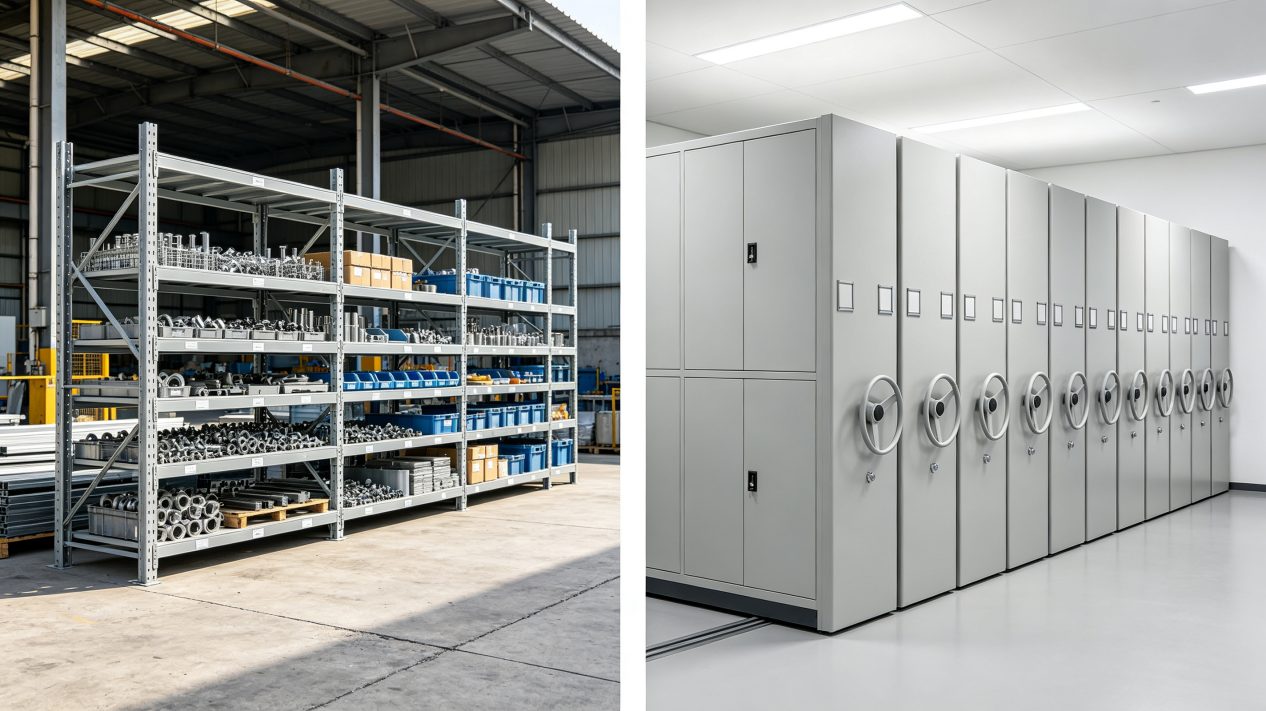
The core design positioning of outdoor racking is outdoor, open-air, semi-open-air, heavy-duty industrial, and weather-resistant storage. It suits the storage of industrial goods such as pipes, hardware, materials, and equipment spare parts. It carries absolutely none of the precision protection, constant temperature and humidity, dust-proof and light-proof, anti-corrosion, and anti-aging features designed for paper archives. Paper archives, by contrast, are highly sensitive, high-value, traceable special document assets that must be preserved permanently, and they impose stringent professional requirements on storage environment, equipment structure, protection standards, and management systems.
Countless archive operation and maintenance cases at home and abroad confirm: when paper archives are stored on outdoor racking, yellowing and embrittlement, moisture and mold, faded handwriting, dust accumulation, and insect and pest contamination appear within one to two years; within about three years, batches of archives are scrapped beyond repair. This article dismantles the fatal drawbacks of storing archives on outdoor racking across five dimensions — structural design, environmental adaptability, material characteristics, compliance standards, and long-term cost — and sets them against the exclusive advantages of professional mobile archive shelving, giving a clear answer to: why paper archives must never be stored on outdoor racking, and why permanent archiving requires professional mobile archive shelving. It offers authoritative, actionable grounds for overseas archive project procurement, tender and bidding selection, and archive room renovation.
I.The Fundamental Mismatch: Outdoor Racking and Paper Archive Design Scenarios Are Fundamentally Contradictory
Every equipment performance shortcoming is essentially a structural problem caused by scenario mismatch. The contradiction between outdoor racking and archive storage is predetermined at the product design stage.
Designed for Tough Industrial Materials
The core development and design goals of outdoor racking are to withstand harsh outdoor environments, resist wind and rain, sun exposure, and temperature differences, carry heavy industrial loads, and suit coarse storage management. To adapt to open-air and semi-open-air industrial scenarios, outdoor racking adopts a fully open, through-structure with widened gaps, no closed protection, and weather-resistant coating design — prioritizing ventilation and drainage to avoid outdoor water accumulation and rust, while giving no consideration at all to the preservation needs of fine articles.
Archives Demand a Delicate, Controlled Environment
The core storage needs of paper archives are constant temperature and humidity, enclosed dust-proofing, light-proof and heat insulation, moisture and mold resistance, stability without corrosion, safety and controllability, and long-term low aging. Paper is made of plant fibers and is highly susceptible to light, temperature and humidity fluctuations, dust, harmful gases, and corrosive substances — undergoing oxidation hydrolysis, acidification and embrittlement, and mold damage. It is a classic "delicate, long-term storage asset."
II.Five Fatal Hazards: The Irreversible Damage of Outdoor Racking on Paper Archives
Compared with ordinary indoor shelving, outdoor racking has more extreme environmental adaptability, and its hazards are far more prominent when used for archive storage. Five core hazards directly destroy the service life of paper archives.
1. Fully Open Without Protection — Light and UV Rapidly Accelerate Archive Aging and Embrittlement
Outdoor racking has no side panels, no doors, and no shielding, exposed to natural light, strong indoor light, and ultraviolet for long periods. Under UV radiation, paper fibers rapidly undergo oxidation reactions that break down the molecular structure, causing archives to quickly yellow and embrittle, greatly reducing folding endurance, while ink and handwriting accelerate decomposition and fading. Under ordinary indoor diffuse light, archives stored on outdoor racking age 3–5 times faster than those stored in professional enclosed mobile shelving. Within three years of storage, paper can reach a powdering, crumbly state that is scrapped on contact.
2. Excessive Ventilation Without Climate Control — Severe Temperature and Humidity Fluctuations Induce Mold
Outdoor racking is engineered for full-area ventilation and unblocked moisture dispersion, suited to outdoor rain-proofing and air-drying. But for an archive room, this is a fatal flaw. Paper archives require a stable, constant-temperature, constant-humidity micro-environment; industry standards call for humidity held between 45%–60%. The open structure cannot lock in the archive-room micro-climate. Day-night temperature differences and seasonal moisture changes act directly on the archive surface: high humidity quickly absorbs moisture, causing mold and clumping; dry weather causes dehydration, cracking, and curling. Repeated dry-wet alternation completely destroys the paper fiber structure, causing irreversible damage.
3. Industrial Weather-Resistant Materials — Prone to Corrosion and Static Contamination of Archives
To meet outdoor rust-prevention requirements, outdoor racking often uses thickened galvanized or powder-coated industrial coatings, with large exposed gaps in the metal substrate. Over long-term use, coating wear and air oxidation produce trace metal dust and rust particles. Meanwhile, metal racking easily generates static electricity, continuously attracting dust, mold spores, and suspended pollutants from the air. These particles adhere to the archive surface, continuously catalyzing paper acidification and hydrolysis and accelerating aging. Accumulated dust is hard to clean, causing surface wear and blurred handwriting. In addition, some outdoor racking materials contain trace chemical additives that slowly release over time and indirectly contaminate paper documents.
4. Open With No Security — Archive Loss, Information Leaks, and Complete Management Collapse
Outdoor racking has no locking structure, no partition isolation, and no anti-tip restraints, primarily open for free access. When used for archive storage, anyone can browse, extract, swap, or take out archives at will, easily causing management loopholes such as archive loss, misfiling, information leaks, and tampering. At the same time, the open layout cannot achieve standardized classified and zoned management; archives are piled in a disorderly manner, making ledger reconciliation and traceability queries extremely inefficient. This completely fails to meet the standard management requirements of overseas archive rooms.
5. Coarse Structural Adaptation — Easily Causes Physical Crushing and Damage to Archives
Outdoor racking has large shelf spacing, thick and wide frames, and redundant load-bearing gaps. Designed for irregular industrial materials, it cannot accommodate the neat arrangement of standard archive boxes. Stored archives tend to have gaps and collapse, unevenly distributed shelf loading, and tilting and compression. Long-term storage deforms archive boxes, creases documents, and damages corners. The open racking also has no cushioning protection, so personnel bumping and air disturbance can cause archive displacement and damage.
III.Outdoor Racking vs. Mobile Archive Shelving: Professional Storage Parameter Comparison
To facilitate benchmark selection for overseas projects, tender parameter preparation, and compliance review, the following precise data comparison covers six dimensions — protection capability, environmental adaptability, storage standards, safety management, service life, and compliance rating — intuitively showing the gap between the two.
| Dimension | Outdoor Storage Racking | Professional Mobile Archive Shelving |
|---|---|---|
| Structure | Fully open through-structure, no enclosed protection | Fully enclosed cabinet structure, can be completely closed and locked |
| Light Protection | Zero shielding; UV and strong light strike archives directly | Full light-blocking design, eliminates light-induced aging damage |
| Temperature & Humidity | Ventilation without control; temperature and moisture act directly on archives | Locks in archive-room micro-climate, constant moisture and temperature |
| Dust & Contamination | Very poor; static dust accumulation and rust-particle contamination | Enclosed dust-proofing, no contaminants reach the archives |
| Safety Management | No locking, no zoning, no protection; management out of control | Full locking, zoned control, anti-tip restraints, safe and controllable |
| Space Utilization | Fixed multiple aisles; utilization below 40% | Rail-mobile compressed aisle, utilization reaches 85%–90% |
| Archive Adaptability | Suited to industrial materials; entirely unsuitable for paper archives | Archive-specific module, standard archive boxes in orderly storage |
| Compliance Rating | Fails archive standards; fails audit | Meets EN15095, OSHA & archive standards |
| Sources refer to international archive-storage safety standards and industry practice. Actual values shall be verified per project acceptance requirements. | ||
IV.Mobile Archive Shelving: The Solution Tailored for Long-Term Paper Archive Preservation
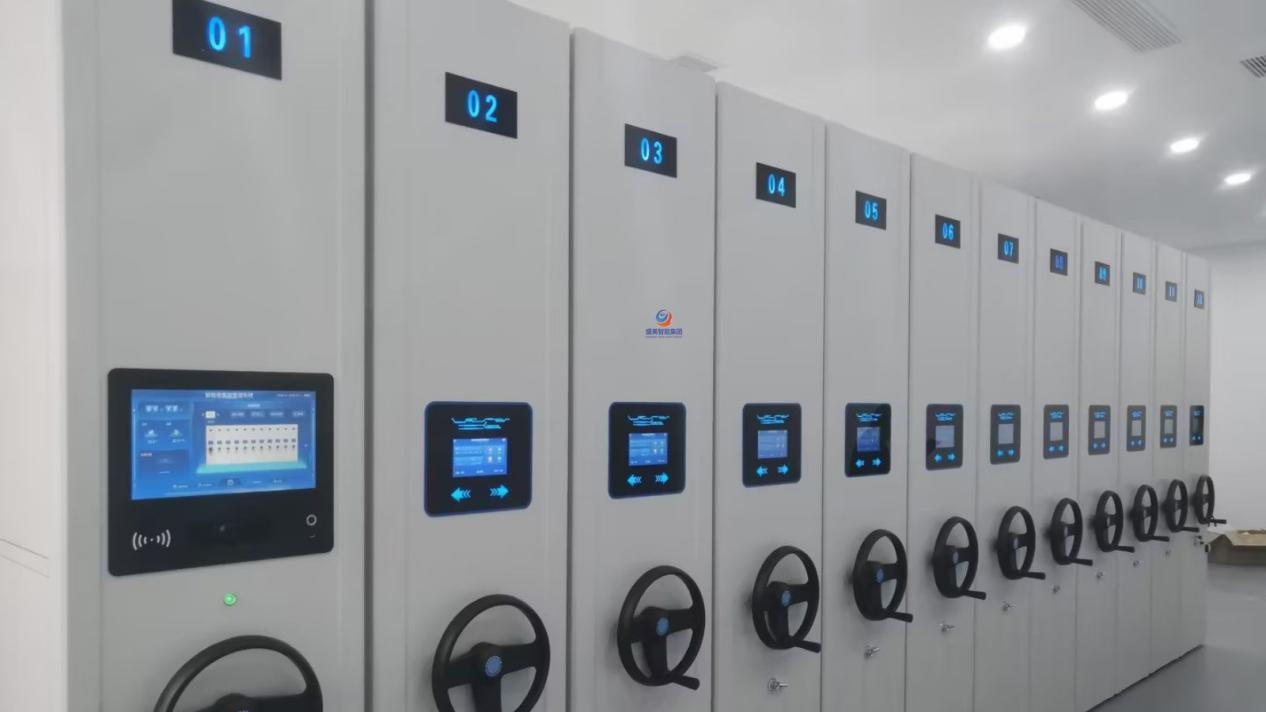
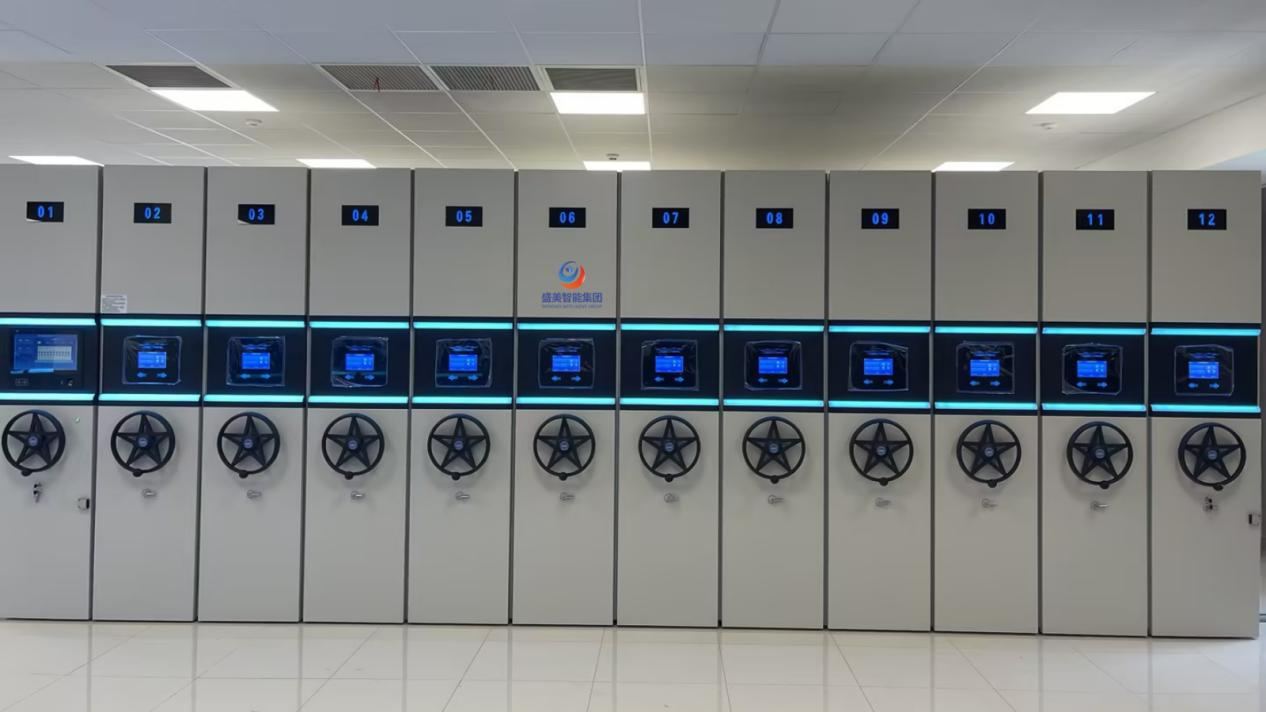
Compared with the all-dimensional shortcomings of outdoor racking, mobile archive shelving precisely matches the permanent storage needs of paper archives across five dimensions — structure, materials, function, protection, and management. It is the only compliant selection for professional archive rooms at home and abroad.
1. Fully Enclosed Light-Proof Protection, Eliminating Archive Aging at the Source
Mobile archive shelving uses an overall enclosed cabinet design. When closed, it forms an independent airtight storage space that completely isolates natural light, UV, and strong indoor light, thoroughly blocking the oxidation and embrittlement reactions triggered by light. The enclosed structure also blocks dust, insects, and floating pollutants, keeping archives in a clean, light-free, stable storage environment for a long time, greatly extending archival preservation life.
2. Locked Micro-Environment, Adapted to Constant Temperature and Humidity Storage
The enclosed cabinet coordinates with the archive-room constant temperature and humidity system, locking in a stable micro-environment and avoiding severe external humidity and temperature fluctuations. It effectively prevents archive moisture, mold, adhesion, cracking, and curling, perfectly matching the environmental standards for long-term paper archive preservation and solving the core pain point of excessive ventilation and environmental loss of control in outdoor racking.
3. Archive-Specific Materials and Processes — Zero Corrosion, No Contamination
Professional mobile archive shelving uses high-quality cold-rolled steel plate, processed through multiple pickling, phosphating, and electrostatic powder-coating treatments. The surface is smooth with no dust, no rust, and no chemical volatiles. It generates no static attraction and causes no contamination or corrosion to paper archives. The material structure is stable, with long-term use showing no aging, peeling, or dust generation, adapted to decades of long-term archival storage.
4. High-Density Compact Storage, Adapted to Long-Term Archive Growth
Relying on the floor rail mobile structure, mobile shelving discards the redundant multi-aisle layout of outdoor racking and achieves a "multi-bank shelf with a single shared aisle" compact model, doubling the space utilization of the archive room. Under the same area, storage capacity is 2.5–3 times that of outdoor racking, without frequent archive-room renovation or new equipment, perfectly adapting to the annual archive growth of enterprises and institutions.
5. Standardized Safety Management, Compliant With Domestic and Overseas Audits
Mobile shelving is equipped with an overall master lock, zoned locking, anti-tip restraints, anti-collision buffering, and other professional safety structures, enabling classified and zoned archiving, permission control, and traceability management, thoroughly solving the management loopholes of open racking. The equipment parameters fully benchmark against international archive storage safety standards and come with complete English technical documentation, allowing smooth passage of overseas project acceptance, compliance audits, and qualification registration.
V.Precise Applicability Boundaries of Outdoor Racking and Mobile Shelving
The Only Applicable Scenario for Outdoor Racking
Suitable only for outdoor, semi-open-air, and industrial warehouse scenarios — for storing hardware and materials, equipment accessories, pipes, packaging goods, temporary turnaround items, and weather-resistant industrial materials. It is strictly prohibited for any paper archives, documents, and permanently filed materials.
The Mandatory Scenario for Mobile Archive Shelving
All paper materials requiring long-term preservation, permanent archiving, and compliance audit must use mobile shelving: government and enterprise contract archives, completion documents, historical archives, medical and educational archives, legal documents, overseas institution archives, and various traceable paper archive rooms.
VI.Outdoor Racking Looks Cheap, But Causes Enormous Waste
Many purchasers choose outdoor racking for archive storage mainly because of its low unit price and strong versatility, but the long-term comprehensive cost is extremely high.
Archives stored on outdoor racking show batch damage and scrapping within 2–3 years, requiring substantial manpower for sorting, re-archiving, and repairing or replacing. At the same time, cluttered and non-compliant archive storage generates rectification costs, audit deductions, and project rework losses; later, when storage becomes saturated, a second round of procurement and renovation is needed.
Mobile archive shelving, by contrast, is a one-time infrastructure investment with 15–20 years of stable use — zero archive loss, zero compliance rectification, and no frequent equipment replacement. With the advantages of long-term low maintenance, zero loss, and high capacity, it greatly reduces the whole-life-cycle operating cost of the archive room and is the truly cost-effective professional solution.
VII.Frequently Asked Questions
From Casual Storage to Standardized, Compliant Preservation
Outdoor racking is industrial storage equipment; its core value is weather resistance, heavy load, and coarse storage. Mobile archive shelving is professional filing infrastructure; its core value is preservation, compliance, long-term durability, and density. Paper archives are non-renewable, high-value assets that cannot withstand the coarse waste of general-purpose outdoor equipment.
Giving up outdoor racking and upgrading to professional mobile archive shelving is not merely an equipment upgrade — it is the inevitable progression of archive management from "casual storage" to "standardized, compliant preservation." It protects the long-term integrity and safety of paper archives while ensuring the compliant implementation and long-term operation of archive projects at home and abroad.
Need Archive Room Equipment Selection & Compliance Consulting?
Unsure about the right storage type, or worried that misusing outdoor racking will cause archive loss and failed acceptance? Shengmei Cabinet offers free diagnosis for overseas archive-room equipment selection, scenario adaptation solutions, compliance parameter comparison, capacity measurement, and renovation budget lists — with full English technical documentation and overseas project acceptance coordination, one-stop solutions to archive-room storage compliance.
Disclaimer: This article is provided for science popularization and technical reference on archive-room equipment selection at home and abroad. Specific compliance standards should be adapted to local archive management regulations and project acceptance requirements. This platform does not assume responsibility for archive loss and compliance issues caused by equipment mismatch.