Hidden Risks of Intermediaries in Archive Compactor Shelving Cross-Border Procurement
This article is part of the Shengmei Cabinet standardized bilingual technical white-paper series on foreign trade risk control. Its layout, hierarchy, and writing style are synchronized with the official website white-paper standards, tailored for cross-border engineering procurement, overseas archive warehouse projects, foreign trade bidding, and cross-border equipment procurement scenarios.
Archive compactor shelving is a specialized, customized infrastructure asset for overseas government agencies, hospitals, universities, and archives. Cross-border transactions involve long lead times, numerous custom parameters, strict compliance requirements, and extended after-sales cycles. The industry relies heavily on intermediary matchmaking. However, intermediary-led cross-border procurement models are rife with hidden risks: information opacity, specification swapping, counterfeit certifications, accountability fragmentation, suspended after-sales service, remittance defaults, and compliance arbitrage. This white paper systematically dismantles the full-process hidden risks unique to the archive compactor shelving industry, their root causes, real-world damage, identification methods, and a complete prevention and control solution—providing overseas clients, cross-border general contractors, foreign trade buyers, and engineering service providers with a practical, risk-controllable, and compliance-ready procurement safety system.
Industry Specifics and the Logic Behind Intermediaries
Unlike standardized general industrial products, archive compactor shelving is a non-standard, project-matched, compliance-intensive, long-service professional storage facility. Every project must be customized according to the overseas archive warehouse dimensions, load-bearing capacity, fire-safety regulations, local certifications, and archive storage standards. It cannot be shipped in bulk as a universal product.
Because of the industry's high specialization, significant overseas information asymmetry, complex project coordination, and demanding localization requirements, foreign trade intermediaries have become a standard presence in cross-border compactor shelving procurement chains.
Intermediaries perform client liaison, translation, project matchmaking, local communication, bidding assistance, and on-site coordination—reducing overseas clients' procurement overhead to some extent. However, in real-world foreign trade execution, the vast majority of procurement disputes, project rework, failed inspections, lost after-sales contact, compliance penalties, and financial losses are not caused by factory quality issues but by intermediary hidden-operation risks. Compactor shelving is long-term infrastructure equipment; once a pitfall is buried during the early stage, later remediation costs are extremely high and may even render an overseas archive warehouse project a total write-off.
Unlike ordinary small-commodity foreign trade, compactor shelving trade is characterized by large per-order amounts, irreversible customization, strict acceptance criteria, long after-sales cycles, difficult cross-border rights protection, and strong compliance linkages. Hidden risks have long incubation periods and severe consequences when they erupt, requiring systematic analysis and front-end prevention.
Full-Process Hidden Risk Overview (Industry-Specific)
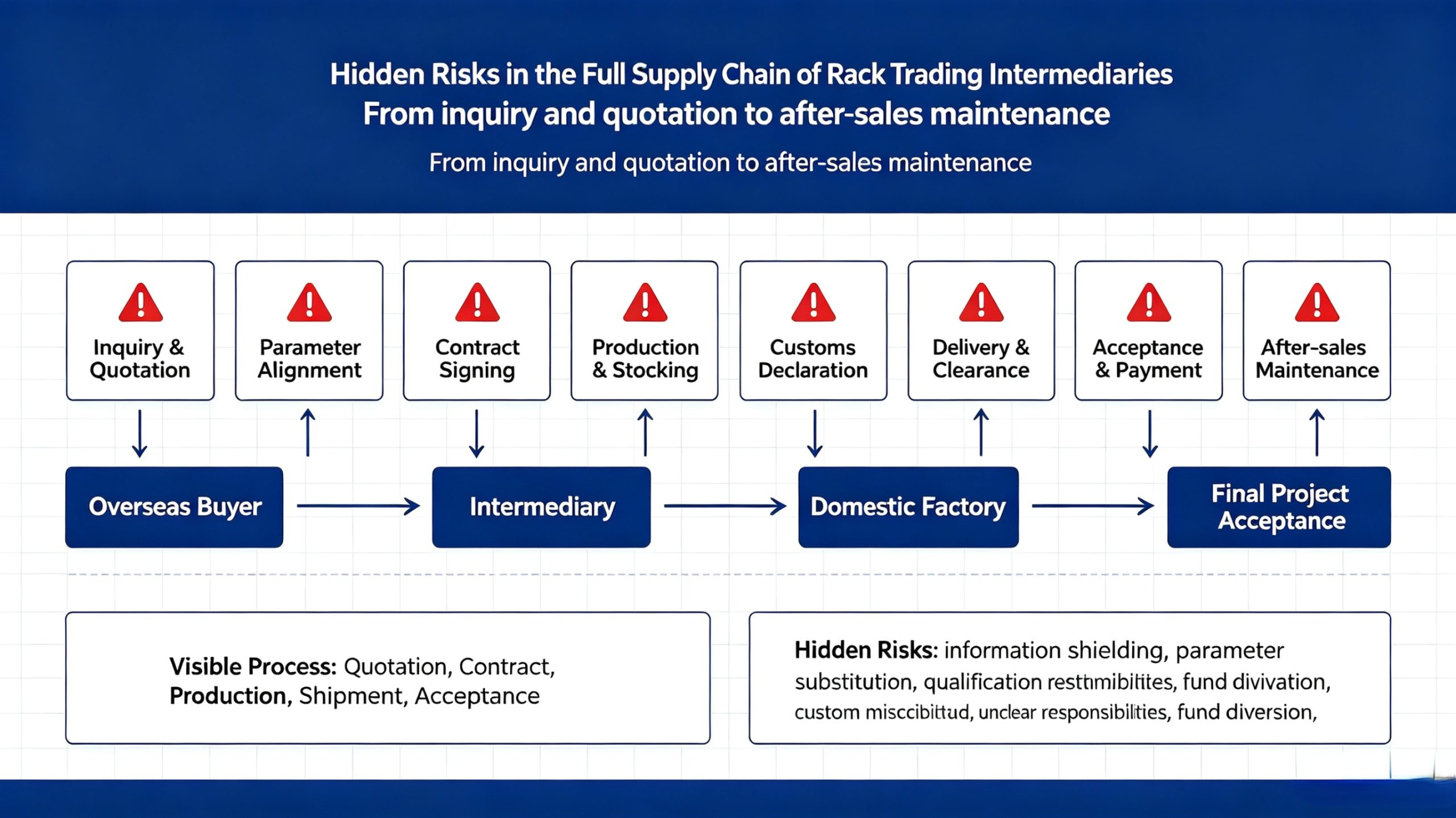
Drawing on extensive hands-on experience with overseas archive compactor shelving cross-border projects, intermediary risks run through the entire chain from inquiry and quotation, parameter alignment, contract signing, production and stocking, customs declaration and shipping, customs clearance and delivery, acceptance and payment collection, to after-sales maintenance. Most risks are highly concealed and undetectable by the buyer in the early stages, only surfacing during project acceptance, audit, or equipment failure—typical rear-loaded risks. This paper breaks down the most frequent, most concealed, and most damaging hidden risks in the industry into eight categories.
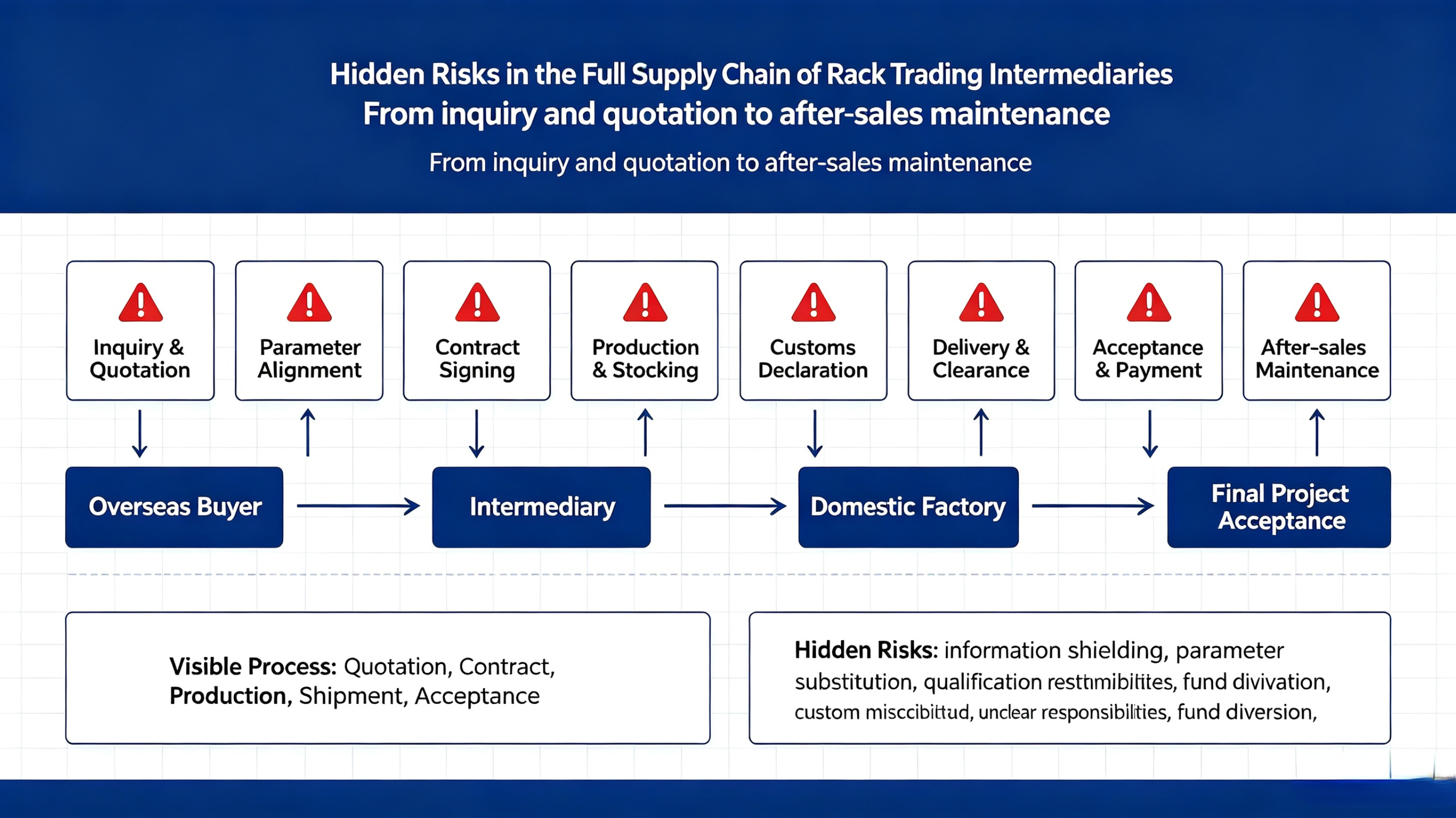
(1) Information Shielding Risk: Bidirectional Information Fragmentation and Deliberate Information Asymmetry
This is the most fundamental and most frequent hidden risk of intermediaries in the compactor shelving trade, and the root cause of all derivative risks. To lock in margin profits, most intermediaries adopt a bidirectional information shielding mechanism: concealing from the overseas client the factory's qualifications, true manufacturing processes, ex-factory costs, and customization standards; and concealing from the production factory the overseas local compliance requirements, acceptance details, warehouse operating conditions, and project audit standards.
In customized compactor shelving projects, parameter precision directly determines whether the project meets compliance standards. To simplify coordination and close deals quickly, intermediaries often omit overseas archive warehouse load-bearing data, height restrictions, climate adaptation needs, and local medical/educational/government compliance clauses, transmitting only basic dimensions. The factory then produces to generic standards, resulting in equipment with corrosion resistance incompatible with overseas salt-fog climates, structural strength insufficient for long-term heavy loads, smart systems incompatible with local voltage, or antibacterial processes failing hospital infection-control requirements. Ultimately the overseas project cannot pass acceptance, leading to rework, return shipping, and remanufacturing losses.
At the same time, intermediaries deliberately block direct contact between the client and the factory. The overseas client cannot obtain original English drawings, compliance certificates, maintenance logs, or after-sales guarantee documents, causing permanent disconnects in subsequent annual audits, inspections, and equipment maintenance.
(2) Specification Swapping & Configuration Shrinking Risk: Overcharging for Under-Delivery
Archive compactor shelving is available in multiple grades—standard, overseas heavy-duty, medical antibacterial, smart traceability, and high-corrosion salt-fog—with enormous price differences in sheet thickness, powder-coating process, motor brand, sensor configuration, corrosion grade, and smart-system version. Some unscrupulous intermediaries exploit overseas clients' lack of industry knowledge and inability to verify original factory standards to engage in serious specification-swapping hidden operations.
Common hidden swapping scenarios: the overseas client's tender requires 1.2 mm thickened national-standard sheet, medical antibacterial electrostatic powder coating, imported smart motors, and fully enclosed dust-proof/corrosion-proof structures. The intermediary verbally promises high-end specs during signing but actually orders from the factory thin sheet, ordinary powder coating, off-brand motors, simplified sealing structures, and a stripped-down smart traceability module—pocketing a huge margin difference. Compactor shelving is concealed-engineering equipment; sheet thickness, internal structure, and anti-corrosion processes are hard to distinguish visually. Short-term use shows no obvious problems, but within 1–3 years the cabinet body deforms, coating rusts, motors jam, systems fail, and archives are exposed to moisture and contamination. By then the final payment has been settled and the intermediary has disappeared, leaving the overseas client with no channel for recourse.
Furthermore, some intermediaries privately cut project accessories: omitting English construction drawings, compliance test reports, operation manuals, spare-part kits, and commissioning services, causing the equipment to fail customs clearance, acceptance, and compliance filing upon arrival—directly affecting the overall rating of the overseas archive warehouse project.
(3) Counterfeit Certifications & Compliance Arbitrage Risk: Fabricated Documents and Acceptance Landmines
Overseas archive compactor shelving projects have strict compliance requirements for CE, RoHS, EN15095, OSHA, medical antibacterial testing, and anti-corrosion salt-fog testing. Some overseas hospital, university, and government archive projects require full sets of English compliance documentation, original factory authorization, and third-party inspection reports to pass audit and acceptance.
A large number of unqualified intermediaries do not hold formal original factory authorization. To meet bidding and acceptance needs, they engage in hidden violations such as Photoshop-forged certificates, borrowing other factories' qualifications, altering test data, or misusing original factory authorization documents. These may temporarily pass in the early stage of the project, but during overseas annual audits, compliance reviews, or third-party spot checks, false qualifications are directly exposed—leading to project rating downgrades, audit deductions, archive warehouse shutdowns, mandatory equipment dismantling, and project liability claims.
The core hidden danger is that certification fraud risk has an extremely strong lag; it is not an immediate risk but is typically exposed 1–2 years after project delivery during compliance review. At that point cross-border recourse, claims, and rectification are extremely difficult, and all losses are borne entirely by the overseas client and general contractor.
(4) Contractual Accountability Vacuum Risk: Ambiguous Tripartite Responsibility and No Safety Net
Compactor shelving intermediary foreign trade transactions commonly have hidden loopholes of misaligned contract subjects and fragmented accountability—the core reason for the high incidence of foreign trade disputes. The conventional cross-border transaction model is: overseas client signs with the intermediary, and intermediary signs with the domestic factory, forming a dual contract chain. It appears closed-loop, but in reality contains a huge accountability vacuum.
First, quality accountability is suspended: the contract only stipulates basic appearance and dimensions, without specifying overseas adaptation processes, corrosion grades, smart parameters, acceptance standards, or maintenance clauses. When quality problems arise, the intermediary blames the factory for production issues, the factory blames the intermediary for parameter misalignment or overseas condition mismatch, and all three parties pass the buck with no one taking responsibility for rectification.
Second, delivery accountability is vague: delivery timelines, on-site installation, bilingual training, commissioning services, and spare-part guarantees promised by the intermediary are not written into the formal contract, rendering all verbal promises invalid. After the equipment arrives, problems such as missing parts, wrong parts, no installation contact, and no commissioning service severely delay the overseas archive warehouse completion schedule.
Third, claims accountability is missing: cross-border return shipping, rework, delay compensation, and breach-of-contract penalty clauses are vague. When problems occur the intermediary simply disappears, leaving the overseas client unable to pursue cross-border liability, freeze funds, or defend their rights.
(5) Capital Chain Hidden Risk: Intercepting Payments, Delaying Remittances, and Capital Misappropriation
In the foreign trade remittance chain, intermediaries hold capital-transfer authority, giving rise to multiple hidden capital risks—especially in large-value compactor shelving engineering projects. First, payment interception and misappropriation: after the overseas client pays in full, the intermediary intercepts part of the funds and places a low-config order with the factory, causing severe specification shrinkage. Second, delaying payment to the factory causes delayed scheduling, deferred shipping, and reduced supporting services, resulting in serious project delays.
Meanwhile some intermediaries exploit overseas clients' unfamiliarity with foreign trade settlement rules to invisibly arbitrage through changed settlement accounts, split payments, vague exchange-rate clauses, and inflated logistics costs—increasing overseas procurement costs. In extreme cases, individual malicious intermediaries collect full payment and then disappear completely, causing the overseas client total loss of both money and goods, fully matching the characteristics of foreign trade fraud.
(6) Logistics & Customs Hidden Risk: Under-Declaration, Shoddy Packaging, and Difficult Damage Claims
Archive compactor shelving is large-scale steel engineering equipment with complex disassembly, large volume, and susceptibility to collision and moisture. It has strict requirements for export packaging, reinforcement, customs declaration, and ocean-freight moisture protection. To compress logistics costs and pocket logistics margins, some intermediaries engage in multiple hidden violations.
First, simplifying packaging: canceling professional moisture-proof film, anti-rust packaging, cabinet reinforcement, and corner protection. Under long overseas shipping cycles and high-humidity salt-fog environments, the equipment arrives with paint abrasion, sheet corrosion, missing accessories, and structural deformation. Second, customs under-declaration, omission, or incorrect product names cause overseas customs clearance obstruction, tariff back-payment, customs fines, and cargo detention—generating high demurrage and customs clearance fees. Third, privately consolidating containers and mixing miscellaneous goods violates overseas import supervision regulations, triggering compliance penalties.
These risks are extremely concealed; buyers cannot verify packaging and customs details in advance. After cargo damage and customs issues erupt, intermediaries deflect responsibility citing logistics force majeure and overseas customs rules, leaving all losses to be borne by the buyer.
(7) After-Sales Maintenance Vacuum Risk: No Long-Term Guarantee and Disconnected After-Sales Contact
Archive compactor shelving is 15–20 year long-cycle equipment. Overseas projects have hard requirements for maintenance, spare parts, troubleshooting, system upgrades, and annual inspections—the core of compliant operation for overseas archive warehouses and also the biggest weak point of the intermediary foreign trade model.
The vast majority of intermediaries operate on a one-time transaction basis, with no overseas after-sales team, no spare-part reserves, and no technical operation and maintenance capability. Once the transaction is complete and profit secured, they basically provide no further service. Six months to a year after equipment use, motor failures, sensor malfunctions, track jams, system errors, and cabinet corrosion appear. When the overseas client contacts the intermediary, they are often unreachable, delayed, or given the run-around.
Moreover, because the intermediary previously blocked direct client-to-factory contact, the client cannot obtain original factory technical support, cannot purchase matched spare parts, and cannot enjoy formal maintenance services—causing the equipment to run with chronic faults or even be taken out of service entirely, directly paralyzing overseas archive warehouse management and affecting the normal archiving and audit acceptance of hospitals, universities, and government archives.
(8) Project Adaptation Hidden Risk: Generic Solutions Replacing Overseas-Specific Customization
Overseas compactor shelving procurement in different countries and scenarios has strong specific adaptation requirements: tropical high-humidity salt-fog regions need high-corrosion configurations; hospital scenarios need medical antibacterial processes; European and American projects need strict OSHA safety standards; classified archives need multi-level security systems. Some intermediaries lack overseas engineering experience, do not understand national operating conditions and compliance differences, and directly apply domestic generic compactor shelving solutions in place of overseas customized solutions—creating serious adaptation hazards.
At first glance the equipment looks identical and the price is lower, but in reality it is completely incompatible with overseas environments and compliance standards. Short-term use shows no abnormality, but over the long term large-scale corrosion, mold, equipment failure, and compliance non-compliance appear. This is a typical low-price, low-quality solution time bomb whose later rectification cost far exceeds the initial procurement price difference.
Intermediary Procurement vs. Factory Direct Procurement — Full-Dimension Comparative Analysis
Through standardized dimension comparison, this section visually reveals the hidden defects of intermediary foreign trade procurement and the compliance advantages of factory direct procurement. It can be directly used for overseas project procurement proposals, bidding explanations, and risk-control system construction.
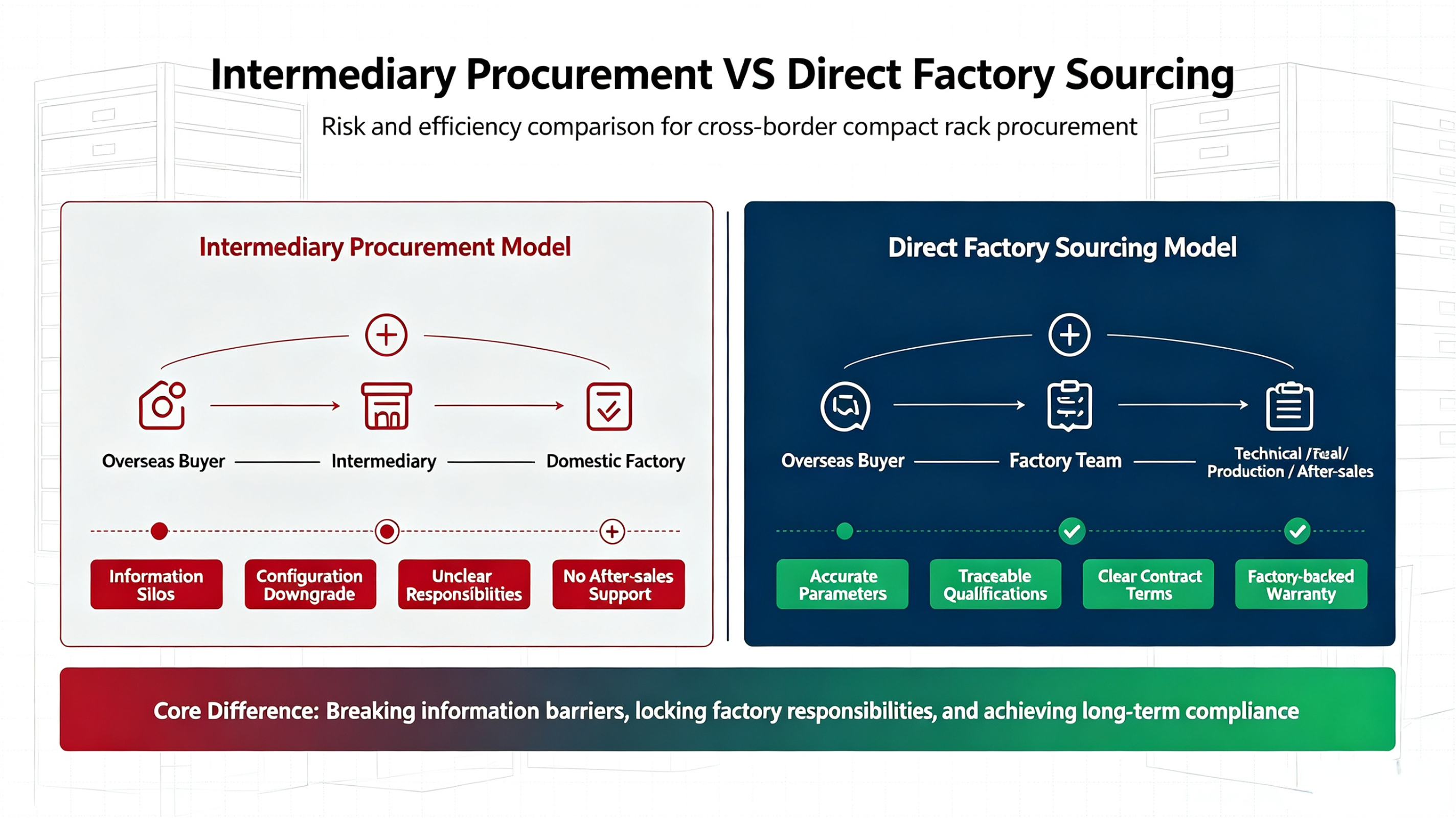
| Dimension | Intermediary Foreign Trade Procurement | Factory Direct Procurement | Core Risk-Control Difference |
|---|---|---|---|
| Information Transparency | Bidirectional shielding, information fragmentation, parameter distortion | Direct client-factory link, precise parameters, demand fulfillment | Eliminates parameter mismatch risk entirely |
| Equipment Configuration Authenticity | Overcharged under-delivery, cutting corners, config shrinkage | Transparent configuration, verifiable processes, checkable parameters | Ensures long-term stable equipment operation |
| Compliance Certification Authenticity | Counterfeit qualifications, borrowed certificates, acceptance landmines | Original factory formal qualifications, traceable, auditable | Meets overseas annual audit and inspection requirements |
| Contractual Accountability | Accountability suspended, tripartite buck-passing, no safety net | Clear accountability, factory full responsibility, after-sales guarantee | Cross-border disputes can be litigated and pursued |
| Capital Security | Interception and misappropriation, hidden arbitrage, high capital risk | Company-to-company settlement, transparent pricing, no hidden fees | Eliminates capital loss risk |
| Logistics & Packaging Guarantee | Simplified packaging, high cargo damage, many customs risks | Export-standard packaging, compliant customs, full-process warranty | Avoids logistics and customs losses |
| Long-Term After-Sales Maintenance | One-time transaction, later disconnected, maintenance suspended | Long-term O&M, spare-part reserves, remote + on-site service | Ensures 15–20 year equipment service life |
| Overseas Operating Condition Adaptation | Generic solution copying, poor adaptation, many hidden dangers | Country-specific customization, climate & compliance dual adaptation | Fully matches overseas archive warehouse standards |
High-Frequency Identification Characteristics of Intermediary Hidden Risks (Quick Self-Check List)
Summarizing high-frequency industry characteristics, buyers can quickly identify high-risk intermediaries and avoid project pitfalls in advance. Applicable to foreign trade due diligence, supplier screening, and risk-control audit scenarios.
Citing channel protection or price confidentiality to strictly prohibit overseas clients from directly communicating with the production factory, verifying parameters, checking qualifications, or confirming after-sales is the highest-risk typical characteristic.
Overseas customized compactor shelving costs are transparent. An abnormally low quotation inevitably accompanies configuration shrinkage, process downgrade, counterfeit certification, or service cuts. There are no industry cases of low-price, high-spec delivery.
Only providing blurry screenshots, unable to provide English original certificates, unable to provide official website traceability links, unable to provide original factory authorization—high probability of counterfeit or borrowed qualifications.
Actively avoids specifying processes, corrosion grades, smart parameters, maintenance duration, compensation standards, and after-sales clauses. All services are verbal promises, refusing to be written into the formal contract.
Unable to provide same-country, same-scenario compactor shelving deployed project cases, site photos, acceptance materials, or client testimonials. Unfamiliar with overseas compliance and operating condition requirements.
Only promising short-term warranty, avoiding annual inspections, spare-part replacement, system upgrades, and remote troubleshooting. No standardized after-sales system.
Full-Process Risk Control Solutions (Deployable Foreign Trade Risk Control System)
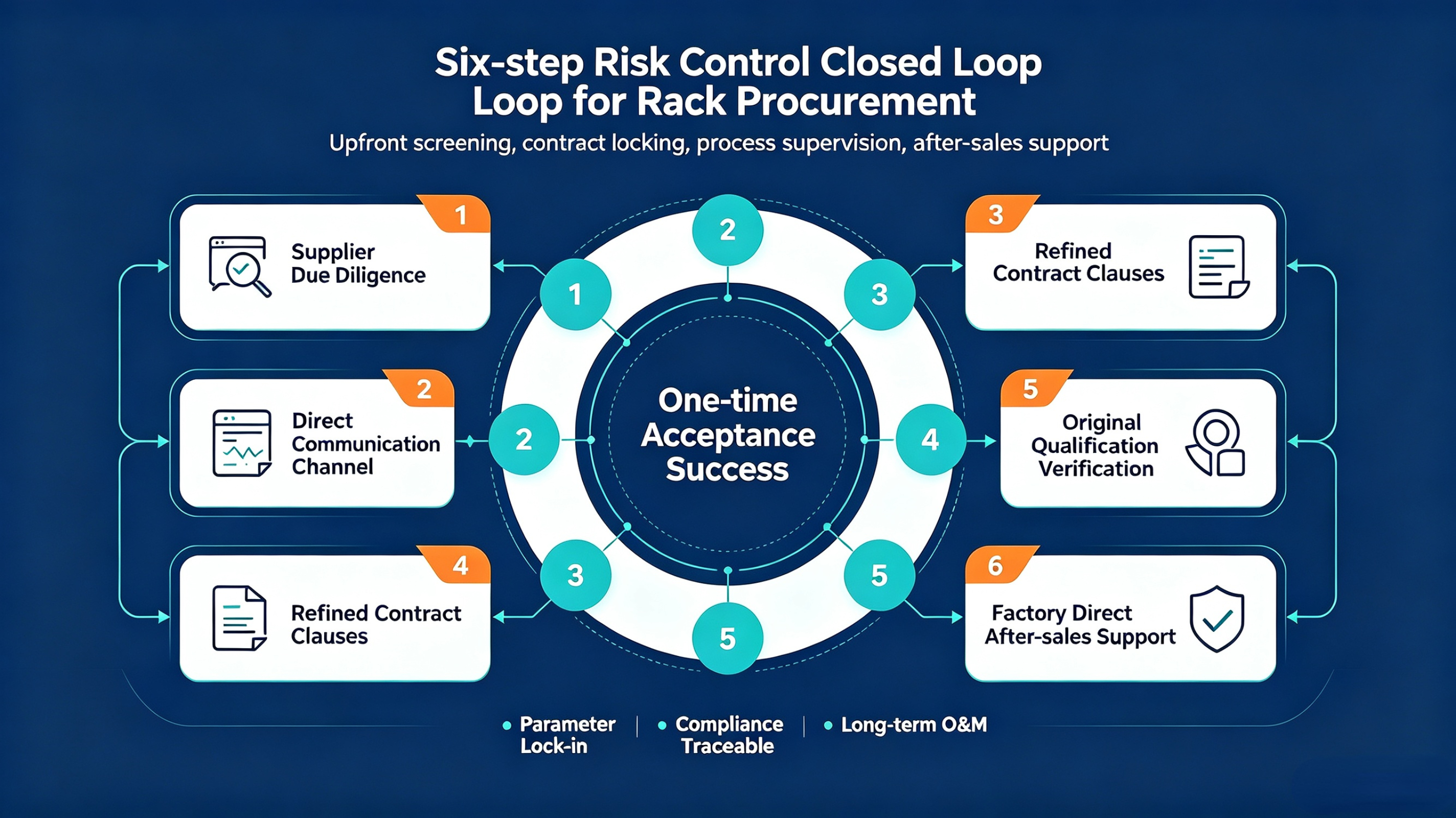
Addressing the full-chain hidden risks of intermediaries and combining hands-on experience with overseas compactor shelving foreign trade, this section establishes a six-part risk-control system of front-end screening, contract lock-in, parameter lock-in, qualification verification, process supervision, and after-sales guarantee—to completely avoid intermediary transaction hazards.
Prioritize partners with formal original factory authorization, overseas engineering deployment experience, and direct factory verification access. Eliminate shell intermediaries with no qualifications, no cases, and no physical entity. Before cooperation, verify corporate qualifications, export customs records, same-country project performance, and compliance certificates to block false partners at the source.
Throughout the project, require factory technical, foreign trade, and after-sales teams to directly participate in coordination, parameter confirmation, drawing review, andsolution finalization. All custom parameters, process standards, and compliance requirements are directly confirmed by the original factory, eliminating intermediary private tampering or parameter deletion. All English technical materials, drawings, and logs are issued directly by the original factory.
Write into the contract in detail: sheet thickness, powder-coating process, corrosion grade, smart configuration, motor brand, sealing structure, packaging standard, delivery timeline, installation and commissioning, bilingual training, maintenance duration, spare-part support, breach compensation, and rework liability. Specify unconditional replacement for configuration mismatch, full compensation for process non-compliance, and liability clauses for after-sales disappearance—eliminating accountability suspension.
All CE, RoHS, EN15095, antibacterial testing, salt-fog anti-corrosion testing, and other qualifications must be verified against original factory originals, official website traceability, and batch-specific reports. Eliminate Photoshop forgery, borrowed certificates, and expired qualifications to ensure long-term project compliance validity.
Require the factory to provide incoming material verification, production photos, process spot checks, and finished-product acceptance videos and images throughout production. Retain traceability materials for key processes. Verify configuration parameters before shipment to ensure shipped equipment is fully consistent with contract standards, eliminating intermediary low-config shipment.
Clarify that the after-sales subject is the production manufacturer, locking in original factory remote technical support, spare-part guarantees, annual inspections, and system upgrade services. These do not terminate because the intermediary transaction ends. Establish a long-term after-sales guarantee system to completely solve the pain point of overseas after-sales disconnection.
FAQ — Frequently Asked Questions on Foreign Trade Compactor Shelving Intermediary Risk Control
In the short term it is margin arbitrage and configuration shrinkage; in the long term it is compliance failure, suspended after-sales, project rework, and audit deductions. Most projects save a small amount of cost upfront, but later rectification, maintenance, and remanufacturing losses far exceed the price difference, and seriously affect the overseas archive warehouse rating.
Demand original certificate files, official website query links, project-specific batch reports, and original factory authorization letters. If they cannot provide these and only offer screenshots or blurry files, there is a 100% qualification risk—do not cooperate.
In international trade, all verbal promises have zero legal force. Only black-and-white contract clauses can serve as the basis for rights defense. Any service not written into the contract is deemed invalid.
Large-scale hospitals, universities, government archive warehouses, and high-compliance audit projects must use factory direct procurement. Small-scale simple projects may work with compliant intermediaries, but original factory qualifications, original factory after-sales, and parameter lock-in must be secured to eliminate hidden risks.
Retain contracts, drawings, communication records, shipment verification materials, and acceptance issue certificates. Pursue liability based on contract breach clauses. Securing original factory liability in advance maximally reduces the difficulty of cross-border rights defense.
Conclusion: Eliminate Intermediary Hidden Risks and Achieve Compliant, Efficient Foreign Trade Procurement
The hidden risks of intermediaries in overseas archive compactor shelving procurement are essentially systematic risks caused by information asymmetry, unclear accountability, transaction opacity, and the absence of after-sales guarantees. Relying on intermediaries to simplify coordination processes and reduce coordination difficulty appears convenient on the surface, but in reality it buries multiple hazards of parameter mismatch, configuration shrinkage, counterfeit certification, compliance failure, after-sales disconnection, and project rework—causing irreversible negative impacts on the compliant construction, long-term operation, and audit rating of overseas archive warehouses.
The core risk-control logic of overseas compactor shelving foreign trade procurement is not to completely abandon the intermediary model, but to break down information barriers, lock in contract accountability, verify compliance qualifications, supervise the production process, and secure original factory after-sales. By establishing a standardized front-end risk-control system, all hidden arbitrage space and risk loopholes of intermediaries are stripped away—retaining the advantages of channel coordination while completely avoiding project hazards. This achieves transparent, compliant, long-term, and low-cost implementation of overseas archive compactor shelving procurement, ensuring that every overseas archive warehouse project passes acceptance in one attempt and operates stably over the long term.
Foreign Trade Project Risk Control Consultation & Original Factory Compliant Procurement Liaison
For overseas archive compactor shelving foreign trade procurement risk control, intermediary risk verification, original factory qualification liaison, contract clause review, and overseas project-specific procurement solution customization, contact us to obtain foreign trade risk-control checklists, parameter lock-in templates, full sets of compliance qualification materials, original factory after-sales guarantee agreements, and country-specific procurement plans—fully safeguarding overseas project compliant implementation and zero-risk acceptance.
Standard email subject: Compactor Shelving Foreign Trade Risk Control Inquiry + Project Country + Project Type