Smart Compactor Shelving Solves Slow Mass Archive Retrieval
Introduction
Under the overseas archive compliance system, slow archive retrieval is no longer a simple office efficiency problem, but a core risk involving compliance, audit and government response. Public archive laws in Europe, America, the Middle East and Southeast Asia clearly stipulate that public, financial, medical and legal archives must be retrieved, verified, filed and traced within statutory time limits. Under traditional manual modes, the average retrieval time for target archives in hundred-thousand and million-level inventory warehouses reaches 15–30 minutes, with a placement error rate over 8%. Problems including overtime retrieval, missing archives, inconsistent accounts and missing traces directly trigger audit deductions, project rectification, government complaints and compliance penalties. Traditional Manual Compactor Shelving and Electric / Powered Mobile Shelving only improve storage density without retrieval logic, positioning capability, automatic access or data closed-loop, failing to meet the 2026 global massive archive operation standards. Smart Compactor Shelving reconstructs the entire process of archive retrieval, access, return, traceability and filing through integrated hardware and software, upgrading the workflow from "manual archive searching" to "system intelligent positioning, automatic aisle opening and full audit traceability".

Four Qualitative Changes of Slow Archive Retrieval Compliance in 2026
Global archive management systems have completed standardized upgrades in 2026. Audit institutions and regulatory authorities officially include retrieval time limit, search accuracy, filing compliance rate and complete log traceability as mandatory assessment indicators. Low-efficiency retrieval has become a project rejection item rather than an internal management issue.
First, statutory retrieval deadlines are strictly enforced. EU, North American, Middle Eastern sovereign fund and Southeast Asian government projects specify clear time limits for public and confidential archives, requiring emergency archives within 5 minutes and regular archives within 10 minutes. Traditional manual retrieval far exceeds the legal limit and triggers mandatory compliance rectification.
Second, manual errors are included in audit accountability rules. In the past, misplacement and missing archives were regarded as management oversights. Under 2026 new regulations, warehouse systems without systematic positioning, automatic verification and operation logs are directly judged as engineering defects of archive management systems, with rectification liabilities borne by both purchasers and suppliers.
Third, labor cost inflation forces intelligent process upgrading. Rising overseas labor costs make repetitive manual searching, checking and entry the largest annual operation expenditure for archives. Traditional manual workflows cannot achieve cost reduction and efficiency improvement, making intelligent retrieval architecture a rigid demand for overseas projects.
Fourth, archive data linkage has become infrastructure standard. Global smart government, smart campus and smart medical infrastructure requires archive warehouses to connect with government platforms, traceability systems and audit systems. Ordinary shelving without data linkage functions cannot complete data synchronization and traceability, leading to overall smart infrastructure acceptance failure.
Core Industry Conclusion: Ordinary compactors solve storage capacity problems; Smart Compactor Shelving solves efficiency and compliance problems. In the massive archive era, operational compliance is more critical than storage volume.

Precision Control at Your Fingertips
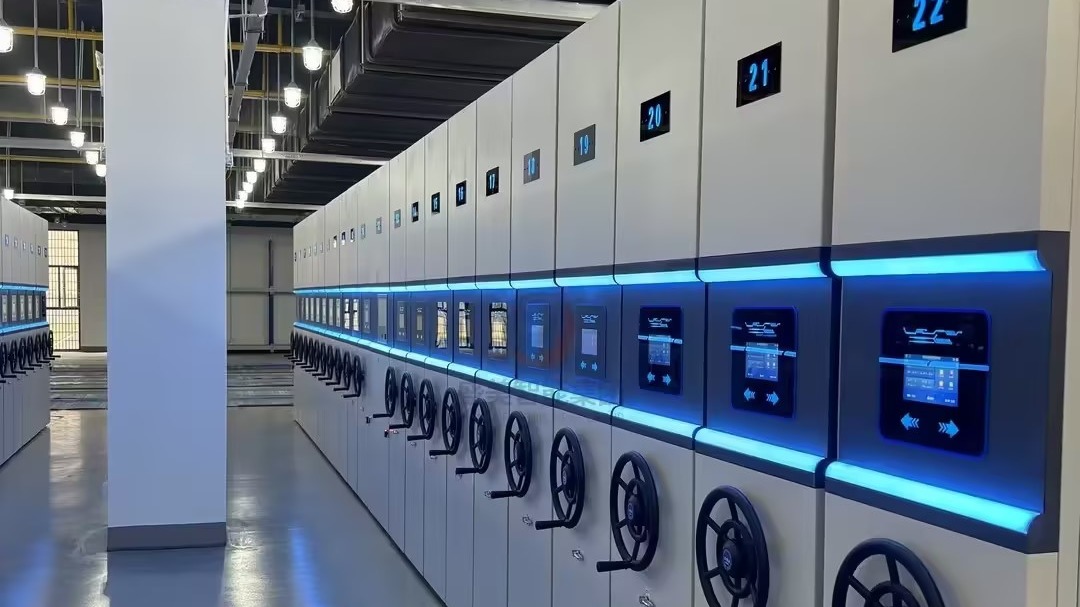
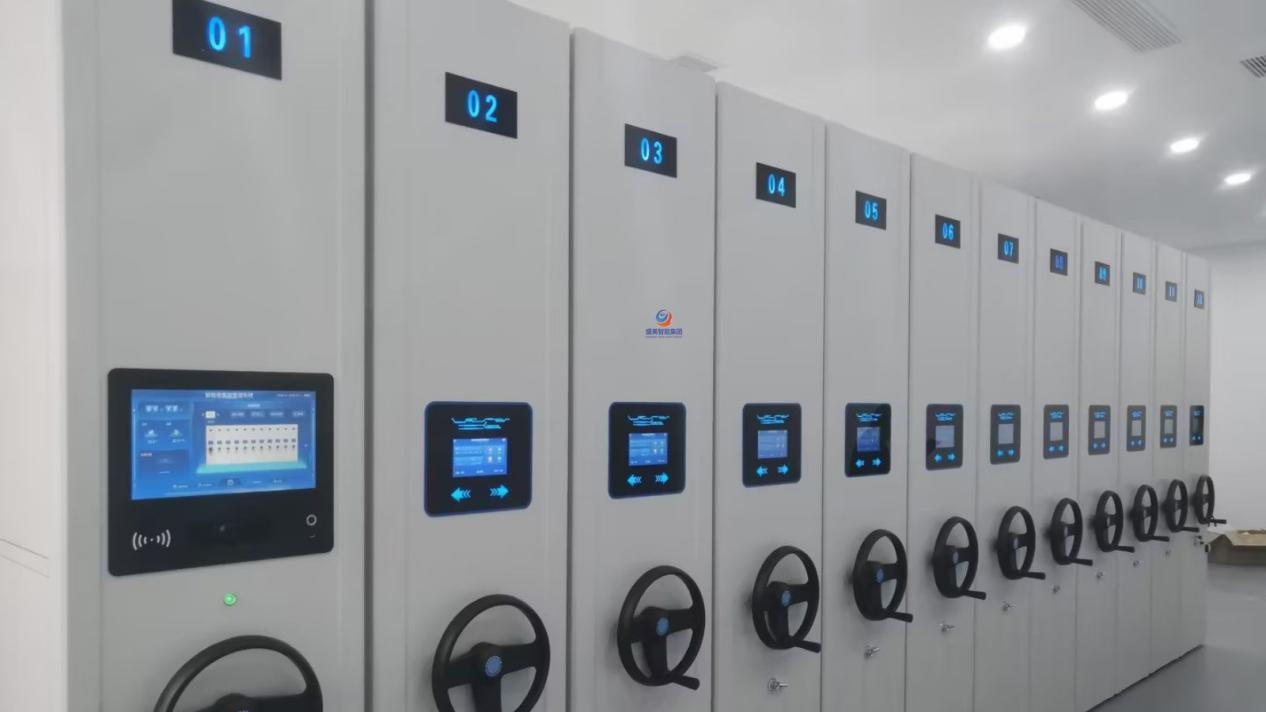
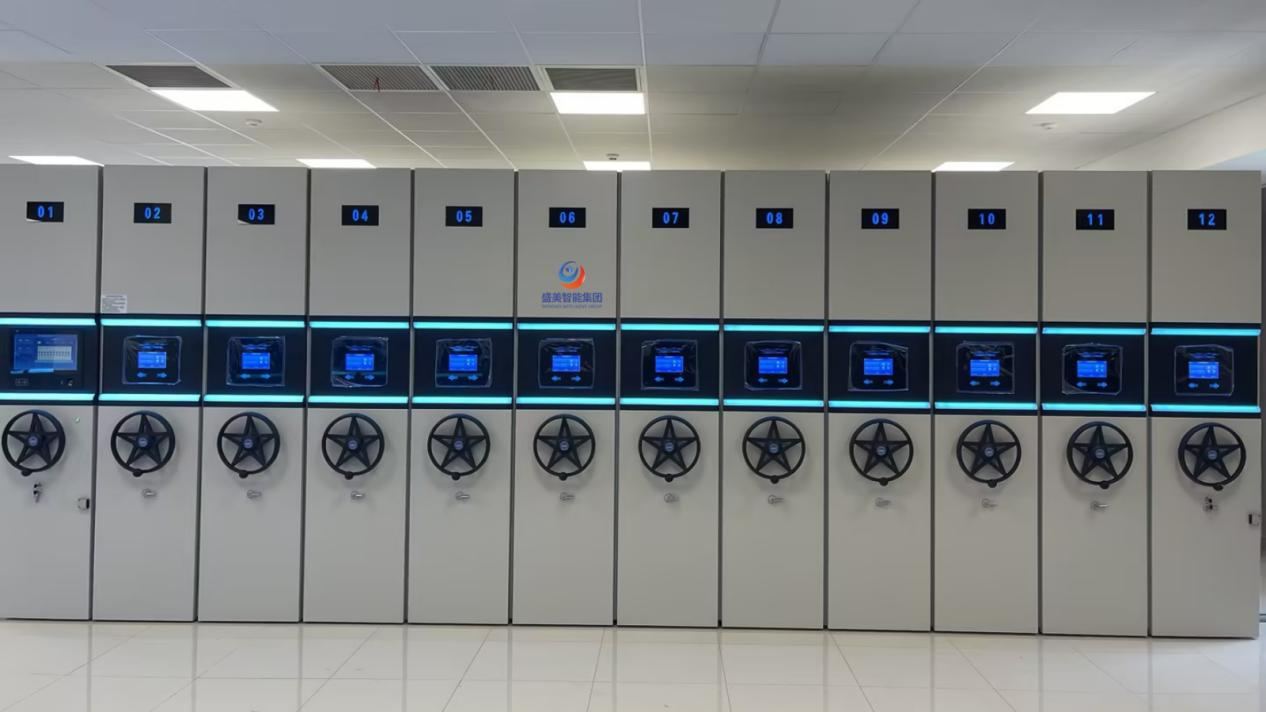
Each unit features an integrated touchscreen interface with real-time inventory status, aisle positioning, and one-touch retrieval commands. The ergonomic handwheel ensures smooth manual override when needed.

Scalable Enterprise Deployment
From compact archive rooms to large-scale government warehouses, the modular design supports seamless expansion. Integrated environmental monitoring and fire safety systems ensure 24/7 operational compliance.
Seven Failure Modes Causing Low Retrieval Efficiency for Massive Archives
Based on thousands of overseas warehouse project data from 2018 to 2026, Shengmei sorted out seven core systematic defects leading to slow archive retrieval. These problems stem from insufficient equipment architecture and incomplete intelligent configuration rather than manual operation errors, which must be avoided in overseas bidding specifications.
1. Disconnection between compartment coding and physical shelves. Traditional warehouses rely on paper ledgers and Excel records without electronic compartment identification and coordinate positioning. Manual registration and checking cause missing files and inconsistent account information after personnel changes or data update omissions.
2. Disorderly archive placement and accumulated errors. Operators return archives by memory without system guidance and error correction. Single misplacement will cause chain disorder. Long-term accumulation leads to chaotic warehouse order and huge manual inventory costs.
3. Manual aisle opening and redundant workflows. Traditional compactors require manual judgment and aisle operation without intelligent target positioning. Retrieving a single file requires opening multiple irrelevant aisles, resulting in over 70% invalid operation and redundant movement.
4. Inaccurate positioning without compartment-level identification. Low-end modified smart devices only support overall shelf positioning without layer and compartment precision identification. Staff still need manual layer-by-layer searching with limited efficiency improvement.
5. Isolated hardware and software data. Modified systems adopt third-party splicing solutions with independent hardware and software. Shelf movements cannot trigger data updates, causing data disconnection, distorted account information and invalid traceability.
6. Missing permission classification and operation logs. Ordinary shelving has no role permission control and traceability records. Unregulated access and movement lead to unaccountable archive loss and tampering, failing overseas audit standards.
7. Absence of intelligent inventory and early warning mechanisms. Massive archive inventory relies on quarterly and annual manual checking with low accuracy and high time cost. Hidden problems break out intensively during audits and emergency retrieval.
Seven-Layer Ultra-Fast Retrieval Architecture (2026 Standardized Speed-Up System)
Different from simple touch-screen modified products on the market, standardized overseas-version Smart Compactor Shelving adopt a seven-layer engineering speed-up architecture. Each layer solves one type of low-efficiency failure, forming a mutually redundant and closed-loop system to realize second-level retrieval, zero misplacement and full traceability for massive archive warehouses, which can be directly written into bidding technical parameters and SOW delivery lists.
Layer 1: Electronic Coordinate Coding System
All shelves, layers and compartments are equipped with unique electronic coding, adopting a five-level coordinate system of "warehouse area-group-column-layer-compartment". Each archive is bound to a fixed physical coordinate during warehousing, completely eliminating paper ledger errors and compartment confusion. The coordinate data is permanently effective regardless of staff changes and warehouse handover, fundamentally solving the problem of unfindable archives and inconsistent accounts.
Layer 2: Full-Coverage RFID Precise Positioning
High-frequency RFID sensors are installed on each layer and compartment to form a full-range perception network with single-compartment accuracy. The system feeds back precise physical positions within milliseconds after retrieval, highlighting target compartments on touch screens and background systems. For million-level archives, blind searching and inefficient manual checking are completely eliminated, with single positioning time controlled within 3 seconds.
Layer 3: Intelligent Target Aisle Automatic Opening
The system automatically analyzes the shelf group and channel of target archives and only opens the required working aisle, while other shelves remain closed to ensure storage density. It avoids blind manual opening and redundant movement, minimizing access workflows. Meanwhile, it inherits international safety standards including anti-pinch, anti-intrusion and abnormal alarms, ensuring efficiency without sacrificing PL-d safety performance.
Layer 4: Bidirectional Hardware-Software Data Synchronization Closed Loop
Adopting native integrated systems instead of third-party modified splicing, all shelf movements, status changes, archive access and return actions are automatically synchronized to the digital background in real time. Hardware status feedback and system instruction execution form an intercommunicated closed loop, eliminating manual secondary entry errors and ensuring 100% consistency between system data and physical warehouse status.
Layer 5: Intelligent Return Verification and Error Correction
During archive return, the system automatically verifies whether the placement position matches the original storage coordinate. Misplacement triggers pop-up reminders, voice prompts and compartment locking to prevent illegal filing. It intercepts manual return errors at the source, avoiding cumulative archive disorder and long-term warehouse chaos.
Layer 6: Hierarchical Permission + Millisecond Traceability Logs
Multi-role hierarchical permission system distinguishes administrators, operators, auditors and visitors with independent operation authorities. All retrieval, access, movement, return and alarm operations retain millisecond timestamps, operator IDs and full behavior tracks. Read-only and non-deletable logs fully meet overseas audit, compliance traceability and responsibility identification requirements.
Layer 7: Intelligent Batch Inventory and Abnormal Early Warning
The system supports one-click full-warehouse intelligent inventory, zoned inventory and classified inventory, reducing million-level archive inventory from several days to tens of minutes. The built-in algorithm actively identifies misplaced archives, long-term unborrowed files and missing archives, generating early warning lists and rectification reports to realize normalized and precise warehouse management.
Eight Intelligent Retrieval Alarm System (Mandatory Audit Standard)
In line with 2026 overseas archive audit specifications, standardized Smart Compactor Shelving is equipped with eight exclusive retrieval alarms, distinguishing common faults and archive operation abnormalities. Each alarm corresponds to clear failure causes, disposal procedures and audit records, serving as the core difference between high-end standardized equipment and low-end modified products.
1. Archive Misplacement Alarm: Triggers when the return position does not match the original coordinate, intercepting illegal filing and retaining error records.
2. Overage Unreturned Alarm: Reminds and marks archives that exceed the specified return time limit to avoid loss caused by long-term outflow.
3. Illegal Retrieval Alarm: Blocks unauthorized access to confidential archives and retains illegal operation records to ensure confidentiality compliance.
4. Data Synchronization Abnormality Alarm: Warns of synchronization failure and delay to prevent distorted ledger data.
5. Compartment Identification Abnormality Alarm: Early warning of invalid RFID sensing and abnormal positioning to avoid retrieval failure.
6. Batch Inventory Abnormality Alarm: Automatically generates abnormal reports when inventory data does not match physical archives.
7. Channel Occupation Alarm: Locks shelf operation when the working channel is blocked to ensure safety and operational efficiency.
8. Device Offline Alarm: Reminds maintenance personnel of shelf communication interruption to avoid long-term equipment failure.
10-Year Full-Cycle Cost Comparison: Low-End Modification vs. Standard Intelligent Architecture
For overseas million-level archive warehouses, low-cost short-term modification saves equipment investment but causes huge long-term losses in labor, audit and maintenance costs. The following is the 10-year full-cycle cost comparison for a standard 60-bay warehouse (USD calculation).
| Cost Item | Low-End Modified Solution | Seven-Layer Standard Intelligent Architecture |
|---|---|---|
| Incremental Equipment Cost | $0 | $9,600 (60 bays) |
| Annual Labor Retrieval Premium | $7,200 | Near-zero |
| Annual Manual Inventory Cost | $3,600 | -90% |
| Annual Audit Rectification Risk | $4,800 | $0 |
| 10-Year Total Cost | ~$156,000 | ~$12,800 |
Core Conclusion: The 10-year operation cost of low-end modified equipment is more than 12 times that of standardized intelligent equipment. The intelligent speed-up architecture is the only engineering solution for long-term cost reduction and compliance risk avoidance.
Ten Acceptance Checklists for Overseas Mass Archive Intelligent Speed-Up Projects (Contract-Ready)
- 1. Complete five-level electronic coordinate coding for the entire warehouse without omission or disorder, supporting batch calibration and reset.
- 2. Single-compartment RFID precise positioning with error within one compartment and response time ≤3 seconds.
- 3. Automatic target aisle opening triggered by retrieval results without manual channel selection.
- 4. Real-time bidirectional hardware-software synchronization without delay, disconnection or manual supplementary entry.
- 5. Effective native return error correction function with early warning, interception and traceability for misplacement.
- 6. Complete multi-level permission control with clear role division and zero permission loopholes.
- 7. Millisecond read-only non-deletable operation logs supporting batch export and audit filing.
- 8. Full activation of eight retrieval alarms without function reduction or shielding.
- 9. Effective intelligent inventory function with automatic report generation and abnormal list output.
- 10. Qualified overall retrieval efficiency: regular archives within 10 minutes, emergency archives within 5 minutes, misplacement rate ≤0.5%.
Overseas Procurement FAQ
Get Your Free Customized Archive Room Layout Plan
If you are facing archive room capacity constraints and planning an archive room upgrade, contact the Shengmei engineering team for a free customized CAD space-optimization layout and capacity calculation proposal.
Please provide: archive room length, width and ceiling height · current archive volume · annual archive growth · load-bearing test report (if available) · city · equipment selection preference · whether RFID upgrade is needed.