Mobile Compactor Shelving · Manual / Electric / Intelligent

Three ways to move an archive.

Procurement-ready mobile shelving engineered on the same modular base — hand-wheel, electric drive, or intelligent RFID control. Built around real archive rooms: 2400–2500 mm frames, 80 kg per-shelf load rating and the archive "ten-protection" standard.

2400×900×560 mm standard · 80 kg/shelf · ten-protection archive standard · project engineering support
ProjectEngineering support
LayoutRoom-specific planning
58 / 66Patents / software copyrights
60+R&D engineers supporting projects

Three control modes

Same modular base.
Different operating modes.

All three modes share one chassis, track and shelf system — the only thing that changes is the operating system. That means a room can start manual and be upgraded to electric or intelligent later, bay by bay.

Manual compactor shelving

The workhorse for high-density storage.

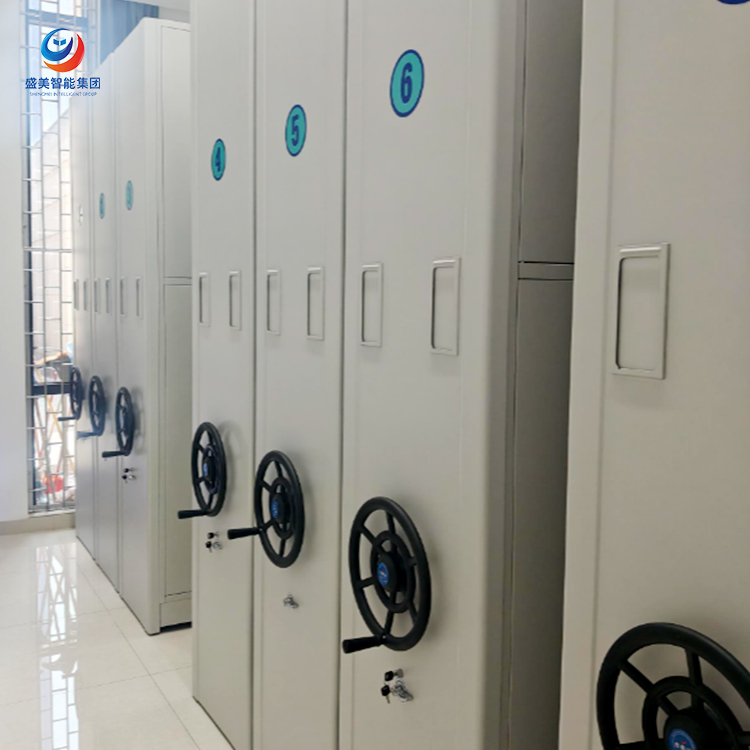
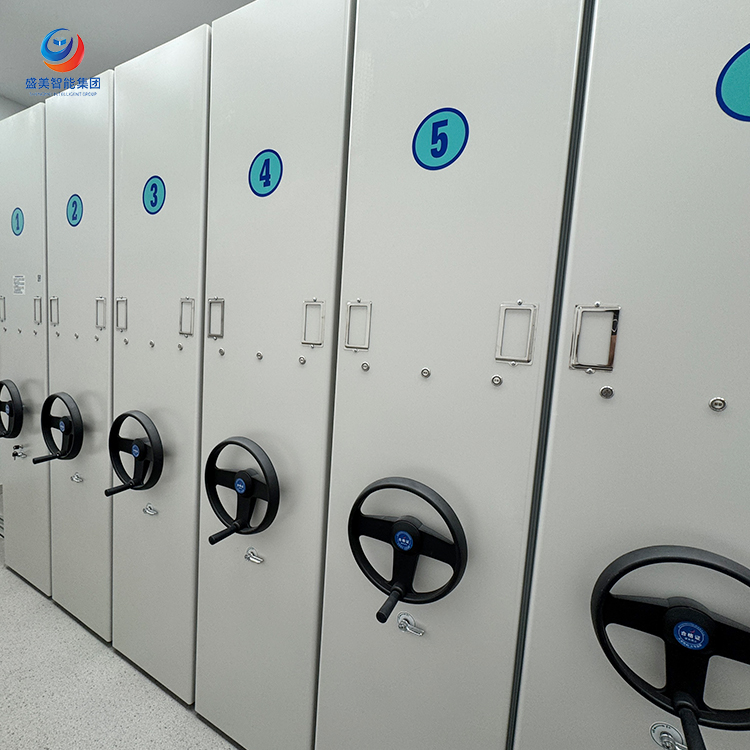
Mechanical chain-and-handwheel drive with a 336 mm five-point hand-wheel. No power required per bay, no dependence on mains supply inside the archive hall — the most reliable, lowest-cost route to dense archival storage.

  • 336 mm star-shaped hand-wheel, anti-slip spherical grip
  • Mechanical anti-tilt, anti-derailment and brake locks
  • 80 kg uniform static load per shelf (24h tested)
  • Magnetic sealing strips between columns + dust cover
  • 2400×900×560 mm
  • 5 / 6 / 7 / 8 / 12 / 14 layers
  • Column width 500–800 mm

Electric compactor shelving

Push-button aisles for daily-volume archives.

Each movable carriage is driven by a low-voltage DC motor with push-button control and infrared safety sensing. Designed for mid-density rooms where retrieval happens every day but full RFID tracking is not yet required.

  • Low-voltage DC drive with soft-start / soft-stop
  • Infrared anti-crush sensing with brake-stop logic
  • Per-block push-button control panel
  • Upgrade path to intelligent mode (same chassis)
  • 2400×900×560 mm base
  • 800–1000 mm aisle travel
  • 2–6 tracks by bay count

Intelligent compactor shelving

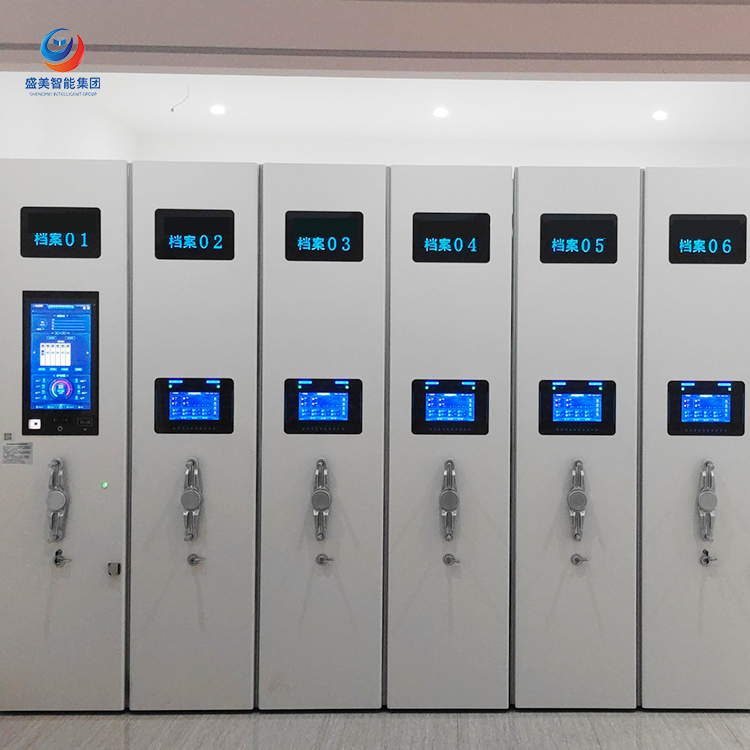
Touchscreen, RFID & networked control.

15.6" or 21.5" touchscreen master column on Android 9, 120 W 24V brushless DC motors on the movable columns, and RFID archive positioning. The procurement-grade option for government, hospital and enterprise archives.

  • 15.6" standard / 21.5" premium master touchscreen
  • 120 W 24V brushless DC motor per movable column
  • RFID / light-guided positioning to shelf & box
  • Access logging, alarm & environment monitoring
  • 2500×900×560 mm
  • Android 9 · 2G/32G · TCP/IP
  • IP67 master column

Compare at a glance

Which control mode fits your room?

The intelligent mode carries the most complete specification. Manual and electric versions share the same track and shelf base, so the decision comes down to daily operation and future expansion.

Manual compactor shelving
Manual mode

Manual Compactor Shelving

Mechanical chain-drive, hand-wheel operation. The lowest-cost route to high-density archival storage.

  • Drive: mechanical chain + hand-wheel
  • Power: none per bay
  • Size: 2400×900×560 mm
  • Load: 80 kg/shelf
Cost-effective Get quote →
Electric compactor shelving
Electric mode

Electric Compactor Shelving

Low-voltage DC drive with infrared safety and push-button panel per block. The balanced choice for daily volume.

  • Drive: low-voltage DC motor
  • Control: push-button per block
  • Safety: infrared anti-crush
  • Upgrade: intelligent-ready
Mid-size archives Get quote →
Intelligent compactor shelving
Intelligent mode

Intelligent Compactor Shelving

RFID positioning, automated aisle opening, 15.6"/21.5" touchscreen and central management integration.

  • Control: 15.6"/21.5" touchscreen
  • Motor: 120 W 24V brushless DC
  • Size: 2500×900×560 mm
  • System: Android 9 + RFID
Enterprise-grade Get quote →

Configuration matrix

One spec sheet.
Three operating modes.

Cross-reference dimensions, drive, controls and accessories. The same block layout can be configured for any mode — what changes is the operating system.

SpecificationManualElectricIntelligent
Standard size (H×D×W)2400×900×560 mm2400×900×560 mm2500×900×560 mm
Drive systemMechanical chain + hand-wheelLow-voltage DC motor120 W 24V brushless DC motor
Power requirementNone per bayLow-voltage DC per block150 W × (columns − master)
Control panel336 mm hand-wheelPush-button per block15.6" / 21.5" touchscreen
Operating system——Android 9 · 2G / 32G
Aisle openingManual hand-wheelPush-buttonAuto-positioning
RFID positioning—OptionalStandard
Safety sensingMechanical locksInfrared anti-crushIR + entry protection + head-count
Column width500–800 mm500–800 mm500–800 mm
Shelf load (static)80 kg / shelf80 kg / shelf80 kg / shelf
Layer count (double-sided)5 / 6 / 7 / 8 / 12 / 145 / 6 / 7 / 8 / 12 / 145 / 6 / 7 / 8 / 12 / 14
Surface finish13-step powder coating13-step powder coating13-step powder coating + anti-static
Centralized management—OptionalStandard
Typical projectS / M roomsM / L roomsL / multi-block archives

All values align with GB/T 13667.3-2013 (manual), GB/T 13667.4-2013 (electric) and DA/T 65-2017 (intelligent archive compactor requirements). Final dimensions are confirmed against room drawings at the proposal stage.

Dimension engineering

How we size
a compactor room.

Every Shengmei compactor is configured from four engineering formulas — layer height, column width, column length and track count. This is the same logic our proposal team applies to your room drawings.

Layer height

Manual = (H − 120 base − 30 top) ÷ layers − 25
Intelligent = (H − 100 sys − 120 base − 30 top) ÷ layers − 25

  • Double-sided 6 layers — 2300/H330 · 2400/H345 · 2500/H365
  • Double-sided 5 layers — 2000/H330 · 2100/H360
  • Double-sided 12 layers — 2300/H154 · 2400/H160
  • Double-sided 8 layers — 3000/H330

Column width

Column width = usable width × 2 + 70 mm

  • 560 mm column → 245 mm usable per side
  • 630 mm column → 280 mm usable per side
  • 750 mm column → 340 mm usable per side
  • Range 500–800 mm · ★ = common stock

Column length

Length = net length × groups + (groups+1) × 50 + side 50 × 2

  • 4-group column — 820×4 + 5×50 + 50×2 = 3630 mm
  • Max 8 groups per column
  • Standard group 900 mm or 1000 mm
  • Side panels 50 mm (60 mm smart light-strip)

Track layout

Tracks = 2 (1–3 grp) · 3 (4–5) · 4 (6–7) · 5 (8) · 6 (9)

  • 18×18 steel — 100 mm track, 106 mm slot, 26 mm deep
  • 20×20 steel — 108 mm track, 114 mm slot, 30 mm deep
  • Aisle travel 800–1000 mm (≤1000 smart)
  • +tracks both sides when a zone exceeds 15 columns

Reference tables

Layer & column
size quick lookup.

Standard layer-pitch and column-width tables. ★ marks the most commonly specified stock sizes — quick reference for your evaluation team.

Double-sided layers

Layer pitch by frame height

LayersHeight (mm)Layer pitch
5 layers2000 / 2100H330 / H360
6 layers2400H345
6 layers2300 / 2500H330 / H365
7 layers2700 / 2800H335 / H350
8 layers3000H330
12 layers2300 / 2400H154 / H160
Column width (mm)

Column width ↔ usable per side

Column widthUsable / sideColumn widthUsable / side
500215580255
560245620275
630280700315
750340800365
540235600265
650290720325

Operating scenarios

Match the mode
to the room.

Each control mode is built around a different daily-use profile. Use this as a quick filter to align your procurement decision with the actual archive workflow.

Manual · Setup A

Schools, small enterprises & project archives.

For rooms where retrieval happens a few times per day on predictable schedules. Manual mode delivers the highest space-saving density per dollar invested, with no power dependency inside the archive hall.

  • Schools
  • Small offices
  • Project archives
  • Legal libraries
Electric · Setup B

Mid-size archives & daily-volume records.

Mid-volume retrieval, multiple users per day. Electric mode gives push-button aisles and infrared safety, while keeping the same chassis as the manual version for future upgrade.

  • Hospital wards
  • Department archives
  • Court records
  • Bank branches
Intelligent · Setup C

Government, hospital & enterprise-grade archives.

Where every record must be traceable, every access logged and every retrieval can be planned on screen. Intelligent mode connects RFID tracking, positioning and access control into one operation layer.

  • Government archives
  • Tertiary hospitals
  • Enterprise HQ
  • Museum storage

Procurement → Operation

One project path.
Four clear steps.

1

Plan & configure

Share room dimensions, capacity target and retrieval frequency. We propose the mode and configuration.

2

Confirm & quote

Final spec, drawings and proposal pricing aligned to procurement requirements and timeline.

3

Manufacture & ship

Knock-down modular packaging, factory QC and coordinated shipping to project site.

4

Install & support

On-site or remote installation guidance, commissioning and after-sales technical service.

Add-on options

Configure the shelves
around your archive.

The same chassis accepts a broad range of add-ons. Select only the modules that match the operating mode and the archive "ten-protection" standard — nothing extra.

RFID Positioning

Tag every box, locate every record to shelf & box. Required for intelligent mode, optional elsewhere.

Access Control

Card, fingerprint, face and PIN login to limit archive entry to authorised staff only.

Aisle Auto-Position

Automated aisle opening and guided positioning for retrieval accuracy and time savings.

Environment Monitor

Temperature, humidity, water-leak, PM and smoke integration for sensitive archive rooms.

Anti-Crush Sensing

Infrared anti-crush sensing with brake-stop and reverse logic for people-safe operation.

LED Aisle Light

Low-voltage (≤24V) high-brightness LED lighting per aisle for safer retrieval.

Label & Bin Holder

Magnetic or slide-in label holders, document bins and accessory rails for every shelf.

Central Dashboard

Multi-block operating dashboard, movement history and energy reporting at one terminal.

Project resources

The combined catalog for
your evaluation team.

Compactor Shelving Catalog — All Three Modes

One combined catalog covering all three control modes: mechanical dimensions and hand-wheel specifications for the manual system, DC drive and infrared wiring diagrams for the electric system, and RFID configurations with project-ready specification tables for the intelligent system.

  • Manual
  • Electric
  • Intelligent / RFID
Download PDF ↓

Project questions

What procurement teams ask first.

Clear answers before specification keeps archive-storage projects moving on schedule.

How do I choose between manual, electric and intelligent mode?

Match the mode to daily retrieval volume and budget. Manual is most cost-effective for low-frequency rooms; electric fits mid-volume daily use; intelligent is required where RFID tracking, automated positioning or networked management are part of the spec.

What is the standard size and how is it calculated?

The standard manual compactor is 2400×900×560 mm (H×D×column-width) and the intelligent compactor 2500×900×560 mm. Layer pitch, column width, column length and track count are all derived from four engineering formulas we apply to your room drawings.

How much can each shelf carry?

Each shelf is rated for 80 kg uniform static load, tested for 24 hours with no plastic deformation. Cold-rolled steel per GB711: chassis δ2.0–3.0 mm, column δ1.1–1.5 mm, shelf δ0.8–1.0 mm.

Can I mix modes inside the same room?

Yes. All three modes share the same chassis, track and shelf system, so a single room can run manual on some columns and intelligent on others. This is common in phased procurement.

What standards does the system comply with?

GB/T 13667.3-2013 (manual), GB/T 13667.4-2013 (electric), DA/T 65-2017 (intelligent archive compactor management) and the archive "ten-protection" requirement for fire, water, dust, pest, light, theft, temperature and gas protection.

Spec your archive

Share the room, capacity and operating mode you need.

Tell us the basics. Our engineering team will configure a compactor layout and proposal pricing around your project.