
Hand-wheel power.
Zero electricity.
The same high-density capacity as powered systems, moved by a precision gear drive: one pound of effort on the handle moves up to 10,000 lb of loaded carriage. No wiring, no controllers, no service contract.
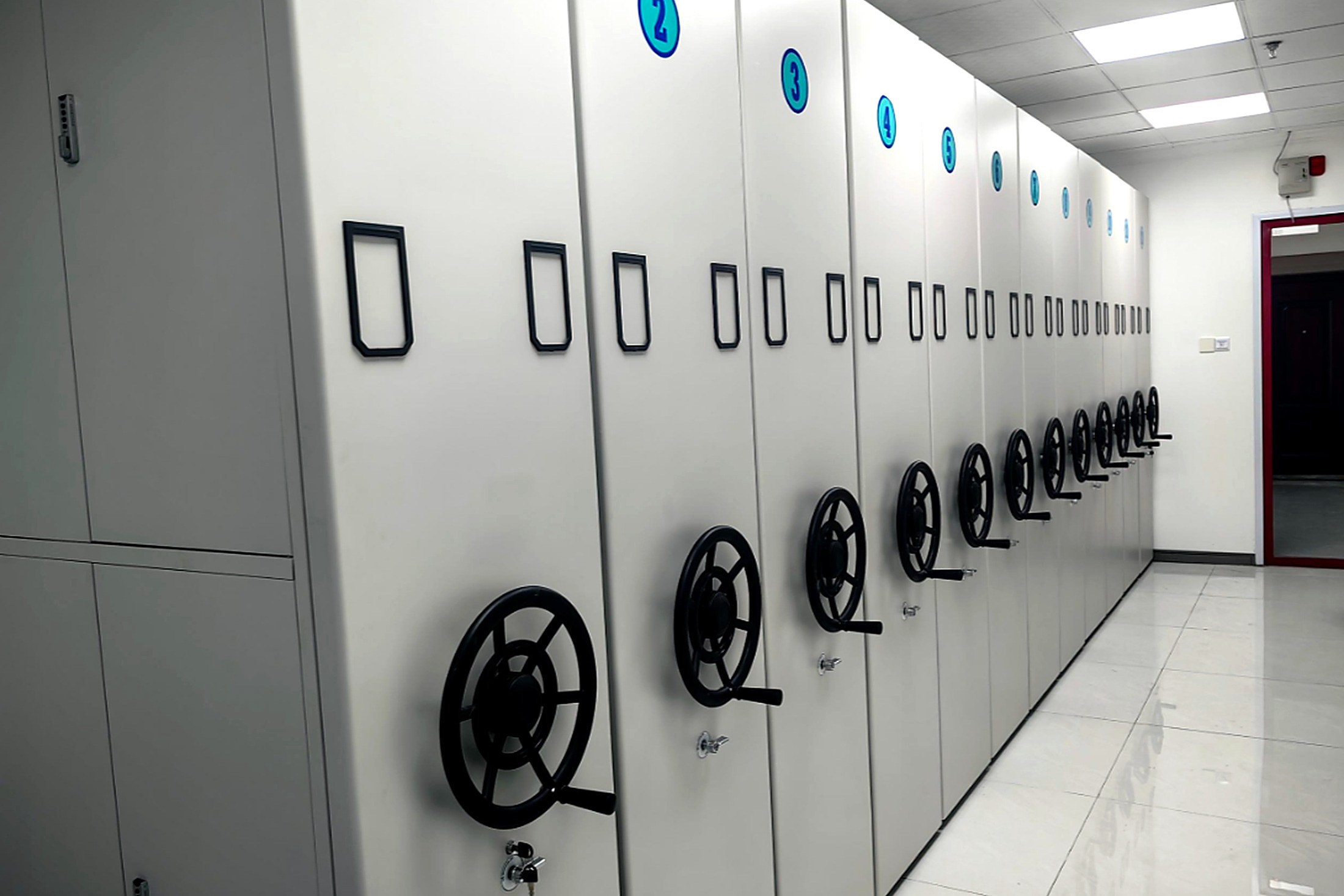
Same collection. Half the floor.
- 1Rows park togetherCarriages slide on shared rails — fixed aisles disappear into one.
- 2The aisle follows youTurn the wheel and the open aisle moves to wherever staff are standing.
- 3Capacity doublesTwice the bays in the same room — or the same bays in half the floor.
Locked, braked and tip-proof — by hardware, not sensors.
A hand-wheel run protects people and collections with physical mechanisms that never need power, firmware or calibration.
The lock above the handle fixes both neighbouring carriages, so the open aisle cannot drift closed while staff are working in it.
Every carriage hooks into the rail line, holding the run upright under uneven loading — and meeting seismic requirements where specified.
Wheels brake the instant the handle is released, and a positioning stop keeps parked rows from creeping on floors that deflect.
A lock in the handle hub freezes the drive shaft, so only authorised staff can move the run or open its aisles.
Rubber bumpers absorb the impact when carriages close, protecting the structure, the shelves and the files inside.
Magnetic strips and rubber seals close the gaps between columns, shutting out dust, light and pests whenever the run is parked.
The quiet engineering under every run.
What makes a hand-wheel run feel effortless at year fifteen was decided at the welding table.
One welded frame instead of bolted sections — the carriage stays square under tonnes of load instead of racking out of alignment.
A 3.0 mm cold-rolled chassis carries shelf load straight down to the wheels; uprights stay true through decades of daily use.
Rails are levelled to sub-millimetre tolerance and paired with a continuous drive shaft, so both sides of the run move in perfect sync.
Low-profile rails sit flush with the finished floor and accept ramps and deck covers in any flooring — accessible, with nothing to trip on.
Hand-wheel runs in daily service.
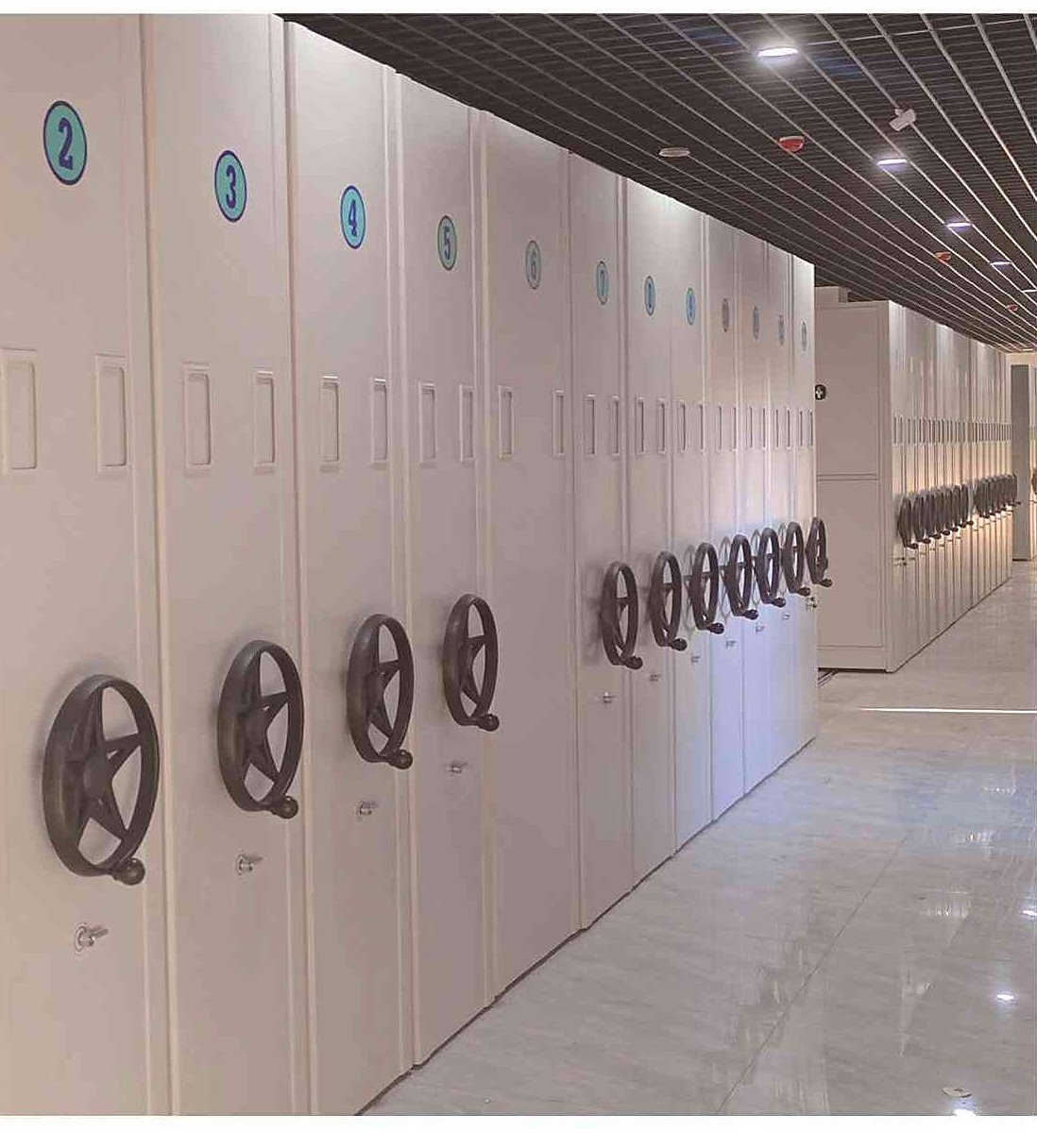
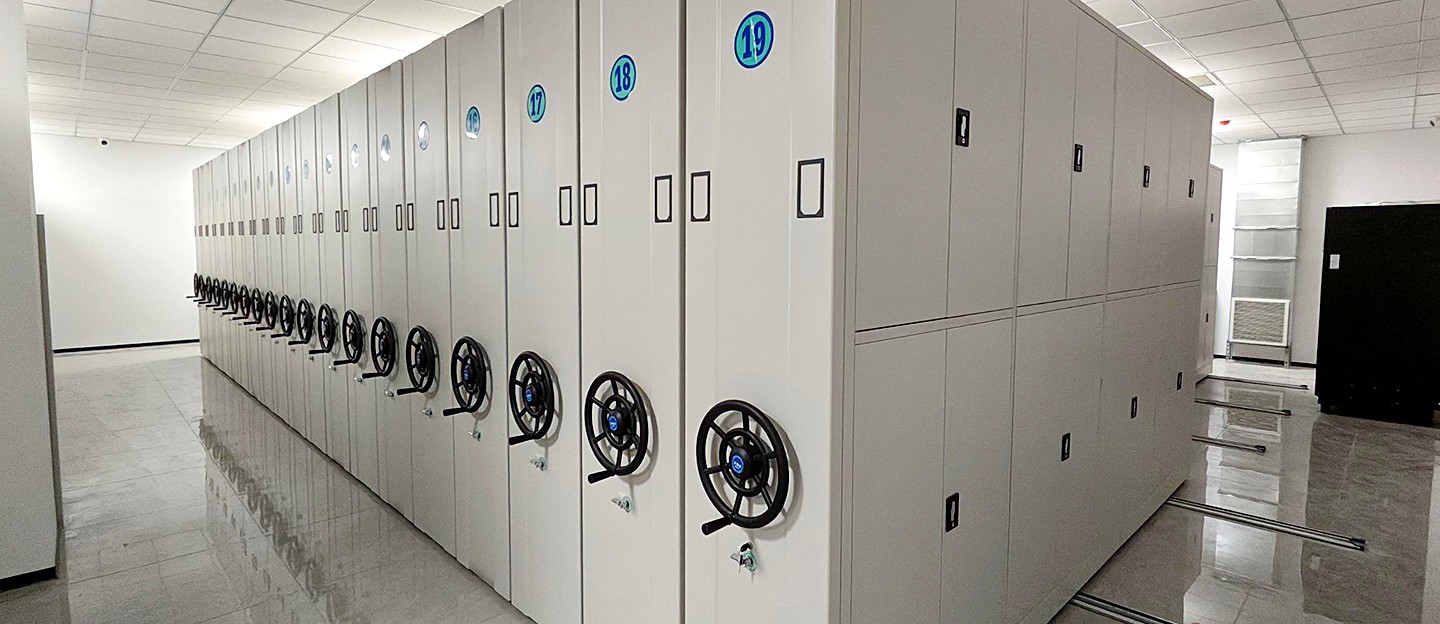
Key figures up front. The full data sheet below.
| Technical specification · manual compactor series | |
|---|---|
| Standard bay | 900 mm W × 560 mm D × 2,300 mm H — custom sizes on request |
| Shelf load | 80 kg standard · 100 kg reinforced deck option |
| Tiers & pitch | 4–7 tiers per bay; shelf pitch adjustable in 25 mm steps |
| Steel | 1.5 mm cold-rolled uprights · 3.0 mm chassis members · 2.0 mm heavy-duty option |
| Working aisle | 750–900 mm, sized for trolleys, step ladders and wheelchair access |
| Min. room height | 2,500 mm (bay height + 140 mm top clearance) |
| Drive | Three-spoke ergonomic handle · 30:1 sealed gearbox · chain drive to both carriage sides |
| Finish | Powder-coat in RAL colours; chrome-plated handle option |
| Compliance | CE · ISO 9001 manufacturing |
| Options | Dividers, pull-out reference shelves, label holders, dual control from either run end, seismic anti-tilt track |
Four checks that decide the project.
A mobile run concentrates more weight on its rail lines than almost anything else a building holds — 125–200 psf for paper and books, far above the 50 psf office norm. Checking these before the quote prevents the surprises that surface after delivery.
Paper and books need 125–200 psf (≈6–10 kPa) across the system footprint; museum-grade storage 275–300 psf. An office-rated floor (50 psf) is not enough.
Within ±3 mm over any 3 m span. Out of tolerance is still workable — rails are shimmed level during installation, adding about half a day.
150 mm slab on grade, or 200 mm on upper floors. Carpet is cut back along the rail lines; vinyl and epoxy can stay.
Plan the layout to about 85% full and keep expansion bays in the design — a run filled to 100% on day one has nowhere to grow.
Questions buyers actually ask.
Does a manual system need any electricity?
Can it be installed on an upper floor?
How much weight can one person actually move?
What maintenance does it need?
Can we expand or relocate the system later?
Get a manual-system quote with layout.
Send room size and collection type — we return bay count, tier configuration and a per-run quote within two working days.